Nine of Cups and Nine of Swords Tarot as Feelings
- Arcana
- Nine of Cups — Minor Arcana, Cups; Nine of Swords — Minor Arcana, Swords
- Elements
- Nine of Cups — Water; Nine of Swords — Air
- Elemental interaction
- Neutral elements — energies coexist without conflict
- Numerology
- 9 + 9 = 18 → 9
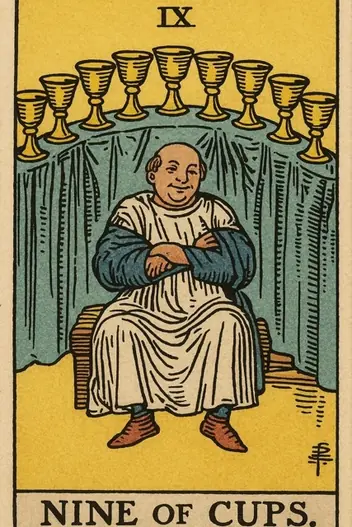
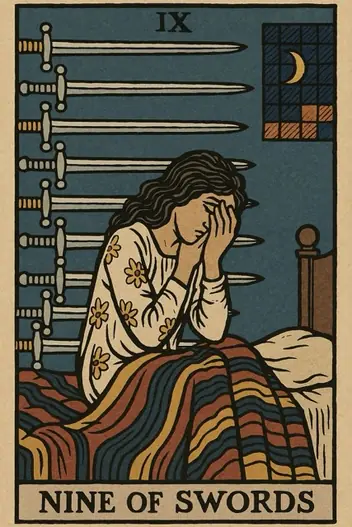
The Nine of Cups often represents a moment of emotional fulfillment, a wish granted, or a deep sense of satisfaction. It is the card of "having it all." Conversely, the Nine of Swords is the card of nightmares, anxiety, and mental anguish—the feeling of being haunted by your own thoughts. When these two cards appear together, they create a powerful psychological paradox: the achievement of a desire does not guarantee peace of mind.
This combination signals a critical juncture where external success clashes with internal turmoil. The seeker may have what they thought they wanted—a relationship, a promotion, or a material goal—only to find that the victory is hollow or accompanied by unexpected stress. The core insight here is that fulfillment is not just about getting what you want, but about managing the psychological cost of having it. This pairing forces a pragmatic examination of your expectations versus reality.
Core Dynamics & Interpretation
The fusion of the Nine of Cups and Nine of Swords creates a state of cognitive dissonance. On one hand, you feel a genuine sense of accomplishment or satisfaction (Cups). On the other, you are plagued by worry, self-doubt, or fear of loss (Swords). This is not a simple "bad" card; it is a complex psychological signal that your inner narrative is out of sync with your outer circumstances.
In a practical sense, this pair often appears when a person has achieved a goal but now fears they cannot maintain it. For example, getting the dream job might trigger imposter syndrome. Entering a desired relationship might spark anxiety about being abandoned or not being good enough. The key dynamic is that the Nine of Cups represents the "what," while the Nine of Swords represents the "but." The mind is sabotaging the heart's victory.
From a Jungian perspective, this is the Shadow of the Wish. The conscious mind celebrates the achievement, but the unconscious throws up a storm of negative projections. The strategic action here is to separate objective reality from subjective fear. You must ask: Is the anxiety a rational warning about a real problem, or is it a cognitive bias—like catastrophizing or perfectionism—that needs to be managed? The answer determines whether you need to protect your gains or simply calm your nervous system.
Your pair is already on the table. Ask your question and draw the clarifying card
or simply focus on it
Love and Relationships
If you are single:
This combination suggests you may attract a partner who seems perfect on paper but triggers deep insecurities. Focus on whether the anxiety comes from the person or from your own expectations.
If you are in a relationship:
You may have a partner who fulfills your needs but also makes you feel constantly on edge. The issue is likely a communication breakdown about emotional safety, not a lack of love.
In relationships, this pairing often describes a dynamic where one partner feels satisfied (Cups) while the other feels anxious or burdened (Swords). Alternatively, it can represent a person who is happy with the relationship's external structure but secretly tormented by internal fears—such as fear of commitment, fear of intimacy, or fear of being controlled. The key relationship advice is to initiate a direct, honest conversation about your anxieties. Do not let the Nine of Swords fester into resentment. Instead, use the emotional security of the Nine of Cups as a foundation to address the underlying fears. Boundaries are critical here: Are you taking on your partner's anxiety, or are you projecting your own? Pragmatically, this is a call to practice emotional differentiation—to know where you end and your partner begins.
Ask your specific question
Don't rely on generic meanings. Get a customized reading tailored specifically to your energies.
Career and Finances
Strategic Opportunities:
Leverage your current success to build a safety net. The Nine of Cups indicates a strong position; use it to negotiate better terms, save money, or diversify your income.
Strategic Opportunities:
Address the source of your anxiety directly. If you fear losing your job, update your resume and network. Action is the antidote to the Nine of Swords.
Calculated Risks:
Avoid making major financial decisions based on fear. Do not quit a stable job out of panic, nor double down on a risky investment out of greed. Objectively audit your risk tolerance.
Professionally, the Nine of Cups and Nine of Swords together suggest a high-stakes success scenario. You may have achieved a significant milestone—a promotion, a big sale, or a successful project—but the pressure to repeat that performance is causing sleepless nights. The financial warning here is clear: do not confuse temporary euphoria with long-term stability. The Nine of Cups can create a false sense of invulnerability, while the Nine of Swords can make you overly pessimistic. The strategic move is to create a buffer zone. Build an emergency fund, diversify your portfolio, or set clear performance metrics so that your anxiety is data-driven, not emotion-driven. Treat your success as a platform, not a finish line.
Reversed Positions: What Changes?
When cards appear in a reversed position, internal tension rises to the surface, becoming more obvious, yet also more manageable.
If the Nine of Cups is reversed:
This indicates blocked potential. You are denying yourself pleasure, even when it is available. This may stem from rigid internal prohibitions ("You can't be happy until..."). Advice: start small — allow yourself one pleasure without guilt. This will break the pattern of self-limitation.
If the Nine of Swords is reversed:
Anxiety becomes overt and somatized (headaches, gastrointestinal issues). Instead of nightmares, there is chronic fatigue. The main trap is avoidance. You refuse to look at the source of your fear. Strategy: write down your biggest fear on paper and assess its realism on a scale from 1 to 10. This will return cognitive control to you.
If BOTH are reversed:
This is complete imbalance. Outwardly, you may appear unhappy, while inwardly, you are in a state of numbness. This is a dangerous combination of apathy and suppressed aggression. Correction: a radical change in routine or environment is necessary. Any action that snaps you out of your stupor will be beneficial. Start with physical activity — it is the fastest way to "reset" the nervous system.
Shadow Side & Pitfalls
The shadow side of this combination is a cycle of self-sabotage. The seeker, having achieved a wish, may unconsciously create problems to justify their anxiety. For example, someone in a happy relationship might pick fights to prove their fears of abandonment are correct. This is a cognitive distortion known as "emotional reasoning": believing that because you feel anxious, something must be wrong. The pitfall is that you may discard the Nine of Cups (the good thing) to escape the Nine of Swords (the bad feeling). This is a tragic, avoidable loss. Another shadow manifestation is paranoia or micromanaging. You might try to control every variable to prevent the imagined disaster, which ironically creates the very stress you are trying to avoid. The root cause is often a fear of being unworthy of happiness. The unconscious belief is, "If I have what I want, I must be ready to lose it."
Synthesis: Strategic Conclusion
Constructive use of this combination requires a paradoxical approach: you must stop fighting anxiety and start using it as a compass. The Nine of Swords is not an enemy, but a signaling system. It points to those areas of life where your values and actions have diverged. Instead of "treating" the fear, ask yourself: "What exactly am I afraid of losing? And what does that say about what is truly important to me?" The Nine of Cups, in turn, provides you with the resource for this exploration. You already have a platform (status, money, relationships) that allows you to afford being vulnerable.
Strategic advice: conduct an "inventory of desires." Divide a sheet of paper into two columns. In the first, list everything you have and are proud of (Nine of Cups). In the second, list all your fears and nightmares (Nine of Swords). Now, find the points of intersection. Which of your fears is directly linked to one of your achievements? For example: "I am afraid of being fired (fear) because I got a position for which I lacked sufficient experience (achievement)." This is your zone of growth. Your task is not to get rid of the fear, but to make it concrete and manageable. Create an action plan that reduces the likelihood of that fear. This transforms the anxiety-inducing factor into a working project.
Remember: true maturity is not the absence of fear, but the ability to act effectively despite it. This combination of cards calls you to become a "wise steward" of your psyche. You cannot control the emergence of anxious thoughts, but you can control your reaction to them. Use the energy of satisfaction from the Nine of Cups as fuel for a courageous analysis of your shadow aspects. Only by accepting your vulnerability can you truly enjoy your achievements.
Your Next Step: Personal Context Matters
The core message of the Nine of Cups and Nine of Swords is that fulfillment is a psychological skill, not just a destination. You have the capacity to achieve your desires, but you must also develop the emotional resilience to enjoy them. The anxiety you feel is not a sign to retreat, but a signal to grow your inner capacity for peace. Separate the real problems from the imagined ones, and take concrete steps to protect your gains without letting fear drive your decisions.
Ready to apply this insight to your specific situation? While this analysis provides a powerful framework, the true value of Tarot comes from personal context. The Fortune Cards app uses advanced AI to give you a deep, personalized interpretation of this exact combination for your unique question—whether it's about a specific relationship, a career move, or a personal challenge. Stop guessing and start acting with clarity. Use the app on the web or download it now to get your tailored reading. Your next step is just one click away.
Interpretation by the Fortune Cards editorial team, based on the Rider–Waite tradition and Jungian archetypes. About our methodology · Updated: 2026-10-08
Other Combinations with Nine of Cups
Other Combinations with Nine of Swords
Explore Individual Card Meanings
Ready to find answers to your questions?
Start your first reading now and look at your situation with fresh clarity. The cards are ready to reveal deeper meaning.