Love Tarot: Nine of Wands and Four of Swords
- Arcana
- Nine of Wands — Minor Arcana, Wands; Four of Swords — Minor Arcana, Swords
- Elements
- Nine of Wands — Fire; Four of Swords — Air
- Elemental interaction
- Friendly elements — energies support each other
- Numerology
- 9 + 4 = 13 → 4
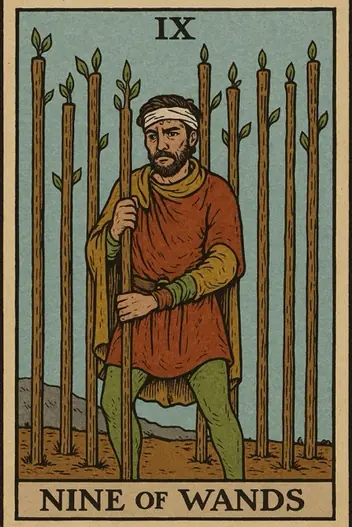
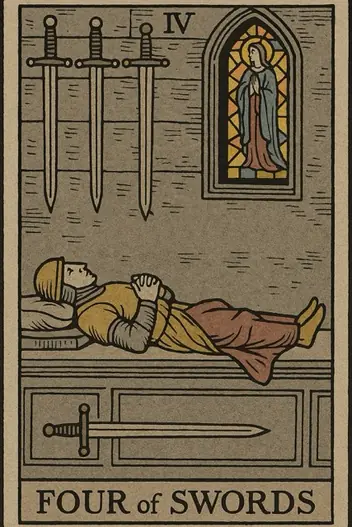
The intersection of the Nine of Wands (the wounded sentinel, defensive resilience) and the Four of Swords (strategic rest, mental sanctuary) creates a powerful psychological tension. This pairing represents the critical moment when a person, exhausted from a sustained battle, must decide whether to lower their defenses and rest, or risk burnout by staying on high alert. It is the archetypal struggle between the warrior’s duty and the healer’s necessity.
In practical terms, this combination often appears when you have been defending a position—emotional, professional, or personal—for an extended period. You are still standing, but your resources are depleted. The Four of Swords does not signal surrender; it prescribes a tactical pause. The core dynamic here is risk management: the realization that continued vigilance without recovery leads to diminishing returns and increased vulnerability to error.
Core Dynamics & Interpretation
The psychological state created by the Nine of Wands and Four of Swords is one of guarded exhaustion. You are hyper-aware of past wounds and potential threats, yet your capacity to respond effectively is waning. The Nine of Wands represents the hypervigilant ego, scanning the horizon for the next attack. The Four of Swords introduces the reparative unconscious, demanding a withdrawal from the battlefield to process trauma and restore cognitive function.
This is not a passive or lazy combination. It is a calculated withdrawal. The mind is telling you that the best strategy right now is to stop fighting and start planning. The danger is that the defensive posture of the Nine of Wands will reject the rest offered by the Four of Swords, leading to decision fatigue and reactive aggression. The key insight is that true strength lies in knowing when to disengage. The archetype here is the strategic commander who orders a retreat to preserve the army for the next campaign, not the coward who flees.
The real-world implication is clear: you need to create a boundary of time and space for recovery. This could mean taking a day off work, ending a draining conversation, or simply committing to 30 minutes of uninterrupted silence. The combination demands that you trust the process of restoration as a legitimate part of your defense strategy.
Nine of Wands and Four of Swords in Love Tarot
If you are single:
This combination suggests you are approaching new connections with a weary skepticism. You have been hurt before and are now scanning for red flags before allowing any vulnerability. The advice is to pause the search and focus on healing your own trust issues before engaging with potential partners.
If you are in a relationship:
The dynamic is likely one of emotional standoff. One partner (or both) is feeling defensive and guarded, needing space to process recent conflicts. The risk is that this need for rest is misinterpreted as rejection or coldness.
The relationship dynamics here are centered on emotional boundaries and unspoken exhaustion. The Nine of Wands partner may be silently carrying the weight of past arguments, while the Four of Swords partner may be withdrawing to avoid further conflict. The key relationship advice is to explicitly negotiate a "time-out" period. Agree on a specific duration (e.g., 24 hours) where both parties can disengage without accusation. Use this time not to ruminate on grievances, but to actively rest your nervous system. The goal is to return to the conversation with a repaired capacity for empathy, not to avoid the issue entirely. Boldly state your need for rest as a sign of commitment to the relationship, not abandonment.
Your pair is already on the table. Ask your question and draw the clarifying card
or simply focus on it
Career and Finances
Strategic Opportunities:
Delegate or automate repetitive tasks. Your energy is best spent on high-level strategy, not on defensive firefighting. Identify one responsibility you can offload this week.
Strategic Opportunities:
Use this time to audit your professional boundaries. Review your workload, client demands, or team expectations. Where are you over-functioning? Redefine your scope of work.
Calculated Risks:
Do not make major financial commitments or career changes. The combination warns against making decisions from a state of depletion. Your judgment is compromised. Specifically avoid signing contracts or making large investments for at least ten days.
The professional analysis here is about resource allocation. The Nine of Wands signals you are in a defensive posture at work—perhaps protecting a project, a client relationship, or your reputation. The Four of Swords warns that this posture is unsustainable. The most important financial warning is against "revenge spending" or "escape purchases" as a way to cope with workplace stress. Instead, treat your mental rest as a capital investment. A single day of focused recovery can yield higher productivity than a week of grinding. In negotiations, buy time. Request a 48-hour delay before responding to a tense email or counteroffer. This is not weakness; it is strategic patience.
Get a personalized interpretation
Unlock the combined meaning of your cards in the context of your unique question — for free.
What Are the Risks of Nine of Wands and Four of Swords?
The shadow side of this pairing manifests as paralyzed vigilance. Instead of resting, the seeker may remain in a state of high-alert rumination, replaying past defeats and preparing for future attacks that never come. This leads to the cognitive bias of negativity dominance, where every potential threat is magnified and every opportunity for rest is dismissed as a risk. The self-sabotage emerges when the seeker refuses to take the prescribed break, believing that to rest is to be weak. This can result in burnout, irritable outbursts, or a complete collapse of boundaries. Another pitfall is using "rest" as a disguise for avoidance. The Four of Swords is about deliberate, restorative stillness, not indefinite procrastination. If you are using "I need to rest" to avoid a necessary confrontation or decision, you are misreading the cards. The shadow is a false peace that masks unresolved conflict.
Reversed Nine of Wands and Four of Swords Explained
When the Nine of Wands is reversed, the defense mechanism breaks down. You stop defending yourself, not out of strength, but from complete exhaustion and recklessness. This is a state where you throw down your shield and charge into attack without a plan. Warning: this is a direct path to professional or emotional collapse. Advice: artificially create limitations for yourself to avoid making a mess of things.
If the Four of Swords is reversed, it signifies an internal resistance to rest. Your psyche refuses to slow down, even when your body is crying out for help. This is a classic case of stress-induced insomnia. Advice: use forced methods — physical exertion until fatigue, meditation, or taking melatonin. Without this, you will burn out.
When BOTH cards are reversed, a complete imbalance arises: you can neither defend yourself nor rest. This is a state of chaotic agitation — you thrash about but make no progress. Corrective measure: radically simplify your life. Remove everything non-essential, leaving only basic functions: sleep, food, work. Recovery will take three times longer than with the upright cards.
Synthesis: Strategic Conclusion
Constructive use of this pair's energy requires a paradoxical approach: surrender to win. The Nine of Wands gives you perseverance and willpower, but if you do not let in the Four of Swords, you will break. Your task is not to choose between battle and rest, but to synchronize them. Imagine an athlete who calls a timeout one minute before the end of the match. They are not losing—they are regrouping for the decisive shot.
The strategic advice for integrating these energies is: divide your day into "zones of defense" and "zones of recovery." The first 4 hours, you work in maximum concentration mode (Nine of Wands), and the next 2 hours—complete mental rest (Four of Swords). No half-measures. You are either fully "in the field" or fully "in the rear." Mixing these modes is the primary cause of burnout.
The deep conclusion is that true strength is not the ability to endure endlessly, but the ability to stop in time. You will not become weaker if you acknowledge your fatigue. On the contrary, you will become strategically invulnerable. Use the energy of the Nine of Wands not to defend yourself from the world, but to defend your right to rest. Set rigid boundaries around your recovery. Say "no" to everyone demanding your attention until you have rested. This is the highest form of self-preservation and the key to your future victory.
Where to Go From Here
The core message of the Nine of Wands and Four of Swords is that strategic rest is the highest form of defense. You have earned the right to pause. Your resilience is not measured by how long you can endure pain, but by how wisely you manage your energy. This combination invites you to treat your mind and body as finite resources that require deliberate replenishment.
While this article provides a deep archetypal analysis, the true power of Tarot lies in its application to your specific life. The Fortune Cards app allows you to input your exact question—about a relationship, a career move, or a personal challenge—and receive a personalized, nuanced interpretation of this combination for your unique situation. You can use the app on the web or download it now to get the clarity you need to make your next move with confidence.
Interpretation by the Fortune Cards editorial team, based on the Rider–Waite tradition and Jungian archetypes. About our methodology · Updated: 2026-10-08
Other Combinations with Nine of Wands
Other Combinations with Four of Swords
Explore Individual Card Meanings
Ready to find answers to your questions?
Start your first reading now and look at your situation with fresh clarity. The cards are ready to reveal deeper meaning.