Page of Wands and Five of Cups Tarot as Feelings
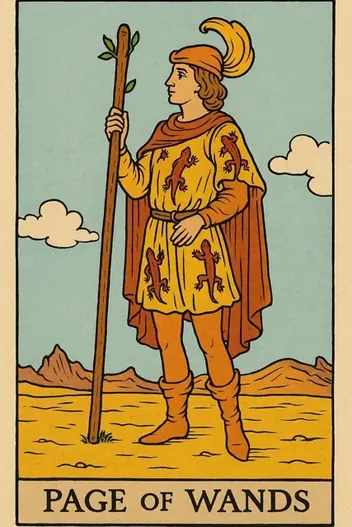

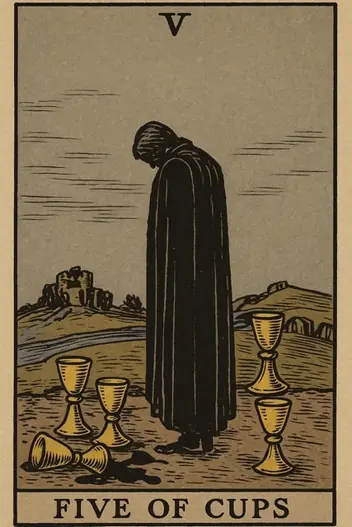
- Arcana
- Page of Wands — Minor Arcana, Wands; Five of Cups — Minor Arcana, Cups
- Elements
- Page of Wands — Fire; Five of Cups — Water
- Elemental interaction
- Opposing elements — energies create tension
- Numerology
- 11 + 5 = 16 → 7
When the Page of Wands—a card of eager exploration, raw potential, and impulsive action—collides with the Five of Cups—a card of grief, regret, and fixation on past failures—you get a psychological paradox. This combination represents a person who is simultaneously excited about a new idea or opportunity yet burdened by a recent emotional loss. The key strategic insight here is that the quality of your future depends on your ability to separate your enthusiasm from your grief.
This dynamic often manifests as a restless desire to move forward while being held back by unresolved sadness. You may feel a spark of inspiration for a new project or relationship, but the shadow of a recent disappointment makes you second-guess your next step. The combination demands that you acknowledge the loss without letting it extinguish your creative fire.
Page of Wands and Five of Cups Combination Meaning
The core conflict here is between forward momentum (Page of Wands) and backward-looking sorrow (Five of Cups) . The Page represents a beginner’s mindset—curious, spontaneous, and willing to take risks. The Five of Cups, however, represents a cognitive bias toward negativity, where the seeker focuses on the two spilled cups (what is lost) rather than the two still standing (what remains). When these two energies merge, the result is often a half-hearted attempt at new beginnings.
Psychologically, this pairing suggests ambivalence: you want to start something new, but you’re not fully committed because part of you is still grieving. This can lead to self-sabotage, where you initiate a project or relationship only to withdraw prematurely when it triggers memories of past pain. The pragmatic takeaway is that progress requires a conscious decision to shift attention from what is gone to what is possible. The Page’s fire can be doused by the Five’s tears, or it can burn through them—the choice is yours.
Career and Finances
Strategic Opportunities:
Launching a small-scale pilot project or side hustle that requires low financial risk but high creative energy.
Strategic Opportunities:
Networking with younger, less-experienced professionals who can bring fresh perspectives to a stagnant team.
Calculated Risks:
Avoid investing significant capital into a venture that is emotionally tied to a previous failure—you may be trying to “win back” what was lost rather than build something new.
Professionally, this combination suggests a tension between innovation and burnout. The Page of Wands indicates a desire to start a new initiative, learn a new skill, or pivot careers. However, the Five of Cups warns that you are still bleeding from a recent professional setback—a failed project, a lost client, or a missed promotion. The smartest financial move is to treat this as a “recovery period.” Take one small, exploratory step (e.g., attend a workshop, write a proposal) but do not commit major resources until you have objectively assessed what went wrong before. The shadow here is rash spending to “feel better” —avoid using new ventures as emotional band-aids.
Your pair is already on the table. Ask your question and draw the clarifying card
or simply focus on it
Love and Relationships
If you are single:
This combination warns against projecting past relationship trauma onto a new, promising connection. The Page of Wands suggests someone attractive and spontaneous enters your life, but you may dismiss them because they remind you of a previous failure.
If you are in a relationship:
Expect a dynamic where one partner is eager to try new experiences (travel, hobbies, intimacy) while the other is stuck in a cycle of resentment over a past argument or betrayal.
In relationships, the Page of Wands and Five of Cups often signals a power struggle between hope and hurt. The Page partner wants to explore and play, while the Five partner needs to process and heal. The critical relationship advice here is to create space for both energies without letting one dominate. If you’re the Page, resist the urge to “fix” your partner’s grief with forced optimism. If you’re the Five, acknowledge your partner’s enthusiasm as a gift, not a threat to your pain. The healthiest outcome involves setting a timeline for mourning and then consciously choosing to engage with the new.
What If Page of Wands or Five of Cups Appears Reversed?
When cards appear in a reversed position, the dynamic shifts but does not disappear—it transforms into a different set of problems.
If the Page of Wands is reversed:
Potential is blocked by internal sabotage. The person not only fears taking action—they actively seek reasons why "it's not even worth trying." The reversed Page of Wands represents suppressed initiative, where ideas exist but remain in the mind, never transitioning into action. Warning: this state can masquerade as "common sense," but in reality, it is fear of failure. Advice: start with micro-steps—actions that take less than 5 minutes—to break the cycle of inaction.
If the Five of Cups is reversed:
Instead of disappointment, denial of losses emerges. The person refuses to acknowledge that something went wrong and continues to invest resources in obviously doomed projects. The reversed Five of Cups is toxic optimism that ignores reality. Advice: conduct an audit of past experience—honestly list what exactly didn't work and why. Acknowledging losses is the first step toward overcoming them.
If BOTH are reversed:
Complete imbalance: impulsiveness without direction (reversed Page) combines with denial of reality (reversed Five). The person may engage in chaotic actions without learning lessons from the past, or conversely, sink into fantasies of a "grand comeback" without taking concrete steps. Logical method for correction: create a structural plan with clear stages and evaluation criteria. External discipline compensates for internal chaos.
Get a personalized interpretation
Unlock the combined meaning of your cards in the context of your unique question — for free.
What Are the Risks of Page of Wands and Five of Cups?
The dark side of this pairing is compulsive restarting—the tendency to abandon a situation the moment it becomes difficult, only to repeat the same mistakes in the next “new beginning.” Psychologically, this is a defense mechanism against vulnerability: by constantly starting over, you never have to face the pain of finishing something that failed. The cognitive bias at play is the “sunk cost fallacy” in reverse—you refuse to invest in any current opportunity because you’re still fixated on a past loss. Watch for signs of passive-aggressive behavior (enthusiasm that fades when accountability is required) or emotional numbness (using the Page’s excitement to avoid feeling the Five’s grief). The most dangerous outcome is when the seeker blames external circumstances for their inability to commit, rather than recognizing their own unresolved sadness.
What Is the Overall Message of Page of Wands and Five of Cups?
Constructive use of the Page of Wands' energy to balance the Five of Cups requires conscious management of attention. The Page of Wands is energy of exploration, but without discipline, it turns into chaotic attempts. The Five of Cups is a lesson in acceptance, but without an active component, it becomes depressive fixation. Strategic synthesis: use the Page's enthusiasm for purposeful exploration of past experience, and the Five's lessons for realistic assessment of new opportunities.
Practical framework:
Divide your situation into three zones: Learning Zone (what I can learn from past failures), Experiment Zone (what I can try with minimal risk), Acceptance Zone (what I must let go of to move forward). The Page of Wands is active in the experiment zone, the Five of Cups in the acceptance zone. Do not mix these zones — when you analyze the past, do not plan the future, and vice versa.
Deep strategic advice:
Embrace the principle of "good enough." The Page of Wands strives for the ideal, the Five of Cups sees only failures. Truth lies in the middle: most endeavors will not be perfect, but neither will they be disasters. The goal is not to avoid all mistakes, but to learn from them without self-flagellation. If you can maintain this mindset, the combination of the Page of Wands and the Five of Cups will transform from a source of stress into a tool for sustainable growth.
Key decision:
Ask yourself: "What can I do today to simultaneously acknowledge my past disappointments and take a step toward a new opportunity?" The answer to this question is the point of synthesis for these cards. Do not choose between enthusiasm and caution — integrate them into a conscious, balanced action.
Applying This to Your Situation
The core message of the Page of Wands and Five of Cups is that new beginnings require emotional closure. You cannot build a fire on wet ground. The path forward is not to ignore your grief, but to integrate it as a lesson that makes your next attempt wiser and more grounded. Your enthusiasm is not the enemy of your healing—it is the tool to rebuild.
While this article gives you the general archetype, the true power of Tarot is in its application to your specific situation. The same combination means something different if you’re grieving a breakup versus a career failure. Get a deep, personalized reading for this exact combination right now by using the Fortune Cards app. Available on the web or as a download, it will analyze your unique question and give you the strategic, psychological insight you need to turn this conflict into clarity.
Interpretation by the Fortune Cards editorial team, based on the Rider–Waite tradition and Jungian archetypes. About our methodology · Updated: 2026-08-26
Other Combinations with Page of Wands
Other Combinations with Five of Cups
Explore Individual Card Meanings
Table of Contents
Ready to find answers to your questions?
Start your first reading now and look at your situation with fresh clarity. The cards are ready to reveal deeper meaning.