Queen of Cups and Knight of Swords Meaning in Tarot
- Arcana
- Queen of Cups — Minor Arcana, Cups; Knight of Swords — Minor Arcana, Swords
- Elements
- Queen of Cups — Water; Knight of Swords — Air
- Elemental interaction
- Neutral elements — energies coexist without conflict
- Numerology
- 13 + 12 = 25 → 7
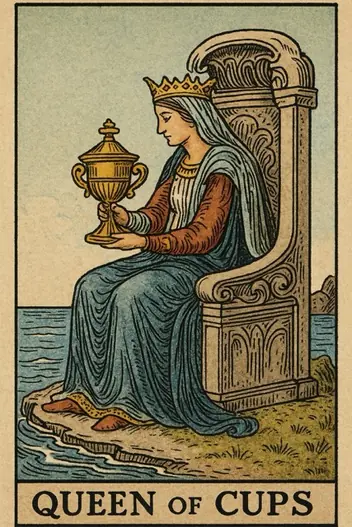
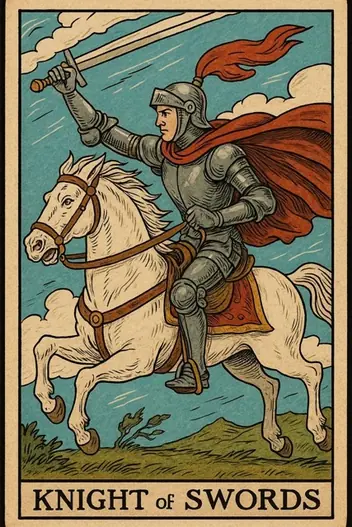
When the Queen of Cups—a symbol of deep emotional intelligence, empathy, and intuitive knowing—meets the Knight of Swords—a figure of sharp intellect, rapid action, and unyielding logic—we witness a psychological clash of archetypes. This pairing represents the internal tension between feeling and thinking, between nurturing and charging ahead. In real life, this combination often surfaces when a person must make a high-stakes decision that demands both heartfelt connection and ruthless clarity.
The Queen brings a calm, receptive energy; she reads the room and feels the unspoken currents. The Knight, by contrast, is a storm of ideas, driven by a mission to cut through confusion with the sword of truth. Together, they create a dynamic that can either produce brilliant, emotionally-informed strategies or a painful disconnect between what one feels and what one does. Understanding this tension is key to harnessing its power without getting wounded by the sharp edges.
Queen of Cups and Knight of Swords: How These Energies Interact
The core dynamic here is a tug-of-war between compassion and conquest. The Queen of Cups asks, "How does this feel? Is this aligned with my values and the well-being of others?" The Knight of Swords demands, "What is the fastest, most efficient path to victory? Stop wasting time with feelings." Psychologically, this can represent a person who has both high emotional sensitivity and a strong intellectual drive, but struggles to integrate them. The key insight is that neither energy is wrong; the danger lies in one dominating the other.
When these energies merge effectively, the result is a strategic empath—someone who can analyze a situation coldly while remaining attuned to the emotional impact on themselves and others. For example, a leader might use the Queen's intuition to sense team morale and the Knight's decisiveness to implement a necessary, difficult change with minimal collateral damage. However, if the Knight overpowers the Queen, the seeker may act on logic alone, cutting off emotional data and causing relational harm. If the Queen dominates, the seeker may become paralyzed by empathy, avoiding necessary confrontations.
The psychological task is to use the Knight's mental energy to protect and serve the Queen's deeper wisdom, not to suppress it. This requires conscious effort to pause before acting—allowing the Queen's feelings to inform the Knight's strategy. The result is a powerful, integrated mindset: swift action guided by a compassionate heart.
Your pair is already on the table. Ask your question and draw the clarifying card
or simply focus on it
Queen of Cups and Knight of Swords: Career and Money
Strategic Opportunities:
Use your emotional intelligence to read the room during negotiations or team meetings. Your intuition can reveal unspoken objections or hidden alliances that your logic alone might miss.
Strategic Opportunities:
Leverage the Knight's drive to propose bold, innovative solutions that are also compassionate. For example, pitch a project that improves efficiency while also enhancing team well-being.
Calculated Risks:
Avoid making hasty decisions under emotional duress. The Knight's impulsiveness, combined with the Queen's sensitivity, can lead to acting on a gut feeling that is actually anxiety, not intuition. Get objective data before committing resources.
In the professional sphere, this combination is a call to balance empathy with execution. You may feel torn between being a supportive colleague and a competitive achiever. The best path is to use your analytical skills (Knight) to structure your empathy (Queen). For example, if you manage a team, use data to identify who needs support, then deliver it strategically. Financially, the Knight's speed can be dangerous—avoid impulsive investments based on a "hunch." Instead, combine the Queen's intuitive sense of value with the Knight's research skills. A key financial warning: do not let the desire for quick wins override your long-term ethical standards. The Queen's integrity must guide the Knight's ambition.
Ask your specific question
Don't rely on generic meanings. Get a customized reading tailored specifically to your energies.
Queen of Cups and Knight of Swords as Feelings
If you are single:
This combination suggests you may be attracted to someone who is intellectually stimulating but emotionally guarded. Be cautious of mistaking intensity for intimacy. Evaluate whether the connection allows for vulnerability, or if it's all mental sparring.
If you are in a relationship:
You or your partner may be experiencing a conflict between emotional needs and logical arguments. The Knight's bluntness can wound the Queen's sensitivity. Prioritize structured communication: set a time to talk, use "I feel" statements, and avoid accusatory language.
In relationships, this pairing often signals a power struggle between heart and head. One partner may feel the other is too cold or critical (the Knight), while the other feels the first is too emotional or indecisive (the Queen). The solution is not to choose one side, but to create a shared protocol for decision-making. For instance, agree to first acknowledge each other's feelings (Queen) before problem-solving (Knight). The most important relationship advice here is to respect the validity of both emotional truth and logical reality. If the Knight's criticism is delivered without empathy, it can erode trust. If the Queen's feelings are used to avoid hard truths, resentment builds. Aim for a balanced dialogue where both perspectives are heard and integrated.
The Shadow Side of Queen of Cups and Knight of Swords
When this energy is blocked or misaligned, the shadow manifests as emotional manipulation or intellectual bullying. The Queen's empathy can become a tool for passive-aggressive control, using guilt to slow down the Knight's progress. Conversely, the Knight's logic can become a weapon, dismissing the Queen's feelings as "irrational" or "weak." This creates a toxic cycle: one partner feels silenced, the other feels frustrated. Cognitive bias alert: Confirmation bias can cause the Knight to seek evidence that justifies ignoring emotional needs, while the Queen may catastrophize, seeing every critique as a personal attack. Self-sabotage occurs when the seeker over-identifies with one archetype, abandoning the wisdom of the other. For instance, a person might quit a stable job (Knight's impulsiveness) because they "felt" undervalued (Queen's sensitivity), without a rational backup plan. The shadow warns: do not let the desire for harmony (Queen) prevent necessary conflict, or let the desire for victory (Knight) destroy valuable relationships.
Queen of Cups and Knight of Swords Reversed: How to Read It
When the cards are reversed, constructive conflict turns into destructive chaos.
Queen of Cups reversed + Knight of Wands upright:
Emotional incompetence. You lose touch with your own feelings or ignore the feelings of others. Your Knight of Wands becomes cruel and tactless. Warning: you risk hurting people without even noticing it. You need to pause and restore empathy before taking action.
Queen of Cups upright + Knight of Wands reversed:
Paralysis of will. You have an understanding of the situation (the Queen), but lack the energy or courage to act. You become a hostage to your own fears and doubts. Advice: stop searching for the perfect moment. Your intuition already knows everything; you just need to take the first step, even an imperfect one.
Both cards reversed:
Complete imbalance and self-deception. You are simultaneously hysterical and passive. Your actions are chaotic, and your emotions are inappropriate. This is the combination of a "toxic arguer" who seeks the truth but is afraid to find it. How to fix it: return to basics. Disconnect from external noise. First, restore the emotional background (set the Queen "upright"), and then the will to action (the Knight). Act strictly sequentially.
Queen of Cups and Knight of Swords: The Combined Message
How can this dynamic be used constructively? Imagine the Queen of Cups is your antenna, and the Knight of Swords is your engine. The antenna picks up signals from the environment (feelings, moods, hidden motives), while the engine drives you toward your goal with maximum efficiency. Your task is to prevent the engine from overheating and the antenna from breaking.
The deep strategic advice is to teach the Knight to wait. The Queen of Cups knows that time is also a resource. Before delivering a "mental strike" (the Knight), take a deep breath and scan the battlefield (the Queen). Ask yourself: "What outcome will be best for all participants a year from now?" If your action plan fails this test of empathy and long-term thinking, it is flawed.
This combination is the ideal tool for leadership in a crisis. When the team panics, you are the calm center that sees both people's fear and the path to salvation. You say: "I understand this is frightening, but here are the facts and here is our plan." This is not just strength; it is wisdom tempered by experience.
Your Next Step: Personal Context Matters
The Queen of Cups and Knight of Swords combination ultimately asks you to integrate your heart and mind into a single, coherent strategy. The Queen provides the "why"—the emotional purpose and human connection. The Knight provides the "how"—the plan, the action, and the courage to execute. Your task is to ensure neither overpowers the other. When balanced, you become a force of compassionate assertiveness, capable of making tough decisions without losing your humanity.
Ready to see how this combination applies specifically to your life? The Fortune Cards app is designed to provide deep, personalized Tarot readings based on your exact question and situation. While this article offers general archetypal insights, the true power comes from applying them to your unique context. Use the app on the web or download it today to get a customized interpretation of the Queen of Cups and Knight of Swords for your love life, career, or personal growth. Your next step is just a click away.
Interpretation by the Fortune Cards editorial team, based on the Rider–Waite tradition and Jungian archetypes. About our methodology · Updated: 2026-08-26
Other Combinations with Queen of Cups
Other Combinations with Knight of Swords
Explore Individual Card Meanings
Table of Contents
- Queen of Cups and Knight of Swords: How These Energies Interact
- Queen of Cups and Knight of Swords: Career and Money
- Queen of Cups and Knight of Swords as Feelings
- The Shadow Side of Queen of Cups and Knight of Swords
- Queen of Cups and Knight of Swords Reversed: How to Read It
- Queen of Cups and Knight of Swords: The Combined Message
- Your Next Step: Personal Context Matters
Ready to find answers to your questions?
Start your first reading now and look at your situation with fresh clarity. The cards are ready to reveal deeper meaning.