Seven of Wands and Six of Pentacles Together in Tarot
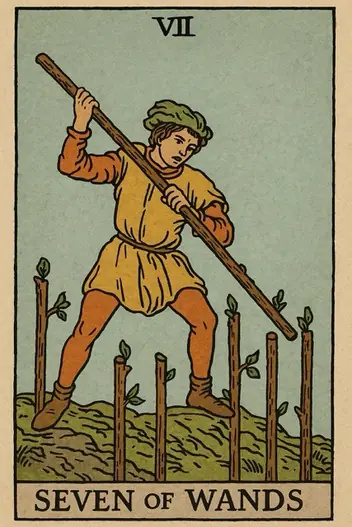

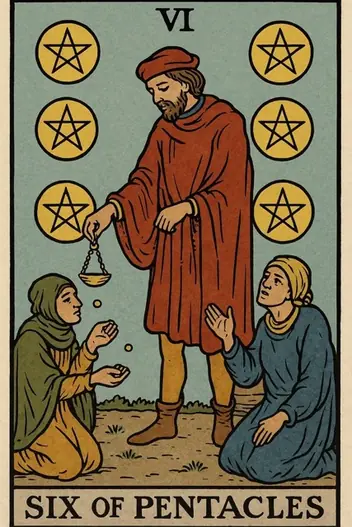
- Arcana
- Seven of Wands — Minor Arcana, Wands; Six of Pentacles — Minor Arcana, Pentacles
- Elements
- Seven of Wands — Fire; Six of Pentacles — Earth
- Elemental interaction
- Neutral elements — energies coexist without conflict
- Numerology
- 7 + 6 = 13 → 4
The intersection of the Seven of Wands and Six of Pentacles creates a powerful psychological tension: the need to aggressively defend your position versus the impulse to give or receive support. This pairing often appears when you are in a high-stakes negotiation—whether with a partner, a boss, or yourself. You are holding ground against external pressures, yet the Six of Pentacles demands you assess who truly deserves your resources and who is merely taking advantage.
From a Jungian perspective, this combination activates the Warrior and the Benefactor archetypes. The Seven of Wands represents the assertive ego that refuses to be pushed off its hill, while the Six of Pentacles symbolizes the ethical distribution of power and wealth. When these energies merge, you are forced to ask: Am I fighting for a fair outcome, or am I just being stubborn? The answer lies in your ability to set clear boundaries without becoming rigid, and to give generously without becoming a martyr.
Core Dynamics & Interpretation
The core dynamic here is a strategic balancing act between self-protection and generosity. The Seven of Wands signals that you are under active challenge—someone or something is testing your position, your competence, or your resources. This is not a passive card; it demands immediate, decisive action. Meanwhile, the Six of Pentacles introduces a transactional element—you may be asked to prove your worth by what you give, or you may be evaluating whether others are giving you what you deserve.
Psychologically, this pairing often triggers cognitive dissonance around fairness. You might feel compelled to hoard your energy (Seven of Wands) out of fear of being exploited, while simultaneously feeling a moral obligation to share (Six of Pentacles). The healthiest resolution occurs when you defend your core values and non-negotiables, but remain flexible on the how of resource exchange. For example, you can refuse to compromise your standards while still offering practical support to those who respect your boundaries.
The key insight is that defense without generosity becomes isolation, and generosity without boundaries becomes exploitation. This combination asks you to hold your ground with grace, ensuring that your fight is for a cause that benefits not just you, but the larger system you operate within. In practical terms, this means negotiating from a position of strength while leaving room for mutual gain.
Your pair is already on the table. Ask your question and draw the clarifying card
or simply focus on it
Career Meaning of Seven of Wands and Six of Pentacles
Strategic Opportunities:
Leverage your defensive position to negotiate better terms. If you are being challenged at work, use the Six of Pentacles to document your contributions and demonstrate your value to decision-makers.
Strategic Opportunities:
Use your resources to buy stability. Consider investing in training, tools, or allies that strengthen your long-term position, rather than just fighting short-term battles.
Calculated Risks:
Avoid over-extending yourself to please others. The Six of Pentacles can tempt you to give away your time or expertise for free, which the Seven of Wands warns will drain your energy and weaken your leverage.
In the professional realm, this combination signals a critical moment of negotiation or advocacy. You may be defending a project, a promotion, or your reputation against skeptics. The Seven of Wands gives you the combativeness to push back, but the Six of Pentacles insists you frame your defense in terms of value delivered. Instead of saying “I deserve this,” you must demonstrate how your work benefits the team or organization.
**Financially, this pairing warns against mixing charity with business. If you are considering lending money or giving away equity, structure the agreement formally. The Six of Pentacles can represent unequal exchanges—you might give more than you receive if you are not careful. The strategic move is to defend your financial boundaries while still being open to collaborative ventures that offer mutual benefit. Consider setting clear terms upfront and regularly reviewing the arrangement to ensure fairness.
Get a personalized interpretation
Unlock the combined meaning of your cards in the context of your unique question — for free.
What Do Seven of Wands and Six of Pentacles Say About Love?
If you are single:
This pairing suggests you are attracting people who either challenge your independence or test your generosity. You may meet someone who appears to need your help, but verify their intentions before over-investing. Your defensiveness is a healthy filter—use it to screen for partners who respect your boundaries.
If you are in a relationship:
You and your partner may be negotiating a power imbalance around money, time, or emotional labor. The Seven of Wands warns against turning every disagreement into a battle, while the Six of Pentacles reminds you to give credit where it is due.
In relationships, this combination highlights the tension between autonomy and interdependence. The Seven of Wands energy can manifest as defensiveness or a need to control the dynamic, especially if you feel your contributions are undervalued. You may find yourself arguing over who gives more or who is sacrificing more. The psychological trap is to view the relationship as a zero-sum game, where one person’s gain is the other’s loss.
The most effective relationship advice is to shift from a transactional mindset to a collaborative one. Instead of keeping score, define your non-negotiables clearly (Seven of Wands) and then offer support within those boundaries (Six of Pentacles). For example, you can say, “I need to feel respected when we discuss finances. If you can meet that, I am willing to contribute more to our shared goals.” This approach maintains your integrity while preventing resentment from building.
Reversed Seven of Wands and Six of Pentacles Explained
If the Seven of Wands is reversed:
Defense becomes recklessness or capitulation. You either rush into battle without a strategy or, conversely, surrender your positions without a fight. In this context, your generosity (Six of Pentacles) becomes a reckless waste of resources on hopeless projects or people who do not value you. Advice: step back and reconsider what you are actually fighting for.
If the Six of Pentacles is reversed:
Internal resistance to help. You cannot accept support, even when it is necessary. Pride or fear of dependency blocks any incoming resource. In such a context, the Seven of Wands turns into a lonely, exhausting defense, where you refuse reinforcements. Warning: your independence becomes a prison.
If BOTH are reversed:
Complete imbalance of dynamics. You are in a state of chaos, where there is neither clear defense nor healthy exchange. This could be a situation where you aggressively demand resources (reversed Six), but are not ready to fight for them (reversed Seven). Way to correct: return to basics. Identify one, most important "fortress" and one, most valuable resource that you are willing to give or receive. Act on the principle of "one goal — one step."
Shadow Side & Pitfalls
The shadow manifestation of this combination is defensive miserliness—hoarding resources out of fear, while simultaneously feeling guilty about not sharing. This creates a cycle of resentment and withdrawal that damages relationships and career opportunities. You may become overly critical of others’ requests, seeing every ask as a threat to your security.
Another pitfall is performative generosity—giving just enough to appear generous, while secretly keeping score and expecting repayment. This is the Six of Pentacles shadow of manipulation, combined with the Seven of Wands shadow of paranoia. Cognitive biases at play include the scarcity mindset (believing there isn’t enough to go around) and the just-world hypothesis (assuming that if you give, you will automatically receive).
To avoid these traps, regularly check your motivations. Ask yourself: Am I defending a principle, or just my ego? Am I giving freely, or with strings attached? The healthiest path is to set firm boundaries around your core resources (time, energy, money), while giving within those limits without expectation of return. This prevents burnout and maintains your integrity.
Synthesis: Strategic Conclusion
How can the energy of the Seven of Wands be used constructively to balance the Six of Pentacles? The answer lies in the principle of "selective strength". The Seven of Wands is the energy of holding one's ground, but it becomes ineffective if you try to hold everything at once. Your task is to channel this defensive power toward protecting your right to a healthy exchange.
Strategically, this means you must firmly define your "non-negotiable reserves": time for rest, personal budget, emotional resources. This is your "fortress," which you will defend at all costs. Everything else is the "marketplace," where you can be generous, but only on terms of mutually beneficial exchange.
A profound piece of advice:
Transform your defense from reactive to proactive. Instead of fending off attacks on your resources, create a system for their distribution. For example, set clear working hours, limits on financial assistance, and rules for emotional support. The Six of Pentacles in its healthy form is not chaotic giving, but fair stewardship.
Remember: your strength lies not in giving everything, but in giving the right amount to the right people at the right time. Only then will the Seven of Wands cease to be an exhausting battle and instead become a strategic defense of your well-being.
Where to Go From Here
The combination of Seven of Wands and Six of Pentacles ultimately asks you to defend your worth without losing your generosity. It is a call to stand your ground on what matters, while remaining open to fair exchange with those who respect your boundaries. The balance is delicate, but achievable through clear communication and self-awareness.
To unlock the full potential of this reading for your specific situation, use the Fortune Cards app. While this article provides the general archetype, the true magic happens when Tarot is applied to your unique question—whether it’s about a relationship, career move, or personal dilemma. The app can deliver a deep, personalized interpretation of this exact combination, tailored to your context. You can use it on the web or download it to get immediate, actionable insights right now.
Interpretation by the Fortune Cards editorial team, based on the Rider–Waite tradition and Jungian archetypes. About our methodology · Updated: 2026-08-26
Other Combinations with Seven of Wands
Other Combinations with Six of Pentacles
Explore Individual Card Meanings
Table of Contents
Ready to find answers to your questions?
Start your first reading now and look at your situation with fresh clarity. The cards are ready to reveal deeper meaning.