Six of Swords and Knight of Swords Tarot as Feelings

- Arcana
- Six of Swords — Minor Arcana, Swords; Knight of Swords — Minor Arcana, Swords
- Elements
- Six of Swords — Air; Knight of Swords — Air
- Elemental interaction
- Same element — energies intensify each other
- Numerology
- 6 + 12 = 18 → 9
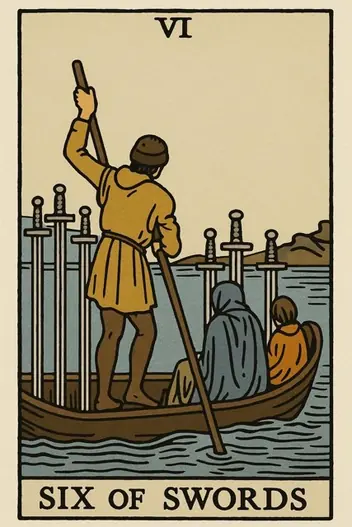
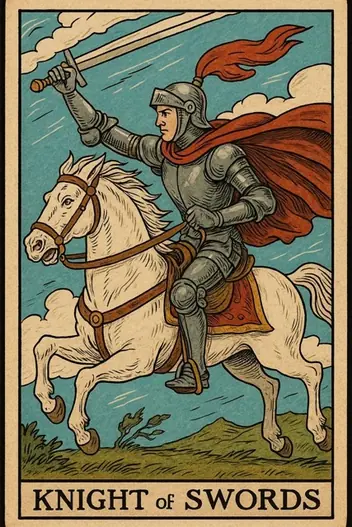
The Six of Swords represents a necessary, often reluctant, transition—a quiet journey away from turbulence toward calmer waters. It is the archetype of pragmatic retreat, where the ego accepts that holding on is more costly than letting go. The Knight of Swords, in stark contrast, is the archetype of swift, decisive action—a charge into battle fueled by intellectual conviction and a need for immediate resolution. When these two cards appear together, they create a powerful psychological tension: the pull to move on thoughtfully versus the push to act immediately.
This combination signals a critical decision point where the seeker must reconcile the need for a strategic exit with an overwhelming urge to force a solution. The core conflict is between measured departure and aggressive conquest. In real life, this often manifests as a sudden, well-researched decision to leave a situation—a job, a relationship, or a mindset—but with an edge of impatience that risks burning bridges. The key is to harness the Knight’s clarity without sacrificing the Six’s long-term perspective.
Core Dynamics & Interpretation
The psychological state created by this pairing is one of calculated urgency. The Six of Swords provides the why—the logical understanding that the current path is no longer viable. The Knight of Swords provides the how—the mental energy and speed to execute the exit. This is not a passive drift; it is a purposeful, accelerated transition. The seeker is likely processing a painful truth (Six of Swords) but is now ready to confront it head-on with a plan (Knight of Swords).
However, this combination carries a significant risk of cognitive rigidity. The Knight’s single-minded focus can distort the Six’s need for a smooth, gradual passage into a reckless charge. The most important insight here is that action without adequate planning is self-sabotage. The Knight of Swords solves problems quickly, but the Six of Swords reminds us that some problems require a ferry, not a cavalry charge. The pragmatic approach is to use the Knight’s energy to accelerate the transition, not to short-circuit the necessary emotional processing.
The real-world implication is a period of intense mental activity where the seeker is simultaneously detaching from the past and planning a new future. This is a time for clear, decisive communication, but also for vigilance against impulsive decisions driven by frustration or a desire for control. The merger of these energies demands a disciplined mind—one that can hold the tension between the need for speed and the value of a careful exit strategy.
Career and Finances
Strategic Opportunities:
A sudden, logical career pivot—accepting a new job offer, starting a business, or leaving a toxic work environment based on a well-researched plan.
Strategic Opportunities:
Negotiating a severance or exit package with clear, assertive communication. This is the time to leverage your mental clarity to secure a favorable outcome.
Calculated Risks:
Avoid making a public or irreversible move when you are still emotionally reactive. The Knight’s haste can lead to burning professional bridges that the Six of Swords would prefer to cross quietly.
In your professional life, this pairing is a powerful signal for strategic realignment. You have likely been enduring a situation that no longer serves your growth—a dead-end role, a misaligned project, or a conflict with management. The Knight of Swords gives you the courage and intellectual firepower to initiate change. However, the Six of Swords insists that this change must be methodical, not chaotic. The most important financial warning is this: do not resign or make a major investment purely out of frustration. The Knight’s energy is sharp but short-lived; ensure your decision is backed by data, not just a desire to escape.
For financial planning, this combination suggests a liquidation of assets or a strategic withdrawal from a risky venture. The Knight of Swords excels at cutting losses quickly, while the Six of Swords recommends moving the remaining capital to a safer harbor. Bold strategic tip: Use this energy to audit your professional network and cut ties with relationships that drain your resources or clarity. The Knight gives you the courage to have the difficult conversation; the Six ensures you leave with your dignity and portfolio intact.
Your pair is already on the table. Ask your question and draw the clarifying card
or simply focus on it
Six of Swords and Knight of Swords in Love Tarot
If you are single:
This combination suggests you are ready to decisively move on from a past heartbreak or a pattern of unfulfilling connections. You have the clarity to know what you don’t want, but be cautious of jumping into a new relationship simply to prove you’ve moved on.
If you are in a relationship:
You and your partner are facing a critical juncture that requires both honest conversation and a willingness to change the status quo. One partner may feel the need to leave, while the other wants to fight for the relationship—creating a power struggle.
In relationships, the Six of Swords and Knight of Swords combination often signals a painful but necessary breakup or a radical shift in the relationship’s structure. The Knight brings a sharp, unyielding communication style that can cut through denial, but it can also wound. The key relationship advice is to maintain emotional honesty without turning the conversation into a battle. If you are the one initiating the change, state your reasoning clearly and calmly, like the Knight, but allow for the gradual emotional adjustment of the Six. If you are the one being left, this combination warns against trying to block the exit. The Knight’s energy will not be contained.
Bold advice:
Do not confuse decisiveness with cruelty. The Knight of Swords can be brutally honest, but the Six of Swords teaches that the journey away from pain should be as gentle as possible. If you are staying, use this energy to renegotiate boundaries with direct, non-accusatory language. The relationship can survive this tension only if both parties respect the need for a structured, albeit fast, transition.
What If Six of Swords or Knight of Swords Appears Reversed?
When archetypes become distorted, the dynamics turn toxic. The reversed Six of Swords points to blocked potential — you are stuck in the "pre-departure" phase, endlessly packing your bags but never leaving the house. In combination with the upright Knight, this creates recklessness: a person mimics frantic activity to hide their fear of real movement. Advice: stop and honestly admit that you fear not change, but loneliness in a new place.
The reversed Knight of Swords represents inner resistance or passive aggression. Instead of a clear strike — sarcasm, criticism, and empty arguments. Paired with the upright Six, this means you are sabotaging your own salvation by finding intellectual reasons not to leave your comfort zone. Warning: your "rational" arguments are a defense mechanism. Stop analyzing and start acting.
If BOTH cards are reversed, we see a complete imbalance of dynamics — a state of paralysis where fear (reversed Six) has merged with anger (reversed Knight). This is a classic "self-sabotage" trap. A logical way to correct it: start with a small action. Do not try to solve the global problem. Make one concrete move — send a resume, write a message, close an old account. Physical action will break the cycle of fruitless rumination.
Your unique Tarot reading
See how these cards interact with your destiny. Start a free personal reading now.
Six of Swords and Knight of Swords: Warning Signs
The shadow of this combination is a catastrophic failure of judgment driven by cognitive biases. The most common pitfall is the confirmation bias of the Knight of Swords—seeking only evidence that supports a hasty departure while ignoring the emotional or logistical costs. This can lead to self-sabotage, where the seeker interprets a normal challenge as a reason to flee, mistaking a necessary transition for an emergency evacuation.
Another shadow manifestation is emotional repression. The Six of Swords often involves grief and sadness, but the Knight of Swords wants to bypass these feelings through sheer mental force. The result is a person who leaves a situation physically but remains psychologically trapped, unable to process the real emotions driving the exit. This can lead to repetitive patterns where the seeker charges from one situation to the next, never truly healing the wounds that prompted the initial departure.
Finally, the Knight’s aggressive communication can turn the Six’s peaceful journey into a destructive confrontation. The seeker may use the truth as a weapon, scorching the earth behind them in a way that creates unnecessary enemies. The shadow warning is clear: speed without wisdom is recklessness. If you feel a frantic, impatient energy, pause and ask yourself if you are running toward a solution or simply away from discomfort.
What Is the Overall Message of Six of Swords and Knight of Swords?
How to constructively utilize the energy of this pair? The key to synthesis lies in transforming the Knight of Swords into a scout, and the Six of Swords into a logistics hub. Your task is not to attack blindly, but to use the Knight's intellectual power to scan the terrain, gather information, and select the optimal route. In this scheme, the Six of Swords is responsible for resources: it guarantees you have enough "fuel" (time, money, support) to complete the journey.
A deep strategic piece of advice: apply the military tactic of the "Clinch." Do not try to win the war with a single blow. Instead, use the Knight of Swords for a series of quick, precise strikes (calls, letters, meetings) that create "noise" and divert attention, while the Six of Swords quietly moves your main assets out of the danger zone. This is not cowardice—it is pragmatism.
Your ultimate goal is not simply to leave or to attack. Your goal is to occupy a new position from which you can dictate the terms. This combination teaches us that the fastest way to overcome a crisis is to acknowledge its reality (the Six) and simultaneously develop a plan of attack (the Knight). Do not let emotions dictate strategy, but do not ignore them as data either. Your decision must be a cold calculation, reinforced by a deep understanding of your own true desires.
Where to Go From Here
The core message of Six of Swords and Knight of Swords is that a decisive, intellectual exit from a painful situation is both necessary and possible, but only if you balance speed with strategy. You have the clarity to see the truth and the courage to act—but you must also have the wisdom to navigate the transition with grace. This is not a time for passive waiting or reckless charging; it is a time for purposeful, calculated movement.
While this article provides the general archetype, the true magic happens when Tarot is applied to your unique situation. The meaning of this combination shifts dramatically depending on whether you are the one leaving, the one being left, or the one trying to change the rules. To get a deep, personalized interpretation of this exact combination for your specific question, use the Fortune Cards app. You can access it on the web or download it now to receive a tailored reading that considers your exact context, helping you make the right decision with confidence and clarity.
Interpretation by the Fortune Cards editorial team, based on the Rider–Waite tradition and Jungian archetypes. About our methodology · Updated: 2026-08-26
Other Combinations with Six of Swords
Other Combinations with Knight of Swords
Explore Individual Card Meanings
Table of Contents
Ready to find answers to your questions?
Start your first reading now and look at your situation with fresh clarity. The cards are ready to reveal deeper meaning.