Six of Swords and Three of Pentacles Tarot as Feelings
- Arcana
- Six of Swords — Minor Arcana, Swords; Three of Pentacles — Minor Arcana, Pentacles
- Elements
- Six of Swords — Air; Three of Pentacles — Earth
- Elemental interaction
- Opposing elements — energies create tension
- Numerology
- 6 + 3 = 9
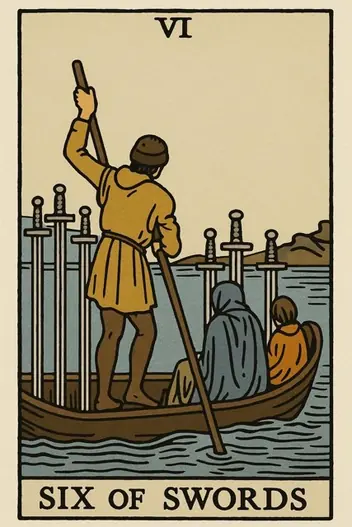
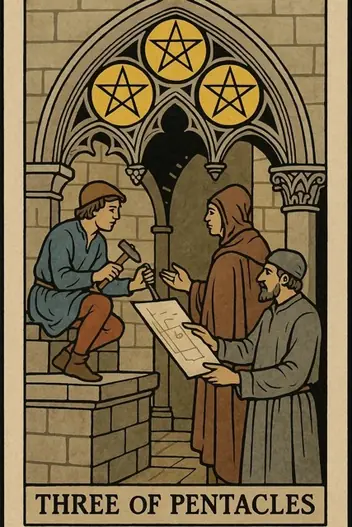
When the Six of Swords—the card of moving through grief, transition, and cognitive restructuring—meets the Three of Pentacles—the card of skilled teamwork, apprenticeship, and deliberate craftsmanship—a powerful psychological dynamic emerges. This combination suggests that the most effective way to navigate a difficult life transition is not through isolation or heroic individualism, but through structured collaboration and practical skill-building.
The collision of these archetypes forces a pragmatic question: What if your path to a better future requires you to temporarily rely on others' expertise, even as you feel the urge to retreat? The answer lies in treating your emotional recovery as a project that requires a team, a blueprint, and a timeline.
Six of Swords and Three of Pentacles Combination Meaning
The psychological state created by the Six of Swords and Three of Pentacles is one of directed vulnerability. The Six of Swords represents the conscious choice to leave behind a painful situation—a relationship, a career, a belief system. This requires emotional courage. However, the Three of Pentacles adds a layer of strategic humility: you cannot build the boat to cross the river alone. You need a mentor, a collaborator, or a structured system to execute the transition.
This combination activates the Apprentice Archetype in Jungian terms. You are not the master of your new situation yet. You are learning the ropes, accepting feedback, and contributing your specific skills to a larger project. The key insight here is that your transition is not a solo journey of escape, but a collaborative project of construction. The old shore is behind you, but the new shore requires a workshop.
In real-world terms, this means you must resist the urge to disappear or cut ties completely. Instead, identify one or two competent individuals—a therapist, a career coach, a skilled colleague, a supportive partner—and agree to a structured process. The Three of Pentacles demands blueprints, schedules, and measurable progress. The Six of Swords demands you show up, even when you feel numb or uncertain. The psychological risk is mistaking isolation for healing; the reward is turning a crisis into a credential.
Career Meaning of Six of Swords and Three of Pentacles
Strategic Opportunities:
Seek out a mentor or join a project team where you can learn new skills while contributing your existing ones. This is ideal for upskilling during a career transition.
Strategic Opportunities:
Use a collaborative structure to manage a difficult professional change, such as a department restructuring, a return to school, or a pivot to a new industry. Treat your resume like a blueprint.
Calculated Risks:
Avoid taking on a solo leadership role or a "lone wolf" project during this time. The risk of burnout and poor decision-making is high. Also, beware of over-committing to a team that lacks a clear plan; collaboration without a blueprint is just chaos.
In the professional arena, the Six of Swords and Three of Pentacles is a highly pragmatic signal for career reinvention. The Six of Swords suggests you are leaving behind a role, a company, or an industry that no longer serves you. However, the Three of Pentacles warns against making this transition in isolation. Your next job is likely to come through a collaborative network, not a solo application.
Financially, this combination advises investing in skill development and professional relationships rather than speculative ventures. The Three of Pentacles is the card of the craftsman; it values tangible output and incremental improvement. A bold financial strategy here is to allocate a specific budget for courses, certifications, or networking events. The Six of Swords ensures you are not wasting money on things you will emotionally abandon. Instead, every dollar spent should be part of a clear transition plan.
A critical warning:
Do not confuse "busy collaboration" with actual progress. The Three of Pentacles can become a trap of endless meetings and feedback loops. The Six of Swords demands forward movement. Set a hard deadline for your transition and use the team to hold you accountable.
Your pair is already on the table. Ask your question and draw the clarifying card
or simply focus on it
What Do Six of Swords and Three of Pentacles Say About Love?
If you are single:
This pair suggests you are ready to move on from a past hurt, but not by jumping into a romantic whirlwind. Instead, focus on building a friendship or a low-pressure connection where you can practice new relational skills. Look for someone who is competent and collaborative, not just emotionally intense.
If you are in a relationship:
You and your partner are likely navigating a major life change together—a move, a career shift, or a healing process from a betrayal. The relationship itself is the "project" that needs deliberate effort, clear roles, and mutual respect for each other's current limitations.
In relationships, this combination signals a period of practical healing. The Six of Swords indicates that one or both partners are carrying emotional baggage from the past. The Three of Pentacles prevents this from becoming a melodrama by insisting on structured communication and shared responsibility. You might need to schedule difficult conversations, agree on household duties during a stressful period, or attend couples therapy as a "team."
The critical relationship advice here is to avoid the trap of "rescuer" or "patient" dynamics. The Three of Pentacles demands equal contribution, even if the contributions are different. One partner may handle logistics while the other handles emotional processing. Boldly set a timeline for the transition and review your progress together. If you are single, this is not the time for a passionate rebound; it is the time for a collaborative friendship that allows you to practice trust without immediate romantic pressure.
What If Six of Swords or Three of Pentacles Appears Reversed?
When the dynamic becomes distorted, the rational plan collapses.
If the Six of Swords is reversed:
You are stuck in a "comfortable chaos zone." You know you need to leave, but you sabotage the step. Instead of learning (the Three), you waste time on endless consultations and information gathering. Advice: Acknowledge that the fear of the unknown is stronger than the fear of your current pain. Take the first step before you are 100% ready.
If the Three of Pentacles is reversed:
You have left (the Six is upright), but you haven't integrated into the new team. You try to do everything yourself, refusing help, or conversely, you shift responsibility onto others. Warning: Arrogance or laziness now will lead to isolation. Learn to ask for advice and delegate.
If BOTH are reversed:
Complete imbalance. This is a state of "running on a hamster wheel"—you are busy but not moving toward your goal. The chaos of the past (the Six) mixes with the chaos of the present (the Three). Correction: Stop. You don't need the next step; you need a pause. Reduce your tasks to one and focus on a basic skill.
Deepen your understanding
Find out exactly what this reading means for your current life situation with our oracle.
Shadow Side & Pitfalls
When the energy of these two cards is blocked or distorted, the seeker may fall into cognitive dissonance and false collaboration. The shadow of the Six of Swords is emotional avoidance disguised as progress. You might join a project or a team not to build something new, but to distract yourself from the pain of what you left behind. This leads to surface-level participation—showing up, nodding, but never truly investing.
The shadow of the Three of Pentacles is over-reliance on external validation. You may become the "good apprentice" who never graduates, constantly seeking approval from a mentor or a partner rather than developing your own authority. This creates a dependency complex where you mistake collaboration for self-abandonment.
Another common pitfall is arrogance masquerading as independence. The seeker might reject help outright, insisting they can "do it alone" (a shadow of the Six of Swords' isolation), or they might micromanage the team, refusing to trust others' competence (a shadow of the Three of Pentacles' perfectionism). The result is a stalled transition, where you are neither fully present in the past nor fully committed to the future.
The cognitive bias to watch for is the "sunk cost fallacy" applied to relationships or career paths. You may stay in a collaborative project that is no longer serving your transition simply because you have invested time and effort. The Six of Swords reminds you that leaving is a skill, not a failure.
Six of Swords and Three of Pentacles Combined Message
The energy of the Six of Swords is your engine of change, while the Three of Pentacles is the control system for this movement. How can they be constructively combined? Use the Six to cut away everything superfluous: old grievances, inefficient habits, toxic connections. Then engage the Three to channel the liberated energy into a concrete project: learning, collaboration, construction.
Your primary task is to cease being a solitary emigrant and become a member of a new professional guild. The Six of Swords often symbolizes solitude on the journey. The Three of Pentacles breaks this isolation by offering cooperation. Strategic advice: find a group of like-minded individuals who share your new goal. This could be a business club, a study group, or even a therapeutic group.
Do not try to overreach. Forward movement must be methodical, like laying bricks. First, acquire knowledge (the Three), then apply it to move away from the old (the Six). Or vice versa: first leave the environment that holds you back, then seek a teacher. Sequence here matters more than speed. This combination promises not quick success, but deep and sustainable growth, grounded in real competence.
Your Next Step: Personal Context Matters
The core message of the Six of Swords and Three of Pentacles is that healing and progress are not passive events; they are deliberate projects requiring a team and a plan. You are not simply "moving on"—you are building a new structure for your life, one skill and one relationship at a time. The psychological freedom comes from accepting that you do not have to know everything; you just have to show up and collaborate with integrity.
However, the meaning of this combination shifts dramatically based on your specific question, your current life phase, and the surrounding cards in a spread. A general analysis can guide you, but a personalized reading reveals the exact next steps for your unique situation.
Ready to turn this insight into action? Use the Fortune Cards app to get a deep, personalized interpretation of the Six of Swords and Three of Pentacles for your exact question. Whether you are navigating a breakup, planning a career pivot, or seeking clarity on a financial decision, the app applies these archetypes to your specific context. You can access it on the web or download it now to receive a custom reading that tells you what to do next, not just what the cards mean.
Interpretation by the Fortune Cards editorial team, based on the Rider–Waite tradition and Jungian archetypes. About our methodology · Updated: 2026-08-26
Other Combinations with Six of Swords
Other Combinations with Three of Pentacles
Explore Individual Card Meanings
Table of Contents
- Six of Swords and Three of Pentacles Combination Meaning
- Career Meaning of Six of Swords and Three of Pentacles
- What Do Six of Swords and Three of Pentacles Say About Love?
- What If Six of Swords or Three of Pentacles Appears Reversed?
- Shadow Side & Pitfalls
- Six of Swords and Three of Pentacles Combined Message
- Your Next Step: Personal Context Matters
Ready to find answers to your questions?
Start your first reading now and look at your situation with fresh clarity. The cards are ready to reveal deeper meaning.