Six of Wands and Ace of Cups Together in Tarot
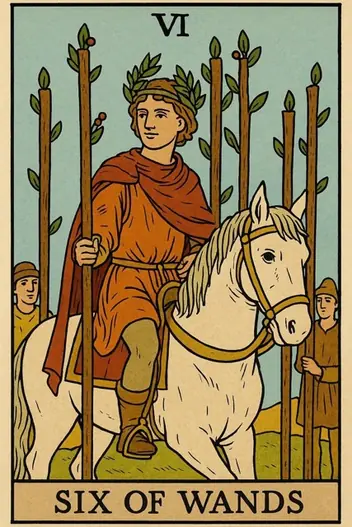

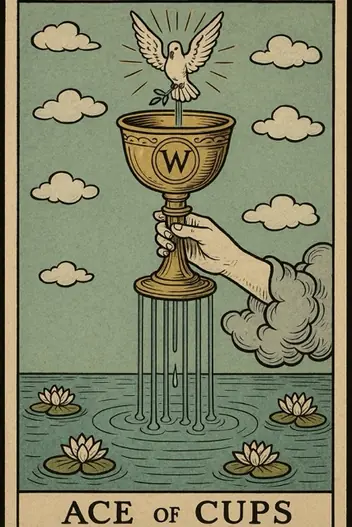
- Arcana
- Six of Wands — Minor Arcana, Wands; Ace of Cups — Minor Arcana, Cups
- Elements
- Six of Wands — Fire; Ace of Cups — Water
- Elemental interaction
- Opposing elements — energies create tension
- Numerology
- 6 + 1 = 7
The intersection of the Six of Wands and the Ace of Cups creates a powerful psychological state where public validation meets private emotional overflow. The Six of Wands represents a moment of recognition, victory, and the ego's satisfaction at being seen and celebrated. The Ace of Cups, by contrast, is the archetype of pure emotional potential—an overflowing vessel of love, compassion, and intuitive openness. When these two cards appear together, the core tension is clear: you are receiving external applause while simultaneously being asked to stay emotionally grounded and authentic. This combination demands that you manage the gap between how others perceive your success and how you truly feel inside.
Practically, this pairing suggests a period where your achievements are attracting positive attention, but the real work lies in not letting that recognition inflate your ego or disconnect you from your genuine emotional needs. The psychological insight here is about integration: the persona (the victorious self) must align with the shadow (the vulnerable, feeling self). If you bask only in the glory of the Six of Wands, you risk emotional burnout or a hollow victory. If you drown in the Ace of Cups without structure, you may miss the strategic benefits of your success. The key is to receive praise without letting it define your self-worth, and to channel your emotional openness into sustainable relationships and projects.
Core Dynamics & Interpretation
At the heart of the Six of Wands and Ace of Cups combination lies a dynamic of emotional validation versus external validation. The Six of Wands is a card of social proof—you have achieved something notable, and your community, peers, or authority figures are acknowledging it. This can trigger a cognitive bias known as the "spotlight effect," where you overestimate how much others are focused on your success. The Ace of Cups counterbalances this by urging you to turn inward and ask: Does this victory genuinely fill my emotional cup, or am I performing for applause?
The psychological state created by this merger is one of heightened sensitivity to feedback. You are likely feeling both euphoric and vulnerable—celebrated yet exposed. This is a fertile moment for emotional intelligence growth, but only if you resist the urge to let pride block vulnerability. The practical implication is clear: use the momentum of recognition to deepen authentic connections, not to accumulate superficial accolades. For example, after a public success, you might feel tempted to network aggressively, but this card pair advises you to instead reach out to one or two trusted allies and share your genuine feelings about the experience. This is a time for quality over quantity in both relationships and projects.
The shadow risk here is emotional inflation—believing that your external success makes you immune to ordinary human needs. You might neglect self-care, ignore relationship tensions, or assume that everyone's admiration means you are "above" criticism. The antidote is pragmatic self-reflection: schedule time alone to process your emotions, write down what you are genuinely grateful for (not just what looks good on social media), and ask yourself whether your current path aligns with your core values, not just your public image.
Career Meaning of Six of Wands and Ace of Cups
Strategic Opportunities:
Leverage your recent recognition to negotiate for more resources, time, or support. This is an ideal moment to ask for a raise, a promotion, or a budget increase for a project you care about.
Strategic Opportunities:
Mentor or delegate to solidify your legacy. Your success has given you credibility—use it to uplift others, which will also reduce your workload and prevent burnout.
Calculated Risks:
Avoid overextending yourself by accepting every speaking engagement, collaboration, or media request. Saying "no" is a strategic move that protects your emotional energy (Ace of Cups) from being drained by external demands (Six of Wands).
In your professional life, this combination signals a peak moment that requires careful management. The Six of Wands indicates you have achieved a milestone that others recognize—perhaps a successful launch, a promotion, or a high-profile project. The Ace of Cups warns you not to let this success become your identity. The psychological trap is "imposter syndrome in reverse": you may feel so validated that you stop improving, assuming you have "arrived." The strategic countermove is to immediately set a new learning goal. Ask yourself: What skill do I need to develop next to sustain this momentum?
Financially, this is a time of potential windfall, but also emotional spending. The Ace of Cups can manifest as a desire to celebrate by buying things or treating others—which is fine in moderation, but beware of using money to compensate for emotional insecurity. A common pitfall is spending on status symbols to maintain the "victory" image. Instead, invest in experiences or assets that support your long-term emotional well-being, such as a coaching program, a therapy session, or a retreat that helps you integrate this success. Bold financial warning: Do not lend money or make large financial commitments based on your current high. Wait until the emotional high stabilizes before signing any contracts.
Your pair is already on the table. Ask your question and draw the clarifying card
or simply focus on it
Six of Wands and Ace of Cups in Love Tarot
If you are single:
This combination suggests you may attract admirers precisely because of your recent success or confident demeanor. Be cautious—not everyone drawn to your glow has genuine intentions. Evaluate potential partners based on their interest in your inner life, not just your achievements. Look for someone who celebrates your wins but also asks how you feel about them.
If you are in a relationship:
The dynamic here is about shared recognition and emotional vulnerability. You or your partner may be receiving public acclaim, which can create a power imbalance. The key is to celebrate together without letting ego create distance. If you are the one in the spotlight, make a conscious effort to include your partner in the celebration. If your partner is the one being celebrated, support them without resentment.
The relationship dynamics under this card pair often revolve around managing pride and intimacy. When one partner is publicly recognized, the other may feel invisible or jealous—even if they are genuinely happy. This is a classic Jungian shadow issue: the unacknowledged need for recognition can create passive-aggressive behavior. The most effective strategy is to verbalize your feelings directly. For couples, schedule a "victory debrief" where you both share what the success means emotionally, not just logistically. Bold advice: If you feel a twinge of envy, name it. "I'm so proud of you, and I also feel a little left out. Can we plan something special for us?" This turns a potential conflict into a bonding moment.
For singles, the pragmatic warning is to avoid using your success as a filter. You might unconsciously expect admirers to match your "status," which can lead to shallow connections. Instead, use the Ace of Cups energy to lead with emotional availability. Ask yourself: Am I open to love, or am I just enjoying the chase? The best relationships born from this combination are those where you allow yourself to be seen in your vulnerability, not just your victory.
Get a personalized interpretation
Unlock the combined meaning of your cards in the context of your unique question — for free.
What Are the Risks of Six of Wands and Ace of Cups?
The shadow side of the Six of Wands and Ace of Cups combination is emotional narcissism—the belief that your feelings are more important than others' simply because you have achieved external success. This can manifest as overconfidence in relationships (assuming your partner will always support your ambitions) or tone-deafness in leadership (expecting your team to celebrate your win without acknowledging their contributions). The cognitive bias at play is the "self-serving bias" : you attribute your success to your own skill while ignoring external factors or others' help.
Another pitfall is emotional withdrawal under pressure. You might feel so overwhelmed by the attention that you shut down, refusing to accept praise or reciprocate emotional warmth. This is a defense mechanism against vulnerability, but it can alienate the very people who support you. The shadow here is fear of intimacy masked as humility. If you find yourself deflecting compliments or downplaying your achievements, ask yourself: Am I protecting myself from being seen, or am I genuinely uncomfortable?
Finally, watch for the "savior complex" —the Ace of Cups can tempt you to rescue others now that you have "made it." While generosity is admirable, taking on others' emotional burdens can drain your own cup. Set boundaries around your time and energy, especially if people are approaching you with requests for help. The most compassionate act is to help without losing yourself.
What If Six of Wands or Ace of Cups Appears Reversed?
When cards appear in a reversed position, the balance is disrupted, and the energy becomes dysfunctional.
If the Six of Wands is reversed:
This indicates blocked potential or recklessness. You may have enormous emotional potential (Ace of Cups upright), but receive no recognition. Your feelings and ideas go unnoticed, leading to frustration. Advice: stop seeking external approval. Your task is not to prove, but to do. Focus on the process, not the applause.
If the Ace of Cups is reversed:
Here, inner resistance or emotional weakness arises. You have achieved success (Six of Wands upright), but cannot enjoy it. A feeling of emptiness, depression, or fear that "this is undeserved." Warning: this is a direct path to burnout. You need not new success, but therapy or a deep pause to restore connection with your true desires.
If BOTH are reversed:
Complete imbalance. You simultaneously receive no recognition and feel no joy. This is a state of emotional and social collapse. The logical way to correct it: start small. Do not try to conquer the world or find great love. Return to basics: do one small thing well (Wands) and allow yourself one small joy without guilt (Cups). Rebuild the foundation.
What Is the Overall Message of Six of Wands and Ace of Cups?
Constructive use of this energy requires discipline. Your strategy is "The Victor with an Open Heart." The Six of Wands grants you willpower, ambition, and the ability to influence the world. The Ace of Cups gives you depth, empathy, and the capacity for intimacy. Your task is not to choose between them, but to learn how to switch between them.
How to do this? First, use success as fuel for emotional growth. Got a promotion? Invest part of the bonus in shared experiences with loved ones. Received recognition? Use your voice to support those just starting out. This transforms a static trophy into a dynamic resource.
Second, create a "grounding" ritual after every victory. Before moving on, stop and ask yourself three questions: "What am I truly feeling?", "Who am I grateful to for this success?", "How does this make my life more meaningful?" This isn't mysticism; it's a protocol for emotional intelligence.
Third, remember: the Ace of Cups is the beginning, and the Six of Wands is the middle of the journey. Do not rest on your laurels. Use the recognition and emotional uplift you've gained as a platform for the next, even deeper stage of your development. True victory is not the finish line, but the ability to continue the journey, feeling joy with every step.
Applying This to Your Situation
The Six of Wands and Ace of Cups combination ultimately asks you to bridge the gap between public victory and private fulfillment. Your success is real, but its lasting value depends on how well you integrate it into your emotional life. The core message is simple: celebrate authentically, connect genuinely, and protect your inner world from the noise of external applause.
This article provides the general archetype, but the true magic happens when Tarot is applied to your unique situation. Your specific question, your personal history, and the surrounding cards in your spread will reveal nuances that a general interpretation cannot capture. To get a deep, personalized interpretation of this exact combination for your specific question right now, use the Fortune Cards app. You can access it on the web or download it to receive a tailored reading that respects your context, your challenges, and your next best step.
Interpretation by the Fortune Cards editorial team, based on the Rider–Waite tradition and Jungian archetypes. About our methodology · Updated: 2026-08-26
Other Combinations with Six of Wands
Other Combinations with Ace of Cups
Explore Individual Card Meanings
Table of Contents
- Core Dynamics & Interpretation
- Career Meaning of Six of Wands and Ace of Cups
- Six of Wands and Ace of Cups in Love Tarot
- What Are the Risks of Six of Wands and Ace of Cups?
- What If Six of Wands or Ace of Cups Appears Reversed?
- What Is the Overall Message of Six of Wands and Ace of Cups?
- Applying This to Your Situation
Ready to find answers to your questions?
Start your first reading now and look at your situation with fresh clarity. The cards are ready to reveal deeper meaning.