Six of Wands and Eight of Swords Tarot Combination
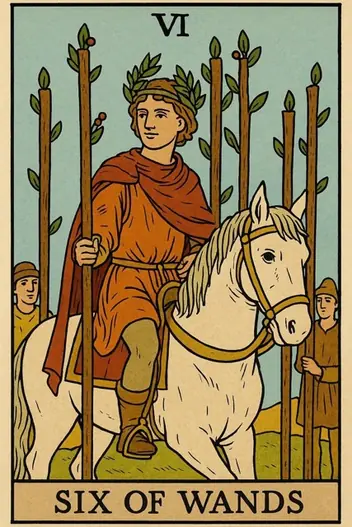

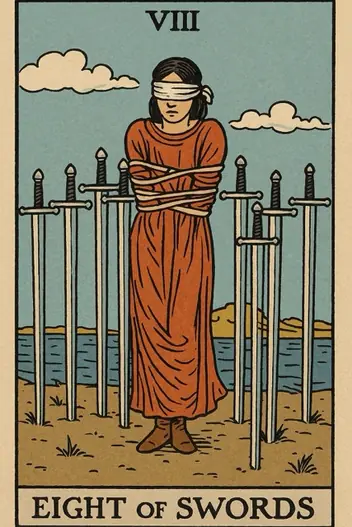
- Arcana
- Six of Wands — Minor Arcana, Wands; Eight of Swords — Minor Arcana, Swords
- Elements
- Six of Wands — Fire; Eight of Swords — Air
- Elemental interaction
- Friendly elements — energies support each other
- Numerology
- 6 + 8 = 14 → 5
The intersection of the Six of Wands—representing public recognition, triumph, and validation—with the Eight of Swords—symbolizing mental entrapment, self-imposed limitations, and perceived powerlessness—creates a paradoxical psychological state. You have achieved something tangible, yet your mind refuses to accept it. The crowd cheers, but you hear only your inner critic. This combination reveals a profound disconnect between external success and internal reality.
In pragmatic terms, this pairing often appears when a client has recently received a promotion, completed a major project, or been publicly acknowledged—yet feels trapped by imposter syndrome, fear of the next step, or the weight of expectations. The Six of Wands offers the evidence of competence; the Eight of Swords insists it’s a fluke. The core conflict is not between you and the world, but between your achievements and your self-concept.
Six of Wands and Eight of Swords Together: Meaning
The central psychological dynamic here is cognitive dissonance between objective success and subjective limitation. The Six of Wands provides clear, external proof of capability—awards, praise, or career advancement. The Eight of Swords, however, operates as a rigid mental schema that filters this evidence through a lens of inadequacy. The seeker may literally have the trophy in hand but feel like a fraud waiting to be exposed.
This combination often triggers a self-fulfilling prophecy of stagnation. The temporary high of victory (Six of Wands) is immediately undercut by the fear of maintaining that success (Eight of Swords). The mind creates blindfolds and binds itself with "what if" scenarios: What if I can't repeat this? What if they discover I'm not that good? The critical insight is that the bonds are self-tied. The swords in the ground represent past fears that have become rigid beliefs, not external obstacles.
From a Jungian perspective, this is a confrontation with the Shadow of the Ego. The Six of Wands inflates the Persona—the mask we show the world—while the Eight of Swords reveals the underlying insecurity the Persona was meant to hide. The path forward is not to seek more validation, but to integrate the fear into the success. Acknowledge the anxiety, but refuse to let it dictate your next move. The real battle is internal, not external.
Six of Wands and Eight of Swords Love Outcome
If you are single:
This pairing suggests you may be meeting people who are genuinely interested, but your own self-doubt is filtering out viable connections. You might reject someone because you assume they’ll eventually reject you.
If you are in a relationship:
One partner may be receiving praise or attention (from work, family, or social circles) while the other feels invisible or trapped in a comparison game. The dynamic is one of unspoken resentment and misaligned self-worth.
In relationships, the Six of Wands and Eight of Swords combination often points to a power imbalance masked by outward success. One partner may be thriving publicly—earning accolades, leading projects, or being the "star"—while the other feels mentally shackled, perhaps believing they are "not enough" to match that success. This is not a sign of incompatibility, but a warning about unspoken expectations.
The key relationship advice here is to verbalize the insecurity. The Eight of Swords thrives in silence. If you are the "successful" partner, actively reassure your partner that their worth is not contingent on your achievements. If you are the one feeling trapped, recognize that your partner’s success does not diminish your own value. The danger is that envy or inadequacy will create emotional distance. Practical action: Schedule a judgment-free conversation where each person shares one fear about the other’s success. Breaking the silence breaks the swords.
Your pair is already on the table. Ask your question and draw the clarifying card
or simply focus on it
Six of Wands and Eight of Swords for Career and Money
Strategic Opportunities:
Use your recent recognition as leverage for negotiation—ask for a raise, more resources, or a new role while your credibility is high.
Strategic Opportunities:
Delegate tasks that trigger your imposter syndrome to free up mental bandwidth for high-value work you know you excel at.
Calculated Risks:
Avoid taking on new responsibilities solely to prove yourself to others. This leads to burnout, not growth.
In a career context, this combination is a classic post-promotion or post-launch crisis. You have achieved a milestone (Six of Wands), but now face the "next-level anxiety" of the Eight of Swords. Your mind is flooded with thoughts about maintaining performance, managing new expectations, or fearing exposure as a fraud. Financially, this often leads to conservative, fear-based decisions—hoarding cash, avoiding investments, or turning down opportunities because you doubt your ability to execute.
The strategic move is to treat your success as data, not identity. Your promotion is evidence that your skills are needed at a higher level. Your win is proof that your strategy works. The financial warning here is clear: Do not let fear of losing what you have prevent you from building more. The Eight of Swords creates a scarcity mindset, but the Six of Wands proves abundance is possible. Actionable tip: Write down three specific achievements from the past six months. Next to each, write one concrete skill they required. Use this list as a decision-making tool, not a self-esteem booster.
Ask your specific question
Don't rely on generic meanings. Get a customized reading tailored specifically to your energies.
Negative Meaning of Six of Wands and Eight of Swords
The shadow manifestation of this pairing is toxic humility or performative self-doubt. The seeker may downplay their success to avoid the pressure of maintaining it, or they may unconsciously sabotage their next opportunity to "prove" their inner critic right. This is a form of cognitive self-sabotage: the mind creates a narrative of victimhood ("I'm trapped, I can't handle this") to avoid the responsibility that comes with success.
Another common pitfall is over-identification with the crowd's opinion. The Six of Wands can make a person dependent on external validation, while the Eight of Swords amplifies the fear of losing that approval. The result is a perfectionist paralysis—you stop taking risks because you're terrified of tarnishing your reputation. The shadow here is the belief that success must be maintained without error, which is psychologically unsustainable. The healthy alternative is to accept that success is a process, not a permanent state.
Six of Wands and Eight of Swords Reversed: How to Read It
If the Six of Wands is Reversed:
External recognition is blocked or absent. You may be working hard but receiving no feedback. In combination with the upright Eight of Swords, this intensifies feelings of isolation and helplessness. Warning: do not fall into the victim position. The absence of triumph is not confirmation of your worthlessness, but merely a signal to change your strategy or audience.
If the Eight of Swords is Reversed:
The limitations become conscious, but the person is not ready to remove them. This is a state of passive resistance — you know the problem is in your head, but you don't want to work with it. Paired with the upright Six of Wands, this looks like a refusal of success. Advice: acknowledge that your "I can't" is actually an "I don't want to." Find the benefit you derive from your powerlessness.
If BOTH are Reversed:
Complete imbalance. The person is in a state where there is neither external support nor internal resource. This is deep depression or an identity crisis. The logical way to correct this: start small. Forget about big success. Focus on one, the smallest, task that can be accomplished. Create a micro-victory (reversed Six of Wands) and use it to begin doubting your limitations. Don't try to remove all the blindfolds at once — remove just one.
Six of Wands and Eight of Swords: Tarot Advice
Constructive use of this combination requires a paradoxical approach: you must stop trying to defeat the Eight of Swords with the Six of Wands. You cannot "earn" or "deserve" inner freedom. External achievements do not heal internal wounds. The strategy must be reversed: use the energy of recognition and victory (Six of Wands) not to prove something to the world, but to create a safe space for exploring your limitations.
Your main strategic asset right now is the authority that grants you the right to vulnerability. You are strong and successful enough that you can afford to acknowledge your fear and insecurity. Do it. Say: "Yes, I achieved this, but I am afraid." This action will break the power of the Eight of Swords faster than any new victory. Take off the crown to see that the sword holding you back is merely a shadow.
Deep advice: replace the question "What am I afraid of?" with the question "What belief prevents me from enjoying what I already have?". The answer to this question is the true key. The Six of Wands has given you a platform. The Eight of Swords shows you exactly which belief you are standing on. Your task is not to jump higher, but to remove that shaky platform and build a new one, based on genuine self-esteem rather than external approval.
Where to Go From Here
The Six of Wands and Eight of Swords together deliver a clear message: You have already proven you can win. Now you must prove to yourself that you can handle the win. The victory is real; the prison is mental. Your next step is to separate objective reality from subjective fear, and to act despite the discomfort. The path forward requires courage, not more evidence.
Ready to see how this applies to your specific situation? Use the Fortune Cards app to get a personalized reading for this exact combination. The archetypes provide the map, but only your unique context—your relationship, career, or personal question—can reveal the path. Visit the web version or download the app now to receive a deep, tailored interpretation of the Six of Wands and Eight of Swords for your life, right now.
Interpretation by the Fortune Cards editorial team, based on the Rider–Waite tradition and Jungian archetypes. About our methodology · Updated: 2026-10-01
Other Combinations with Six of Wands
Other Combinations with Eight of Swords
Explore Individual Card Meanings
Table of Contents
- Six of Wands and Eight of Swords Together: Meaning
- Six of Wands and Eight of Swords Love Outcome
- Six of Wands and Eight of Swords for Career and Money
- Negative Meaning of Six of Wands and Eight of Swords
- Six of Wands and Eight of Swords Reversed: How to Read It
- Six of Wands and Eight of Swords: Tarot Advice
- Where to Go From Here
Ready to find answers to your questions?
Start your first reading now and look at your situation with fresh clarity. The cards are ready to reveal deeper meaning.