Temperance and Two of Pentacles Meaning in Tarot
- Arcana
- Temperance — Major Arcana; Two of Pentacles — Minor Arcana, Pentacles
- Elements
- Temperance — Fire; Two of Pentacles — Earth
- Elemental interaction
- Neutral elements — energies coexist without conflict
- Numerology
- 14 + 2 = 16 → 7
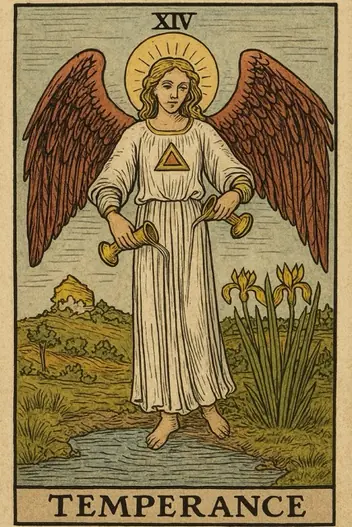
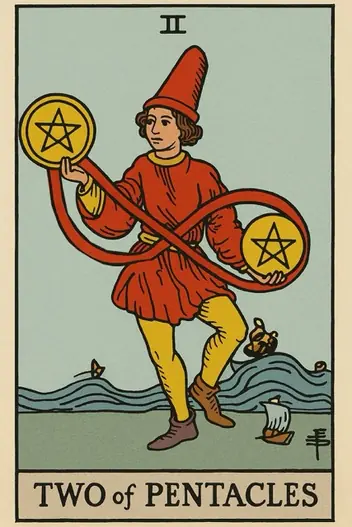
When the archetype of Temperance—the alchemist of patience and moderation—meets the Two of Pentacles—the juggler of competing priorities—you encounter a psychological state defined by dynamic equilibrium. This is not a static balance, but a continuous, conscious adjustment between opposing forces: work and rest, giving and receiving, structure and flexibility. In real life, this combination suggests a period where you must manage multiple demands without losing your center, requiring both emotional regulation and logistical agility.
Temperance and Two of Pentacles Together: Meaning
The core dynamic here is a pragmatic dance between inner harmony and outer chaos. Temperance represents the ego's capacity for synthesis—the ability to hold contradictions without becoming fragmented. The Two of Pentacles introduces the external pressures of time, money, and energy management. Together, they create a mindset where you are constantly recalibrating: you know the ideal path (Temperance's long-term vision), but you must navigate immediate, shifting demands (Two of Pentacles' daily juggling act). The psychological key is cognitive flexibility without emotional burnout. You are not avoiding stress; you are actively managing it through deliberate pacing. This pairing warns against perfectionism—you cannot achieve perfect balance, only optimal flow. The most important takeaway is that sustainable success requires rhythmic adaptation, not rigid control. When you master this, you turn potential overwhelm into a masterclass in resourcefulness.
Temperance and Two of Pentacles for Career and Money
Strategic Opportunities:
Delegation—identify tasks you can hand off to free up mental bandwidth for high-impact decisions.
Strategic Opportunities:
Time-blocking—create structured pockets of focus for different projects, mimicking the Two of Pentacles' juggling rhythm.
Calculated Risks:
Over-commitment—saying "yes" to every opportunity will lead to diminished quality across the board. Objectively assess your actual bandwidth before accepting new work.
In your professional life, this combination signals a need for strategic triage. You are likely juggling multiple revenue streams, deadlines, or roles. The Temperance energy urges you to avoid the hero complex—you cannot sustain all plates spinning indefinitely. Bold financial warning: do not take on debt to smooth over cash flow gaps caused by poor prioritization. Instead, focus on incremental progress in one area before expanding another. The Two of Pentacles reminds you that money and energy are cyclical—some months will be lean, others abundant. Create a buffer (savings, time reserves) to absorb shocks. For negotiations, seek win-win compromises that preserve long-term relationships. This is not a time for aggressive expansion, but for optimizing existing systems. Key strategic tip: automate repetitive financial tasks to reduce cognitive load.
Your pair is already on the table. Ask your question and draw the clarifying card
or simply focus on it
Temperance and Two of Pentacles in Love and Relationships
If you are single:
This combination suggests you are attracted to someone who appears stable but is managing their own chaos. Focus on observing their coping mechanisms rather than their charm. Pacing the relationship is key—avoid rushing into emotional intensity.
If you are in a relationship:
You and your partner are likely navigating a period of conflicting schedules or external demands. The core task is to negotiate shared priorities without resentment. Compromise is essential, but not at the cost of your core values.
In relationships, Temperance and Two of Pentacles highlight emotional regulation as a survival skill. You may feel pulled between your partner's needs and your own responsibilities. The danger is over-functioning—taking on too much to keep the peace, which leads to covert resentment. Healthy boundaries are not walls; they are adjustable gates. Focus on clear, non-defensive communication about what you can realistically offer. Bold advice: schedule regular check-ins to discuss energy levels and commitments. This prevents the slow erosion of intimacy caused by chronic busyness. If single, this pairing warns against romanticizing someone who is overwhelmed—you may be drawn to a "project" rather than a partner. Prioritize mutual emotional availability over potential.
When Temperance and Two of Pentacles Signal Trouble
The shadow of this pairing manifests as chronic indecision or passive-aggressive avoidance. You may intellectualize your overwhelm—endlessly analyzing options without committing to a course of action. This is a defense mechanism against the anxiety of making the wrong choice. Another pitfall is splitting—seeing situations as all-good or all-bad, which undermines Temperance's integrative power. Cognitive bias alert: the "sunk cost fallacy" may keep you in a draining situation because you've already invested significant time or emotion. Self-sabotage can appear as perfectionist procrastination: you delay starting because you can't achieve an ideal balance. The root cause is often fear of failure mixed with a desire for control. To counter this, accept that "good enough" is a legitimate strategy. Also, watch for emotional numbing—using busyness to avoid confronting deeper feelings of dissatisfaction. The shadow here is motion without direction.
Deepen your understanding
Find out exactly what this reading means for your current life situation with our oracle.
Temperance and Two of Pentacles Reversed: What Changes?
If Temperance is Reversed:
This indicates blocked potential or emotional intemperance. Instead of methodical balance, you act chaotically, impulsively, or conversely, get stuck in perfectionism. Advice: deliberately slow down. Your "flexibility" has turned into fussiness. Take a 24-hour pause before any important decision.
If the Two of Pentacles is Reversed:
This is a sign of internal resistance to change or an inability to adapt. You feel like the "balls are dropping," and instead of maneuvering, you try to hold everything together using old methods. Warning: this is a direct path to burnout. Delegate, let go of the non-essential, acknowledge that you cannot control everything.
If BOTH are Reversed:
This is total imbalance. The dynamic is broken. You are either frozen in fear of change (Reversed Temperance) or flailing in panic without a plan (Reversed Two of Pentacles). The logical way to correct this: return to basics. Identify one main goal (Temperance) and one single, simplest step to achieve it (Two of Pentacles). Ignore everything else.
Temperance and Two of Pentacles: Tarot Advice
The constructive use of this dynamic is the creation of a "flexible structure." Imagine your life as a river. Temperance is the riverbed that guides the flow, while the Two of Pentacles is the water itself, which bends around stones and finds new paths. Your task is not to build a dam (rigid control), but to deepen the riverbed (strengthen values and priorities), so that the flow (your activity) is powerful, yet not destructive.
The strategic advice: learn to distinguish between "essence" and "form." Temperance governs the essence (your principles, health, long-term goals). The Two of Pentacles governs the form (schedule, tools, methods of achievement). If the form stops working—change it, without touching the essence. If you feel you are drowning in tasks, ask yourself: "Which of these tasks is truly important for my long-term balance?"—and keep only that one. Your strength lies not in keeping all the balls in the air, but in knowing which ones are glass and which are plastic.
Your Next Step: Personal Context Matters
Temperance and Two of Pentacles together teach that true balance is not a destination, but a continuous process of adjustment. Your core task is to integrate patience with action, accepting that you will sometimes drop a ball—and that's acceptable. The key is learning which balls are glass and which are rubber. This combination rewards those who adapt without losing their ethical center.
While this article provides the general archetype, the true magic happens when Tarot is applied to your unique situation. To get a deep, personalized interpretation of this exact combination for your specific question right now, use the Fortune Cards app. Available on the web or as a download, it offers tailored insights that respect your context, helping you navigate your own balancing act with clarity and confidence.
Interpretation by the Fortune Cards editorial team, based on the Rider–Waite tradition and Jungian archetypes. About our methodology · Updated: 2026-08-26
Other Combinations with Temperance
Other Combinations with Two of Pentacles
Explore Individual Card Meanings
Table of Contents
- Temperance and Two of Pentacles Together: Meaning
- Temperance and Two of Pentacles for Career and Money
- Temperance and Two of Pentacles in Love and Relationships
- When Temperance and Two of Pentacles Signal Trouble
- Temperance and Two of Pentacles Reversed: What Changes?
- Temperance and Two of Pentacles: Tarot Advice
- Your Next Step: Personal Context Matters
Ready to find answers to your questions?
Start your first reading now and look at your situation with fresh clarity. The cards are ready to reveal deeper meaning.