Love Tarot: Ten of Cups and Seven of Swords
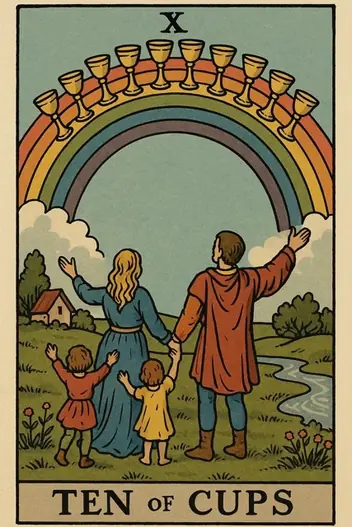

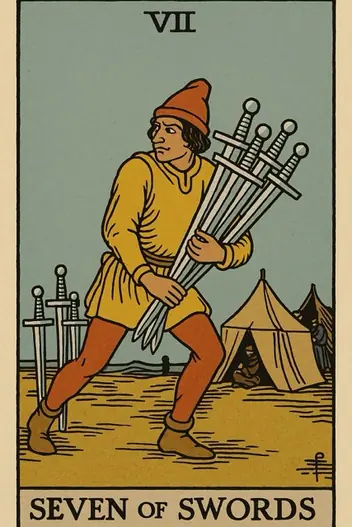
- Arcana
- Ten of Cups — Minor Arcana, Cups; Seven of Swords — Minor Arcana, Swords
- Elements
- Ten of Cups — Water; Seven of Swords — Air
- Elemental interaction
- Neutral elements — energies coexist without conflict
- Numerology
- 10 + 7 = 17 → 8
This card combination presents a fascinating psychological tension: the Ten of Cups represents emotional fulfillment, family harmony, and the archetype of the "happy ending," while the Seven of Swords embodies strategic withdrawal, deception, and the shadow of the trickster. When these two archetypes collide, the core question becomes: How do you protect a fragile emotional ideal without resorting to manipulation or self-betrayal? This is not about simple dishonesty; it is about the conflict between the desire for authentic connection and the perceived need for strategic self-preservation.
In real-world terms, you may be chasing a vision of perfect happiness—a stable home, a loving partnership, or a cohesive team—while simultaneously sensing that achieving this goal requires a certain amount of calculated maneuvering or keeping parts of yourself hidden. The challenge is to distinguish between healthy boundaries and outright deceit, and to recognize when your pursuit of a "perfect" outcome is actually undermining the very trust it requires.
Core Dynamics & Interpretation
The psychological state created by the Ten of Cups and Seven of Swords is one of cognitive dissonance. You are pulled between the archetype of the Nurturer (Ten of Cups) and the Trickster (Seven of Swords). On one hand, you deeply crave emotional security, belonging, and a sense of completion. On the other, you feel compelled to act with stealth, perhaps to avoid conflict, to protect a fragile situation, or to get what you think you deserve without facing direct opposition.
This combination often appears when someone is "faking it until they make it" regarding their emotional life. They may present a flawless, happy exterior—a perfect family photo on social media—while internally harboring secrets, resentments, or a plan to escape. The key insight here is that this strategy is unsustainable. The Seven of Swords energy, when used to protect the Ten of Cups dream, creates a psychological debt. The hidden actions or omissions will eventually surface, threatening the very harmony you sought to preserve.
The practical implication is a need for strategic honesty. The Seven of Swords is not inherently evil; it is about being clever and resourceful. The question is: are you using your intelligence to build the dream (e.g., discreetly saving money for a family goal) or to avoid the difficult conversations required to sustain it (e.g., hiding financial habits from a partner)? The most sophisticated move is to use your strategic mind to strengthen the foundation of your emotional life, not to build a house of cards.
What Do Ten of Cups and Seven of Swords Say About Love?
If you are single:
This pairing suggests you may be attracted to someone who seems perfect on the surface but who is either not fully available or is presenting a curated version of themselves. Your task is to look for consistency between words and actions, not just charming narratives.
If you are in a relationship:
You or your partner may be withholding information to "keep the peace" or to maintain an illusion of domestic bliss. This is a warning sign that unresolved issues are being swept under the rug.
In the context of a relationship, the Ten of Cups and Seven of Swords reveals a power dynamic rooted in hidden agendas. One partner may be playing a role—the perfect spouse, the happy homemaker—while secretly feeling trapped, resentful, or planning an exit. This is not about malicious cheating in every case; it can be as subtle as emotional withdrawal disguised as "being busy," or financial secrecy justified as "protecting the family."
The core psychological issue is a fear of vulnerability. The dream of the Ten of Cups is so precious that the person fears any direct confrontation will shatter it. The bold advice here is to choose courage over control. If you are the one hiding something, ask yourself: Is this secret protecting the relationship, or is it protecting my ego from a difficult conversation? If you suspect your partner is being evasive, focus on creating a safe space for truth, not on catching them in a lie. True emotional fulfillment cannot be built on a foundation of strategic omissions.
Your pair is already on the table. Ask your question and draw the clarifying card
or simply focus on it
Career Meaning of Ten of Cups and Seven of Swords
Strategic Opportunities:
Use your analytical skills to identify hidden inefficiencies within a team or project. You can fix problems quietly without creating public drama.
Strategic Opportunities:
This is an excellent time for discreet networking or making a strategic career move that others don't see coming.
Calculated Risks:
Avoid using deception to get a promotion or credit for someone else's work. The short-term gain will poison the long-term team harmony you need.
In a professional context, this combination points to a high-stakes negotiation or a project with conflicting loyalties. You may be working on a team that feels like a "work family" (Ten of Cups), but you suspect that not everyone has the same agenda (Seven of Swords). Your psychological task is to separate your emotional attachment to the "team culture" from the objective facts of the situation. Are you ignoring a colleague's unethical behavior because it would disrupt the happy office vibe?
Financially, this card pair warns against "robbing Peter to pay Paul" —using clever accounting or short-term fixes to maintain an illusion of financial stability. The bold financial warning is this: Do not take on debt to fund a lifestyle that projects an image of success you haven't actually earned. The Seven of Swords energy is best used for competitive analysis and strategic planning, not for falsifying reports or hiding losses. The most profitable strategy is to align your financial actions with your long-term vision of security, not with a temporary need for approval.
Deepen your understanding
Find out exactly what this reading means for your current life situation with our oracle.
What If Ten of Cups or Seven of Swords Appears Reversed?
If the Ten of Cups is reversed, the illusion itself collapses. You can no longer maintain the facade of the "ideal family" or "dream team." This is a painful yet liberating crisis. Advice: do not try to glue the broken cup back together—acknowledge that the foundation was false, and rebuild from scratch on a basis of honesty.
If the Seven of Swords is reversed, it points to inner resistance and weakness. You can neither fight openly nor resort to cunning. This is a state of paralysis: you know you are being deceived, but you are afraid to expose it. Bold advice: stop playing the victim. Your inaction is also a choice, one that destroys your future.
If BOTH cards are reversed, the imbalance reaches its peak. This is a total collapse of trust and a loss of bearings. You have simultaneously shattered your ideal and lost the capacity for defensive cunning. The logical way to correct this: a total pause. Cease all active actions and communications for 48 hours. Re-establish contact with reality through your body and simple facts (food, sleep, money in the account), then start from scratch, but with clear boundaries.
What Are the Risks of Ten of Cups and Seven of Swords?
When the energy of these cards is blocked or expressed irrationally, the shadow manifests as the "Nice Person" with a hidden agenda. This is the classic passive-aggressive dynamic: the person who smiles and agrees to maintain harmony (Ten of Cups) while secretly sabotaging, gossiping, or planning a quiet exit (Seven of Swords). The cognitive bias at play is optimism bias—the belief that you can maintain the deception indefinitely without consequences.
Another dangerous pitfall is gaslighting, either of yourself or others. You may convince yourself that your "little white lies" are justified because your ultimate goal is a happy family or a peaceful workplace. This is self-deception disguised as altruism. The shadow also includes scapegoating: projecting your own hidden insecurities or actions onto a partner or colleague to preserve your own image of being the "good one." The most destructive outcome is the slow erosion of trust—the very foundation of the Ten of Cups—because the Seven of Swords energy was used to protect a fantasy rather than build a reality.
Synthesis: Strategic Conclusion
Constructive use of this combination requires a high level of reflection. Your task is not to choose between peace and war, but to learn "ecological cunning." Use the energy of the Seven of Swords to protect your vulnerability (the Ten of Cups), not to attack. For example, in business: you can create an ideal service for a client while keeping your technological "kitchen" a secret from competitors.
Strategic advice: conduct an audit of your "sacred cows." Determine which values are non-negotiable for you (honesty, family, trust) and where you are willing to compromise. The clearer you make this distinction, the less internal conflict you will face. Clarity is your primary resource. When you know where your "red line" lies, you don't need to lie—you simply say "no" or walk away.
Deep conclusion: The Ten of Cups is not a static state of happiness, but a process of creating it. The Seven of Swords is not a vice, but a tool for survival. Combine them: build your happiness consciously, using intellect to overcome obstacles, but never sacrifice the foundation for the facade. True harmony is the result of honest dealings, not beautiful illusions.
Applying This to Your Situation
The core message of the Ten of Cups and Seven of Swords is a call for integrity in the pursuit of happiness. You have the intelligence to achieve your dreams, but you must examine the methods you are using. Are you building a genuine sanctuary, or are you decorating a prison cell? The path forward requires you to integrate your strategic mind with your emotional heart. Do not sacrifice truth for temporary peace.
This article provides a powerful map of these archetypes, but the true insight comes from applying them to your specific situation. To get a deeply personalized reading that considers your exact question, your current life circumstances, and the other cards in your spread, use the Fortune Cards app. Whether on the web or through the app, you can get a custom interpretation of this exact combination for your unique relationship, career, or personal challenge right now. Stop guessing—get your tailored answer today.
Interpretation by the Fortune Cards editorial team, based on the Rider–Waite tradition and Jungian archetypes. About our methodology · Updated: 2026-08-26
Other Combinations with Ten of Cups
Other Combinations with Seven of Swords
Explore Individual Card Meanings
Table of Contents
- Core Dynamics & Interpretation
- What Do Ten of Cups and Seven of Swords Say About Love?
- Career Meaning of Ten of Cups and Seven of Swords
- What If Ten of Cups or Seven of Swords Appears Reversed?
- What Are the Risks of Ten of Cups and Seven of Swords?
- Synthesis: Strategic Conclusion
- Applying This to Your Situation
Ready to find answers to your questions?
Start your first reading now and look at your situation with fresh clarity. The cards are ready to reveal deeper meaning.