Ten of Wands and Eight of Pentacles Reversed in Tarot
- Arcana
- Ten of Wands — Minor Arcana, Wands; Eight of Pentacles — Minor Arcana, Pentacles
- Elements
- Ten of Wands — Fire; Eight of Pentacles — Earth
- Elemental interaction
- Neutral elements — energies coexist without conflict
- Numerology
- 10 + 8 = 18 → 9
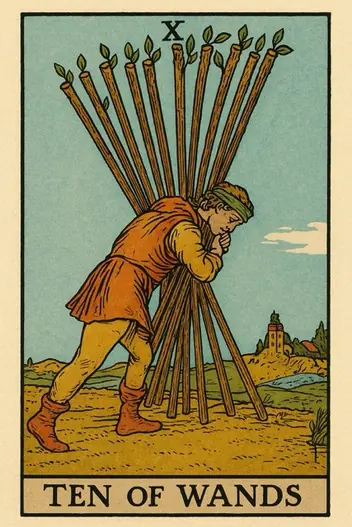
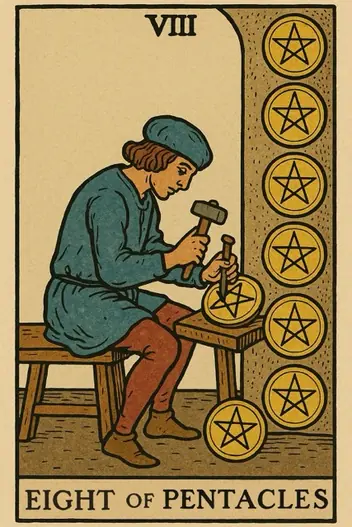
When the Ten of Wands meets the Eight of Pentacles, we witness a collision between overwhelming responsibility and meticulous craftsmanship. The Ten of Wands represents the heavy load of obligations, burnout, and the feeling of carrying more than one's fair share. The Eight of Pentacles, conversely, embodies focused skill development, disciplined practice, and the satisfaction of mastering a craft. Together, they depict a person who is working intensely hard—perhaps too hard—on tasks that may be unsustainable in the long run. This combination asks: Are you perfecting a process that is actually crushing you? Or are you shouldering burdens that could be lightened through strategic refinement?
Psychologically, this pairing activates the Archetype of the Diligent Servant—someone who equates self-worth with productivity. The Jungian shadow here is workaholism disguised as virtue, where the seeker mistakes exhaustion for progress. The pragmatic question becomes: How can you maintain high standards without sacrificing your well-being? The answer lies in distinguishing between necessary effort and compulsive overwork.
Ten of Wands and Eight of Pentacles: How These Energies Interact
The core dynamic of Ten of Wands and Eight of Pentacles is a high-stakes trade-off between volume and quality. The Eight of Pentacles urges you to focus, refine, and specialize—to become an expert in your domain. Yet the Ten of Wands warns that you may be taking on too many projects, clients, or responsibilities to sustain that level of precision. The result is a cognitive dissonance: you want to do excellent work, but the sheer weight of your commitments prevents it. This often leads to diminishing returns, where each additional hour of effort yields less and less value.
From a Jungian perspective, this combination activates the Puer Aeternus (eternal child) archetype in its shadow form—the part of you that says, "If I just work harder, I'll finally be enough." But the Ten of Wands is a reality check: more effort does not equal more worth. The Eight of Pentacles, when healthy, is about mastery through deliberate practice, not self-flagellation. The key insight is to audit your workload ruthlessly: identify which tasks truly require your highest skill and which are merely busywork you’ve accepted out of obligation.
Strategically, this pair demands a triage approach. List everything you are carrying. Ask: Does this task require my unique expertise (Eight of Pentacles), or could it be delegated, automated, or eliminated (Ten of Wands solution)? The psychological breakthrough comes when you realize that perfectionism on the wrong tasks is a form of avoidance—you're hiding from the bigger decision of what to drop.
Ten of Wands and Eight of Pentacles Love Outcome
If you are single:
This combination suggests you may be over-investing in a potential partner who is not reciprocating effort. You are doing the "work" of the relationship alone—analyzing, planning, and perfecting your approach—while they remain passive. Pause and evaluate the balance of energy.
If you are in a relationship:
You or your partner may be carrying the emotional or practical load of the partnership while the other focuses on their own growth. This creates resentment disguised as dedication. Explicitly discuss division of labor and emotional bandwidth.
In relationships, the Ten of Wands and Eight of Pentacles often signals a power imbalance disguised as devotion. One partner is the "craftsman"—constantly working on the relationship, improving communication, planning dates, or handling logistics—while the other partner may be coasting or unaware of the burden. This dynamic mirrors the Jungian Martyr complex: the over-functioning partner believes their suffering is noble, but it actually fosters codependence.
The psychological trap here is mistaking effort for intimacy. You might think that working hard on the relationship equals love, but the Eight of Pentacles reminds you that mastery requires rest, reflection, and sometimes stepping back. Bold advice: Schedule a "relationship audit" conversation. Use a timer to give each partner equal time to speak about what they are carrying. The goal is not to assign blame but to redistribute the wands so both can focus on their own growth without burnout.
For singles, this card pair warns against the "project partner" syndrome. You may be treating a new connection like a skill to master—analyzing their texts, perfecting your responses, and investing disproportionate energy. This is emotional labor without emotional return. Instead, focus on reciprocal energy from the start. A healthy relationship should feel like two craftspeople building together, not one carrying the other’s tools.
Your pair is already on the table. Ask your question and draw the clarifying card
or simply focus on it
Ten of Wands and Eight of Pentacles: Career and Money
Strategic Opportunities:
Systematize your workflow to reduce repetitive tasks. Use the Eight of Pentacles’ discipline to create templates, checklists, or automations that free up mental space.
Strategic Opportunities:
Specialize in a niche where your high effort yields premium results. Stop trying to be good at everything; be exceptional at one thing.
Calculated Risks:
Avoid taking on additional projects just because you can do them well. The Ten of Wands warns of scope creep that will dilute your mastery and damage your reputation.
In a career context, this combination is a red flag for burnout disguised as ambition. You may be the person everyone relies on—the one who says "yes" to extra work, who stays late to perfect details, who carries the team’s unfinished tasks. While the Eight of Pentacles rewards diligence, the Ten of Wands demands strategic boundaries. The psychological cost is decision fatigue and reduced cognitive capacity, which directly undermines the quality work you pride yourself on.
Financially, this pair suggests you are earning money through sheer effort rather than leverage. You are trading time for dollars, not building systems or assets. The Eight of Pentacles encourages skill development, but the Ten of Wands asks: Are you developing skills that will lead to higher hourly value or just more hours? Bold warning: If you are working overtime on low-margin tasks, you are actually losing money in terms of opportunity cost. Consider whether you can raise your rates, delegate lower-value work, or invest in tools that multiply your output.
Strategic advice:
Create a "Stop Doing" list alongside your to-do list. Identify three tasks that consume 80% of your time but generate only 20% of your results. Then apply the Eight of Pentacles’ focus to the remaining 20% that truly matters. This is not laziness; it is resource optimization.
Deepen your understanding
Find out exactly what this reading means for your current life situation with our oracle.
Ten of Wands and Eight of Pentacles Reversed: How to Read It
When cards appear in a reversed position, the dynamics become distorted, revealing deep-seated issues.
1. If the Ten of Wands is reversed:
This points to blocked potential. The person either refuses to take responsibility or, conversely, falls into recklessness, abruptly and chaotically shedding all obligations. Advice: Do not confuse liberation from a burden with escape from reality. You need not get rid of all tasks, but rather redistribute them wisely.
2. If the Eight of Pentacles is reversed:
This is a clear sign of internal resistance and weakness. The person avoids routine work, does not want to learn, or "cuts corners." This may be a consequence of burnout from overload (reversed Ten). Warning: Unfinished work accumulates and turns into an even greater burden.
3. If BOTH are reversed:
This is complete imbalance. You are dealing with a person who neither takes responsibility (reversed Ten) nor wants to learn (reversed Eight). This is a position of infantility and self-justification. Logical way to correct it: You must start small. Take on one, simplest task and see it through to completion. This will restore a sense of control and bring back motivation for work.
Negative Meaning of Ten of Wands and Eight of Pentacles
The shadow of Ten of Wands and Eight of Pentacles is perfectionistic burnout—a state where you become so obsessed with doing things "right" that you lose sight of why you are doing them at all. Jung would identify this as inflation of the Work Ethic archetype, where the seeker’s identity becomes synonymous with their output. The cognitive bias at play is the sunk cost fallacy: you keep investing effort because you’ve already invested so much, even when the return is negative.
Self-sabotage manifests as over-preparation. You may spend hours refining a presentation that no one will notice, or re-checking emails that were already fine. This is a defense mechanism against the anxiety of imperfection. The Jungian shadow work here involves asking: “What am I avoiding by staying busy?” Often, the answer is a fear of inadequacy, rejection, or the unknown. The Ten of Wands’ burden is not just physical—it is emotional baggage you carry to justify your existence.
Poor judgment appears when you refuse to delegate. You may believe that "no one else can do it as well," which is both arrogant and self-limiting. This mindset blocks collaboration and prevents others from growing. In relationships, this leads to resentment; in careers, it leads to plateaued growth. The shadow warning is clear: If you cannot let go of some wands, you will eventually drop all of them.
Ten of Wands and Eight of Pentacles: The Combined Message
To constructively harness the energy of this pair, it is necessary to apply the Eight of Pentacles to the Ten of Wands itself. Instead of carrying the burden as it is, begin to "refine" the process of carrying it. Conduct an audit of your commitments. Ask yourself three questions: 1) What am I doing out of habit? 2) What can be delegated without loss of quality? 3) What would happen if I stopped doing this?
The Eight of Pentacles is a card of craft, not sacrifice. Your task is to transform the burden into professionalism. This means you must stop being a "beast of burden" and become a "master managing their workshop." The strategic advice: focus on one task that will yield the maximum result and perfect it. Renounce everything else.
The deep meaning of this combination lies in the transition from quantity to quality. The Ten of Wands says: "I carry much." The Eight of Pentacles replies: "Carry less, but do it better." Your clarity will come not from doing more, but from ceasing to do the superfluous. Make a decision: your value lies not in the volume of work, but in the depth of your mastery.
Your Next Step: Personal Context Matters
The core message of Ten of Wands and Eight of Pentacles is a call to work smarter, not just harder. You have the discipline to master your craft, but you must also have the courage to set boundaries. The psychological balance lies in honoring your ambition without sacrificing your well-being. Refuse to be a martyr for productivity. Instead, become a strategist who knows when to lean in and when to step back.
While this article illuminates the general archetype, the true power of Tarot lies in its application to your unique situation. The subtle nuances—your specific question, your emotional state, the surrounding cards—can dramatically shift the interpretation. That is why I encourage you to use the Fortune Cards app. Whether on the web or downloaded to your device, it provides a deep, personalized reading of this exact combination tailored to your question right now. Get the clarity you need to transform burden into mastery.
Interpretation by the Fortune Cards editorial team, based on the Rider–Waite tradition and Jungian archetypes. About our methodology · Updated: 2026-10-15
Other Combinations with Ten of Wands
Other Combinations with Eight of Pentacles
Explore Individual Card Meanings
Table of Contents
- Ten of Wands and Eight of Pentacles: How These Energies Interact
- Ten of Wands and Eight of Pentacles Love Outcome
- Ten of Wands and Eight of Pentacles: Career and Money
- Ten of Wands and Eight of Pentacles Reversed: How to Read It
- Negative Meaning of Ten of Wands and Eight of Pentacles
- Ten of Wands and Eight of Pentacles: The Combined Message
- Your Next Step: Personal Context Matters
Ready to find answers to your questions?
Start your first reading now and look at your situation with fresh clarity. The cards are ready to reveal deeper meaning.