Ten of Wands and Knight of Cups Reversed in Tarot
- Arcana
- Ten of Wands — Minor Arcana, Wands; Knight of Cups — Minor Arcana, Cups
- Elements
- Ten of Wands — Fire; Knight of Cups — Water
- Elemental interaction
- Opposing elements — energies create tension
- Numerology
- 10 + 12 = 22 → 4
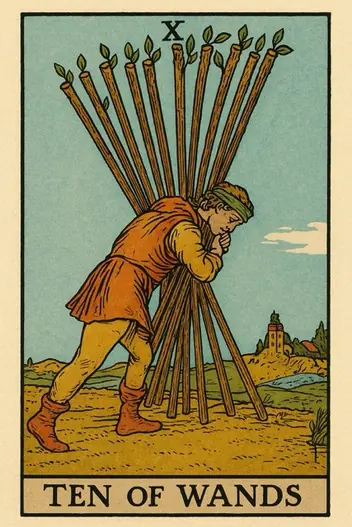
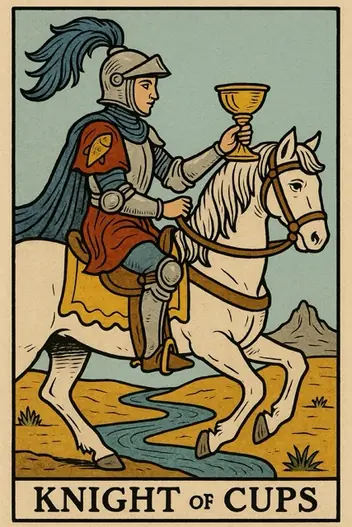
When the Ten of Wands—the card of overwork, responsibility, and crushing burden—collides with the Knight of Cups—the archetype of romantic idealism, emotional pursuit, and creative vision—we witness a profound psychological tension. This pairing represents the moment when your heart’s deepest desires are weighed down by the sheer logistics of making them real. You may feel called to chase a dream, yet find yourself paralyzed by the obligations already on your plate.
The core conflict here is between emotional inspiration and practical exhaustion. The Knight of Cups wants to ride toward a vision, but the Ten of Wands reminds you that you are already carrying ten heavy loads. In Jungian terms, this is the tension between the feeling function (valuing, connecting, pursuing meaning) and the sensation function (managing reality, dealing with limits, enduring strain). The key insight: this combination does not ask you to abandon your dreams, but to strategically reorganize your burdens before you move forward.
Ten of Wands and Knight of Cups: How These Energies Interact
Psychologically, this pairing creates a state of cognitive dissonance: your heart says “go,” but your body says “stop.” The Knight of Cups represents the puer aeternus—the eternal youth who pursues ideals without fully accounting for practical constraints. The Ten of Wands is the senex—the disciplined, overburdened archetype that has taken on too much. When these collide, the seeker risks either burning out by forcing the dream through sheer will, or abandoning the dream entirely out of resentment.
The strategic implication is clear: you must lighten your load before you can ride toward your vision. This does not mean giving up on what matters—it means auditing your current responsibilities. Ask yourself: which of these “ten wands” are truly yours to carry? Which are obligations you have accepted out of guilt, fear, or habit? The Knight of Cups offers emotional intelligence as a tool: use your feelings as a compass to identify which burdens are aligned with your authentic path, and which are dead weight.
In practical terms, this combination often appears when someone is overcommitted at work or in relationships, yet still feels a pull toward a creative or romantic pursuit. The danger is splitting your energy so thin that nothing gets your full attention. The solution is ruthless prioritization: delegate, delay, or delete tasks that do not serve your core vision. Remember, the Knight of Cups does not ride with a heavy pack—he travels light, fueled by passion.
Ten of Wands and Knight of Cups Love Outcome
If you are single:
This pairing suggests you may be attracted to emotionally intense or idealistic partners, but you are too exhausted from other life demands to properly evaluate the connection. Pause before committing. Your judgment is clouded by the desire for escape, not genuine compatibility.
If you are in a relationship:
You or your partner may be carrying an unequal share of emotional or practical burdens. The Knight of Cups energy wants romance and connection, but the Ten of Wands energy is too tired to engage. This creates resentment and withdrawal.
In relationships, this combination often signals a power imbalance in emotional labor. One partner feels like they are doing all the heavy lifting—managing finances, household chores, or family logistics—while the other yearns for spontaneity, romance, and deep conversation. The result is a cycle of guilt and disappointment: the burdened partner feels unappreciated, while the idealistic partner feels neglected.
The key relationship advice here is to schedule intentional quality time—but only after you have openly discussed and rebalanced responsibilities. Use the Knight of Cups’ emotional sensitivity to communicate your needs without blame. Say: “I want to connect with you, but I am overwhelmed right now. Can we agree on how to share the load so we both have energy for each other?” This turns the tension into a collaborative problem-solving opportunity, not a battleground.
Your pair is already on the table. Ask your question and draw the clarifying card
or simply focus on it
Ten of Wands and Knight of Cups in Career Readings
Strategic Opportunities:
Delegate or automate low-priority tasks to free up mental space for creative projects that align with your long-term vision.
Strategic Opportunities:
Use your emotional intelligence to negotiate better terms—ask for a deadline extension, additional resources, or a reduced workload to pursue a passion initiative.
Calculated Risks:
Avoid taking on new commitments until you have cleared at least three of your current “wands.” Do not say yes to a new role, client, or project out of idealistic excitement.
In the professional realm, this combination warns against the “hero complex” —believing you must do everything yourself to achieve your vision. The Knight of Cups wants to create something meaningful, but the Ten of Wands insists you are the only one who can do it. This is a cognitive bias known as over-valuation of effort: we mistakenly equate hard work with effectiveness.
A critical financial warning: do not invest money or resources into a new venture while you are still carrying unsustainable debt or obligations. The Knight of Cups can be impulsive with spending on “dreams” (courses, equipment, travel), while the Ten of Wands reminds you of the bills. Instead, create a phased plan: reduce your current load by 20% first, then allocate that freed-up energy and budget to the new pursuit. This is strategic patience, not abandonment of ambition.
Ask your specific question
Don't rely on generic meanings. Get a customized reading tailored specifically to your energies.
Ten of Wands and Knight of Cups Reversed: How to Read It
When cards appear in a reversed position, the dynamic becomes distorted, but more predictable for analysis.
If the Ten of Wands is reversed:
This indicates blocked potential and recklessness. The person has either thrown off all obligations (quit a job, left a relationship) but doesn't know what to do next. Or they refuse to acknowledge their stress, leading to psychosomatic issues. Advice: Don't confuse liberation with escape. Before making a rash decision, make sure you have a Plan B.
If the Knight of Cups is reversed:
This is internal resistance and emotional weakness. A romantic impulse turns into passive aggression or jealousy. Instead of offering help, the person takes offense and withdraws into themselves. Advice: Work on your self-esteem. Your inability to take initiative destroys relationships faster than any argument.
If BOTH are reversed:
Complete imbalance. This is a "victim" and "tyrant" scenario. The person feels overwhelmed (Wands), but instead of asking for help, they manipulate with guilt (Cups). Logical way to correct it: A strict time-out and separation. You need to physically distance yourself from the source of stress to understand where your real desires end and imposed obligations begin.
The Shadow Side of Ten of Wands and Knight of Cups
The shadow of this combination manifests as martyrdom or passive-aggression. The seeker may complain about their burdens while secretly refusing to let go of any of them—because the suffering itself has become a source of identity or moral superiority. The Knight of Cups then becomes a fantasy escape rather than a real pursuit: you daydream about a perfect relationship or career change, but take no concrete action because you are too exhausted to try.
Another pitfall is emotional manipulation: the Knight of Cups can use charm and idealism to guilt the Ten of Wands person into taking on even more. For example, a partner might say, “If you really loved me, you’d make time for romance,” ignoring the fact that the other person is already overwhelmed. Recognize when your idealism is being weaponized against your own boundaries.
The deepest shadow is burnout disguised as dedication. You may tell yourself you are “following your heart” (Knight of Cups) by working 80-hour weeks on a passion project (Ten of Wands). But this is not sustainable—it is self-destruction. The cognitive bias here is the sunk cost fallacy: you have invested so much that you cannot see the need to stop and reorganize. The real act of courage is not to push harder, but to set down what no longer serves you.
Overall Meaning of Ten of Wands and Knight of Cups
To constructively harness the energy of this pair, you must transform the Knight of Cups from an "escapist" into a "diplomat", and the Ten of Wands from a "burden" into a "structure". Your strategic task is to channel the Knight's emotional intelligence toward solving the problems created by the Ten. Do not dream of shedding the load—dream of reorganizing it.
The first step is a resource audit. Take a sheet of paper and divide it into two columns. In the first (Ten of Wands), write down all your current obligations. In the second (Knight of Cups), list your emotional needs (recognition, rest, creativity, romance). Now, find the point of intersection. For example: "I must submit a report (Wands), and I need to feel valued (Cups)." Solution: ask for feedback from your supervisor before submitting the report to gain recognition in advance.
The second step is delegation through inspiration. The Knight of Cups' energy is the energy of persuasion. Use it to inspire others to take on part of your load. Do not ask for help from a victim position ("I'm tired, help me"), but rather offer participation in an interesting project. Turn routine into a quest. This is the only way to balance these two archetypes without falling into burnout or illusions.
Your Next Step: Personal Context Matters
The Ten of Wands and Knight of Cups combination ultimately asks you to balance your emotional aspirations with practical sustainability. You do not have to choose between your dreams and your responsibilities—but you must strategically reduce your load before you can ride toward what matters. The core message is one of prioritization, not sacrifice: use your heart as a compass, but let your head handle the logistics.
To truly understand how this archetype applies to your specific situation, you need a reading tailored to your unique question. While this article provides the general psychological framework, the real power of Tarot lies in personal context.
Use the Fortune Cards app now to get a deep, personalized interpretation of this exact combination for your specific love, career, or life question. The app analyzes your unique situation and delivers actionable insights you cannot get from generic descriptions. Try it on the web or download it today—your next step is just a click away.
Interpretation by the Fortune Cards editorial team, based on the Rider–Waite tradition and Jungian archetypes. About our methodology · Updated: 2026-08-26
Other Combinations with Ten of Wands
Other Combinations with Knight of Cups
Explore Individual Card Meanings
Table of Contents
- Ten of Wands and Knight of Cups: How These Energies Interact
- Ten of Wands and Knight of Cups Love Outcome
- Ten of Wands and Knight of Cups in Career Readings
- Ten of Wands and Knight of Cups Reversed: How to Read It
- The Shadow Side of Ten of Wands and Knight of Cups
- Overall Meaning of Ten of Wands and Knight of Cups
- Your Next Step: Personal Context Matters
Ready to find answers to your questions?
Start your first reading now and look at your situation with fresh clarity. The cards are ready to reveal deeper meaning.