Ten of Wands and Ten of Cups Tarot Combination
- Arcana
- Ten of Wands — Minor Arcana, Wands; Ten of Cups — Minor Arcana, Cups
- Elements
- Ten of Wands — Fire; Ten of Cups — Water
- Elemental interaction
- Opposing elements — energies create tension
- Numerology
- 10 + 10 = 20 → 2
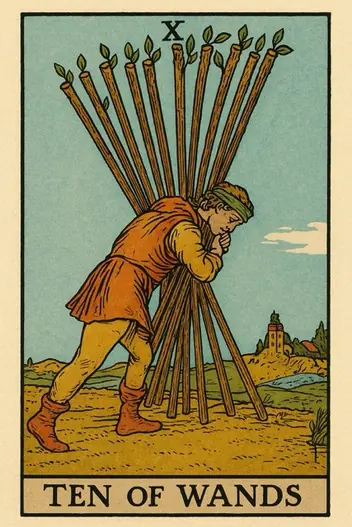
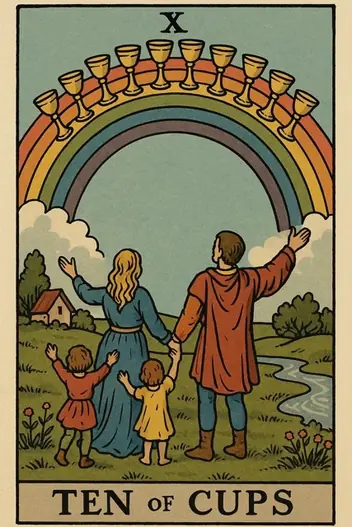
What happens when the heavy weight of responsibility meets the promise of emotional fulfillment? The Ten of Wands represents the end of a cycle of hard work, burden, and perseverance, while the Ten of Cups signifies the culmination of emotional harmony, family bliss, and deep satisfaction. Together, these cards create a powerful tension: you are carrying a massive load because you believe it will lead to a happy ending. The key psychological question here is whether the cost of your labor is worth the reward, or whether you are sacrificing your present peace for a future that may not arrive.
Ten of Wands and Ten of Cups: How These Energies Interact
The core dynamic of this pairing is a cost-benefit analysis of emotional labor. The Ten of Wands archetype embodies the Self-Sacrificing Martyr—the part of you that feels compelled to shoulder every task, obligation, and stressor to maintain stability. The Ten of Cups archetype, conversely, represents the Fulfilled Nurturer—the vision of a harmonious home, a loving relationship, and emotional security. When combined, the seeker often believes that only through extreme effort and sacrifice can they achieve lasting happiness.
This mindset creates a dangerous feedback loop. The more you work to secure emotional happiness, the more exhausted you become, which paradoxically erodes your capacity to enjoy the very happiness you seek. Psychologically, this is a classic burnout pattern disguised as duty. The strategic insight here is to ask: which of your current burdens are actually necessary for your long-term joy, and which are compulsive obligations you have taken on out of guilt or fear? The Ten of Wands warns that you cannot pour from an empty cup, and the Ten of Cups reminds you that the goal is to live in the joy, not just earn it.
Ten of Wands and Ten of Cups in Love and Relationships
If you are single:
This combination suggests you may be attracted to partners who present themselves as "projects" or who require significant emotional labor. Be wary of confusing intensity with intimacy. Ask yourself if the potential reward of a relationship justifies the heavy emotional investment you are already contemplating.
If you are in a relationship:
You are likely the primary "fixer" or "organizer" in the partnership. A significant power imbalance exists where you carry the emotional and practical weight while your partner reaps the benefits. This is unsustainable.
In relationships, the Ten of Wands and Ten of Cups reveal a dynamic where one partner acts as the Emotional Manager while the other enjoys the Emotional Dividend. The burdened partner may feel resentful, yet unable to stop, because they fear that dropping any responsibility will shatter the family or relationship harmony promised by the Ten of Cups. The critical intervention here is boundary negotiation. You must distinguish between shared responsibilities that build a healthy relationship and assumed burdens that you took on from a sense of duty. True emotional fulfillment (Ten of Cups) cannot exist where one partner is chronically overextended. Practical steps include scheduling a weekly "check-in" to redistribute tasks, and learning to say "no" to requests that compromise your well-being.
Your pair is already on the table. Ask your question and draw the clarifying card
or simply focus on it
Ten of Wands and Ten of Cups for Career and Money
Strategic Opportunities:
The completion of a major project or long-term obligation is imminent. Your hard work is about to pay off in a tangible way that provides lasting stability. Use this momentum to negotiate for a promotion or better terms.
Strategic Opportunities:
Your reputation as a reliable, hard-working professional is your greatest asset. Leverage this to delegate more effectively. You have earned the right to ask for help.
Calculated Risks:
Beware of the "Golden Handcuffs" trap. Do not accept a high-stress role solely for the promise of future financial security. The burnout will negate the reward.
Professionally, this pair signals a crossroads between output and outcome. The Ten of Wands suggests you are at the peak of a labor-intensive cycle—perhaps a product launch, a tax season, or a major project deadline. The Ten of Cups indicates that the result will bring significant emotional and financial satisfaction, such as a team celebration, a bonus, or a sense of shared success. However, the cards caution against over-identifying with the workload. The most pragmatic financial advice here is to audit your time allocation. Are you spending 80% of your energy on tasks that produce only 20% of your happiness or income? If so, it is time to automate, outsource, or eliminate the low-value burdens. Do not let the fear of losing the "perfect ending" (Ten of Cups) keep you in a role that is slowly destroying your health.
Ask your specific question
Don't rely on generic meanings. Get a customized reading tailored specifically to your energies.
Ten of Wands and Ten of Cups Reversed Meaning
When cards appear in a reversed position, the dynamic becomes distorted, but also more diagnostic.
If the Ten of Wands is reversed:
The classic burden has been cast off, but not in an eco-friendly way. This can signify blocked potential — you abandoned responsibility before reaching the finish line, or recklessness — you shed the load so abruptly that you destroyed everything you built. Advice: analyze whether your "liberation" is actually an escape from commitment. True lightness comes after completion, not after surrender.
If the Ten of Cups is reversed:
Internal resistance to happiness. You have achieved success, but you do not allow yourself to feel joy. You sabotage moments of intimacy, find flaws in an ideal partner, or believe you "don't deserve" peace. This points to a deep psychological wound or a belief that "happiness is dangerous." Advice: begin a practice of gratitude. Each day, write down three specific things you already have. This reprograms the brain to accept joy.
If BOTH are reversed:
Complete imbalance in dynamics. You simultaneously feel exhausted (Wands) and emotionally drained (Cups). This is a state of apathy and learned helplessness. The logical way to correct this: a complete stop. You need a "digital detox" from all obligations. Before building new happiness, you must acknowledge your powerlessness in the current situation and allow yourself to do nothing. Only after restoring a basic level of energy can you take on responsibility anew and open yourself to feelings.
When Ten of Wands and Ten of Cups Signal Trouble
The shadow manifestation of this combination is Resentful Martyrdom. You may find yourself performing acts of service or taking on extra work while secretly hoping others will notice and reward you. When they do not, you feel bitter. This is a classic cognitive bias known as the "Effort Justification" —you overvalue the outcome because you have invested so much effort into it, even if the outcome is not actually worth it. Another pitfall is Emotional Hoarding: you may cling to a relationship or job that is "good enough" on paper (Ten of Cups ideal) because you are too exhausted to imagine a different path. The shadow warns that you are trading your autonomy for a sense of false security. If you are feeling resentful, ask yourself: Am I doing this out of love, or out of obligation? If the answer is obligation, you are in the shadow.
Ten of Wands and Ten of Cups: Tarot Advice
Constructive use of this pair's energy requires a fundamental paradigm shift: happiness is not a reward for suffering, but the result of competent resource management. The Ten of Wands is not a curse, but a tool. It grants you endurance and determination, but you must use it in measured doses. Your strategic task is not to drop the "wands," but to learn to carry them so they don't weigh on your shoulders, but rest in your hands as tools for building your "Cup."
The profound strategic advice lies in the principle of "conscious sacrifice." Before taking on a new burden, ask yourself: "Which specific aspect of my happiness (time with family, health, hobbies) am I willing to sacrifice for this goal? And is this goal worth that sacrifice?" If the answer is "yes," then proceed, but establish clear time limits for that sacrifice. For example: "I will work 14 hours a day for three months to launch the project, but afterward, I will take two full weeks of complete rest without guilt." This transforms chaotic burnout into a disciplined sprint toward a clearly defined goal.
Remember: The Ten of Cups is not a card of the future, but a card of the present. It indicates that everything necessary for happiness is already within your grasp. Your task is not to obtain this happiness through blood and sweat, but to notice it and protect it from your own perfectionism. The true wisdom of this combination lies in the ability to stop in time and say: "This is enough. I have done enough. I can be happy right now."
Your Next Step: Personal Context Matters
The Ten of Wands and Ten of Cups together deliver a clear message: your hard work is nearing its completion, and emotional fulfillment is within reach—but only if you stop carrying what is not yours. The path forward requires strategic delegation, honest communication about your limits, and the courage to prioritize your own well-being over the illusion of perfect harmony. Remember, the Ten of Cups is about shared joy, not sacrificed joy.
Ready to see exactly how this plays out in your life? While this article reveals the universal archetype, the true power of Tarot lies in its application to your specific question. The Fortune Cards app provides a deep, personalized reading for this exact combination, tailored to your relationship status, career challenges, or personal growth goals. You can use the app directly on the web or download it to get an instant, insightful interpretation of the Ten of Wands and Ten of Cups for your unique situation—right now.
Interpretation by the Fortune Cards editorial team, based on the Rider–Waite tradition and Jungian archetypes. About our methodology · Updated: 2026-08-26
Other Combinations with Ten of Wands
Other Combinations with Ten of Cups
Explore Individual Card Meanings
Table of Contents
- Ten of Wands and Ten of Cups: How These Energies Interact
- Ten of Wands and Ten of Cups in Love and Relationships
- Ten of Wands and Ten of Cups for Career and Money
- Ten of Wands and Ten of Cups Reversed Meaning
- When Ten of Wands and Ten of Cups Signal Trouble
- Ten of Wands and Ten of Cups: Tarot Advice
- Your Next Step: Personal Context Matters
Ready to find answers to your questions?
Start your first reading now and look at your situation with fresh clarity. The cards are ready to reveal deeper meaning.