The Hierophant and King of Swords Meaning in Tarot
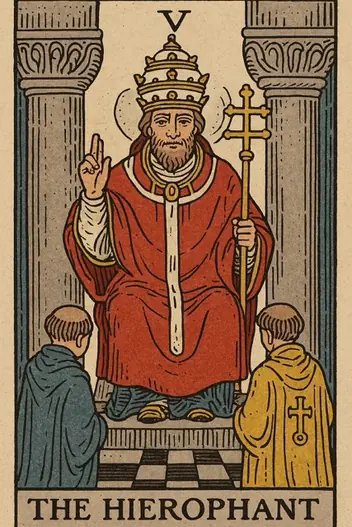
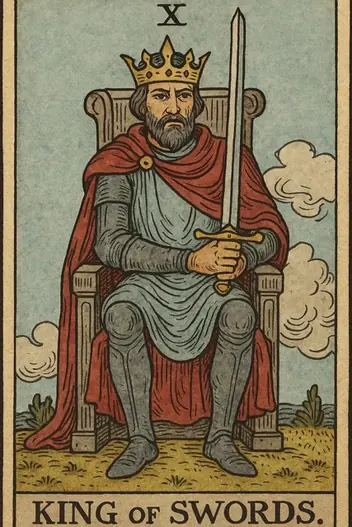
- Arcana
- The Hierophant — Major Arcana; King of Swords — Minor Arcana, Swords
- Elements
- The Hierophant — Earth; King of Swords — Air
- Elemental interaction
- Opposing elements — energies create tension
- Numerology
- 5 + 14 = 19 → 1
When The Hierophant—the guardian of tradition, structure, and established knowledge—collides with The King of Swords—the master of logic, truth, and decisive action—you get a formidable archetype: the strategic institutionalist. This is the energy of a seasoned judge, a disciplined CEO, or a scholar who wields facts like a scalpel. It represents a person or a situation where emotional expression is secondary to objective truth and where systems are respected, but only so long as they can be rationally justified.
Psychologically, this combination signals a fusion of collective wisdom and individual intellect. You are not rebelling against the system; you are learning to master it from within. The Hierophant provides the framework, while the King of Swords provides the analysis. The danger lies in becoming rigid or overly critical, mistaking your own logic for universal law. The pragmatic task is to use established structures (like contracts, protocols, or traditions) as tools for achieving clarity, not as cages for creativity.
The Hierophant and King of Swords Together: Meaning
The core dynamic of The Hierophant and King of Swords is the tension between conformity and intellectual sovereignty. The Hierophant demands adherence to external standards—social norms, ethical codes, or religious doctrine. The King of Swords, however, demands that those standards pass the test of cold, hard reason. When these two energies work in harmony, you become a trusted authority figure: someone who upholds tradition not out of blind faith, but because you have analyzed its value and found it to be strategically sound.
In practical terms, this pairing creates a highly disciplined mental state. You are likely to be focused on due diligence, verification, and structured learning. You may feel a strong pull towards mentorship, teaching, or legal matters. The key psychological insight here is that your judgment is sharpest when you combine the Hierophant's respect for precedent with the King's ruthless objectivity. Avoid the trap of intellectual arrogance—your logic is powerful, but it must be grounded in the real-world systems you operate within.
This energy is excellent for planning long-term strategies, reviewing contracts, or making decisions that require both ethical consideration and factual precision. However, it can be toxic for spontaneity or emotional bonding if you refuse to step out of the analytical role.
The Hierophant and King of Swords in Love and Relationships
If you are single:
This combination suggests you are likely evaluating potential partners through a highly rational filter. You may be drawn to someone who is established, intelligent, and socially conventional. Be cautious about dismissing genuine emotional connection as "irrational."
If you are in a relationship:
You and your partner may be operating as a power couple, but with a potential for coldness. The dynamic is one of mutual respect for competence, but you must guard against turning the relationship into a series of negotiations or performance reviews.
In love, The Hierophant and King of Swords can indicate a relationship that is built on shared values and clear communication, but risks becoming emotionally sterile. You may find that you and your partner resolve conflicts through logic and debate rather than empathy, which can be effective for practical issues but damaging for intimacy. The key relationship advice is to schedule time for vulnerability—allow yourselves to step out of the "judge" and "teacher" roles. If you are single, this pairing warns against over-analyzing a new connection. While it is wise to look for stability and intelligence, do not create a checklist that disqualifies anyone who cannot perfectly articulate their feelings.
Bold emotional honesty is the antidote here. Use your King of Swords clarity to articulate your needs, but let the Hierophant remind you to honor the rituals of care—like regular date nights or acts of service—that build lasting bonds.
Your pair is already on the table. Ask your question and draw the clarifying card
or simply focus on it
The Hierophant and King of Swords in Career Readings
Strategic Opportunities:
Leverage established systems. Apply for roles in law, academia, finance, or corporate governance where your ability to combine tradition with analysis is prized.
Strategic Opportunities:
Become a mentor or thought leader. Use your expertise to write, teach, or consult. This combination is powerful for publishing, creating curriculum, or leading a team through a complex regulatory change.
Calculated Risks:
Avoid over-reliance on rigid structures. Do not let bureaucratic processes stifle innovation. The risk is becoming a bottleneck of approval—your need for perfection and precedent can slow down progress.
For your career, this pairing is a green light for authority and specialization. You are well-suited to roles that require making tough decisions based on evidence and established ethics. This could be a promotion, a legal settlement, or a major financial restructuring. The strategic tip is to document everything. The Hierophant loves records, and the King of Swords loves proof. Together, they make you bulletproof in negotiations.
Financially, this is a conservative, risk-averse signal. You are likely to prioritize long-term security over short-term gains. The bold warning is to avoid the trap of "analysis paralysis." While it is smart to research, the King of Swords can become so focused on logic that it misses the emotional or market-driven opportunities that require a quick, intuitive leap. Trust your research, but set a deadline for your decision.
The Shadow Side of The Hierophant and King of Swords
The shadow side of The Hierophant and King of Swords is dogmatic intellectualism. The seeker may become a rigid, judgmental authority figure who uses tradition as a weapon to silence dissent. Psychologically, this is a form of cognitive rigidity—the belief that your own logical framework is the only valid one. You may dismiss others' experiences as "irrational" or "unprofessional," leading to social isolation or professional sabotage.
Another pitfall is emotional suppression. By prioritizing order and logic, you may ignore your own gut feelings or the needs of those around you. This can manifest as burnout from overwork (the Hierophant's drive for duty) or cynicism (the King of Swords' detachment). Self-sabotage occurs when you refuse to adapt your "proven methods" to a changing environment, insisting that the system must be right even when it is failing. The cognitive bias to watch for is confirmation bias—only seeking evidence that supports your pre-existing beliefs, while ignoring data that challenges your authority.
Ask your specific question
Don't rely on generic meanings. Get a customized reading tailored specifically to your energies.
The Hierophant and King of Swords Reversed Meaning
If The Hierophant is Reversed:
You lose respect for the system, but have no plan to replace it. This is rebellion without strategy. You risk ending up alone, criticizing everyone and everything. Advice: Stop breaking things down and start building your own small structure — even if it's just a daily routine or a budget.
If The King of Swords is Reversed:
Your intellect becomes a weapon for manipulation. You use logic not to seek truth, but to justify your laziness or cruelty. This is the state of a cynical sophist. Advice: Turn off "devil's advocate" mode and admit that some things (a partner's feelings, corporate culture) don't require proof.
If BOTH are Reversed:
Complete imbalance. Anarchy in the mind and chaos in actions. You acknowledge neither external rules nor internal discipline. The only way to fix the situation is to return to basics: establish one simple routine (The Hierophant) and one rigorous intellectual task (The King of Swords), for example, reading and summarizing one professional book.
The Hierophant and King of Swords: Tarot Advice
Constructive use of this combination requires you to consciously choose the role of the "Wise Advisor." You must adopt a position where your intellect (King of Swords) serves the system (Hierophant) rather than destroying it. This is not capitulation, but the highest form of strategic finesse: you acknowledge the value of tradition in order to earn the mandate to change it.
Your task is to become a bridge between the past and the future. Employ the method of "structured doubt": within the established system, ask questions that compel it to evolve. For example, in a corporation, you might ask: "Does this regulation serve our purpose, or does it simply exist out of habit?" Your strength lies in your ability to translate abstract ideas into concrete, measurable plans.
The main strategic advice:
Do not try to prove you are smarter than the system. Prove that you are its most valuable asset. Offer not criticism, but optimized versions of old processes. This is the only way to preserve both authority (Hierophant) and your intellectual integrity (King of Swords). Your goal is not to win an argument, but to create an effective synthesis where reason governs and tradition provides a foundation.
Where to Go From Here
The Hierophant and King of Swords together are a powerful call to combine respect for established wisdom with the courage to think for yourself. Your next step is to ask: Am I using structure to empower or to control? Am I being objective, or just cold? The core message is that true authority comes from balancing rigorous analysis with ethical responsibility.
While this article provides a deep archetypal map, the real value of Tarot lies in applying it to your specific situation. To get a personalized, AI-powered reading of how this combination interacts with your unique question, use the Fortune Cards app. Available on the web or as a download, it offers a deep, context-aware interpretation of this exact card pair for your love life, career, or personal growth right now. Start your reading today and turn insight into action.
Interpretation by the Fortune Cards editorial team, based on the Rider–Waite tradition and Jungian archetypes. About our methodology · Updated: 2026-09-17
Other Combinations with The Hierophant
Other Combinations with King of Swords
Explore Individual Card Meanings
Table of Contents
- The Hierophant and King of Swords Together: Meaning
- The Hierophant and King of Swords in Love and Relationships
- The Hierophant and King of Swords in Career Readings
- The Shadow Side of The Hierophant and King of Swords
- The Hierophant and King of Swords Reversed Meaning
- The Hierophant and King of Swords: Tarot Advice
- Where to Go From Here
Ready to find answers to your questions?
Start your first reading now and look at your situation with fresh clarity. The cards are ready to reveal deeper meaning.