The High Priestess and Temperance Tarot as Feelings
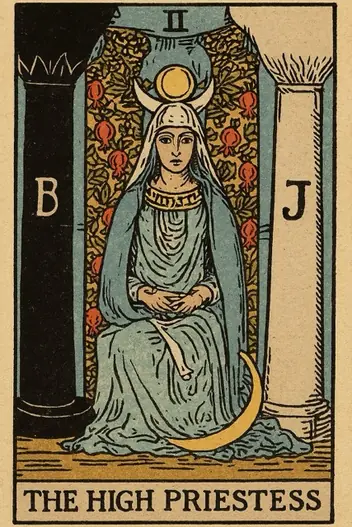
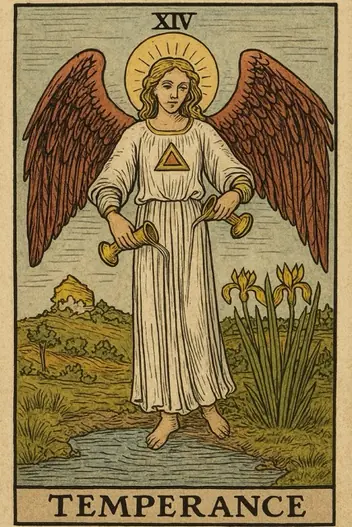
- Arcana
- The High Priestess — Major Arcana; Temperance — Major Arcana
- Elements
- The High Priestess — Water; Temperance — Fire
- Elemental interaction
- Opposing elements — energies create tension
- Numerology
- 2 + 14 = 16 → 7
When the High Priestess and Temperance appear together in a tarot reading, you are being asked to bridge the gap between deep intuition and measured action. The High Priestess represents the vast, unconscious reservoir of inner knowledge—the quiet voice of instinct and hidden truths. Temperance embodies the alchemical process of blending opposites, patience, and moderation. Their collision is not about passivity; it is about strategic waiting—knowing when to listen and when to act, without rushing or forcing outcomes.
This combination signals a phase where emotional intelligence and self-regulation are your greatest assets. You possess the raw data from your subconscious (High Priestess), but you must apply the discipline of Temperance to synthesize it into wise decisions. In real life, this manifests as a period where you feel pulled between two paths, yet the answer isn’t to choose one immediately—it’s to integrate both through deliberate reflection and incremental steps. The key is to avoid the trap of analysis paralysis (over-identifying with the High Priestess) or impulsive action (ignoring Temperance’s call for balance).
What Do The High Priestess and Temperance Mean Together?
The psychological state created by the High Priestess and Temperance is one of calm, deliberate receptivity. You are not waiting passively; you are actively observing your inner landscape while maintaining a steady, grounded presence. This is a mindset of dual awareness: you trust your gut feelings (High Priestess) while simultaneously applying a filter of practicality and timing (Temperance). The core insight here is that truth often emerges not from a single flash of insight, but from a slow, iterative process of integration. You are learning to hold two conflicting truths—such as wanting change but needing stability—without forcing a resolution prematurely.
In real-world terms, this combination often appears when you are at a crossroads where the most logical path contradicts your intuition. The pragmatic advice is to create a structured decision-making timeline: gather your inner insights, then test them with small, low-risk experiments. For example, if you feel drawn to a new career but are uncertain, schedule one informational interview per week rather than quitting your job. This approach honors the High Priestess’s call for depth while respecting Temperance’s demand for measured progress. The danger is mistaking patience for procrastination—ensure you are actively engaging with your intuition, not avoiding a difficult choice.
Your pair is already on the table. Ask your question and draw the clarifying card
or simply focus on it
What Do The High Priestess and Temperance Say About Love?
If you are single:
This pair suggests that rushing into a connection will backfire. Focus on evaluating how a potential partner makes you feel on a gut level, but avoid over-analyzing every detail. Instead, set a 2-3 week observation period where you interact naturally without forcing labels.
If you are in a relationship:
The dynamic here is about emotional pacing. One partner may be more introspective or secretive (High Priestess), while the other seeks harmony and compromise (Temperance). The key is to create space for both without resentment.
In relationships, this combination emphasizes emotional intelligence as a tool for conflict resolution. You are being asked to listen to your own unspoken needs (High Priestess) while also regulating your reactions to your partner’s behavior (Temperance). Avoid the trap of “mind-reading”—the High Priestess can lead you to assume you know what your partner is thinking, but Temperance demands you verify through calm, open dialogue. The most actionable advice is to schedule a weekly “check-in” conversation where both partners share one intuitive feeling (e.g., “I sense you’re pulling away”) and one practical need (e.g., “I need more quality time”). This blends deep insight with structured communication, preventing emotional overwhelm.
Deepen your understanding
Find out exactly what this reading means for your current life situation with our oracle.
Career Meaning of The High Priestess and Temperance
Strategic Opportunities:
Use this period to research and gather hidden information before making any major career move. The High Priestess favors due diligence—review contracts, analyze competitors, or consult mentors who know the “unspoken rules” of your industry.
Strategic Opportunities:
Focus on roles that require both intuition and precision, such as mediation, strategic planning, or creative direction. This combination thrives in environments where you can blend gut feeling with methodical execution.
Calculated Risks:
Avoid making impulsive financial commitments based on a “hunch” alone. Temperance warns that unchecked intuition can lead to overconfidence. Instead, test your idea with a small pilot project or a limited investment.
Professionally, the High Priestess and Temperance signal a time to lead with quiet authority rather than aggressive ambition. You may find yourself in a position where you have critical insights that others lack, but you must present them with diplomacy and timing. A key financial warning: this combination often appears before a period of market volatility or organizational change. Do not react to short-term fluctuations. Instead, diversify your assets and maintain a cash reserve to weather uncertainty. The strategic tip is to schedule a monthly review of your financial plan to ensure your intuitive decisions are backed by data. This blend of inner knowing and external discipline is your strongest asset right now.
The High Priestess and Temperance: Warning Signs
When the energy of these cards is blocked or distorted, the seeker may fall into cognitive biases that undermine their judgment. The most common shadow is over-reliance on intuition without reality-checking—the High Priestess becomes a justification for avoiding uncomfortable facts. For example, you might convince yourself that a failing relationship is “meant to be” because you feel a deep connection, ignoring clear red flags. Conversely, Temperance can manifest as excessive caution that stifles growth—you wait for the “perfect moment” that never arrives, mistaking fear for patience.
Another pitfall is passive-aggressive behavior in relationships. The High Priestess’s secrecy, when combined with Temperance’s desire for harmony, can lead you to suppress your true feelings to keep the peace, only to resent your partner later. Self-sabotage here looks like over-analyzing every decision to the point of inaction, then blaming external circumstances. To avoid this, set a firm deadline for any decision you are currently agonizing over. If you cannot decide by the deadline, choose the option that offers the most flexibility—this honors both the need for inner alignment (High Priestess) and the need for forward momentum (Temperance).
Reversed The High Priestess and Temperance Explained
If The High Priestess is reversed, it indicates blocked intuitive potential or self-deception. You may be ignoring obvious signals or, conversely, acting impulsively, mistaking anxiety for intuition. Advice: return to basic practices — a dream journal or meditation. Without access to inner knowledge, Temperance becomes meaningless waiting.
If Temperance is reversed, it manifests as inner resistance and imbalance. You are either rushing too much or stuck in apathy. The Priestess's energy finds no outlet, causing frustration. Warning: avoid extreme decisions — abrupt resignations or breakups. You need to restore rhythm through physical activity or routine actions.
When BOTH cards are reversed, a complete dynamic imbalance arises: chaotic intuition without brakes (The High Priestess) and a loss of sense of measure (Temperance). This is a state of "emotional burnout" or decision-making under stress. A logical way to correct this: temporarily turn off your "inner critic" and "external stimuli" — take a 48-hour pause without social media, news, or important conversations. Only after this should you reassess the situation.
The High Priestess and Temperance Combined Message
Constructive use of this dynamic requires a conscious paradigm shift from "doing" to "being" . The High Priestess gives you a treasure map, but Temperance is the compass that shows you the pace at which to travel. Your task is not to seek the treasure, but to synchronize your steps with your inner rhythm. The strategic advice: break your main goal down into micro-steps, each requiring not action, but observation. For example, instead of "sign the contract," set the task to "study the partner's motives."
The deep insight is that this combination teaches us to distinguish between patience and resignation. Patience is active waiting, with readiness to act. Resignation is the refusal to act. You must practice the former while avoiding the latter. To make the right decisions, use the "rule of two doors" : if a decision can be postponed without losing quality, postpone it (Temperance's energy). If a delay will destroy the opportunity, act immediately (the Priestess's energy).
The final conclusion: your strength right now lies in your ability to be an "empty vessel" . Do not fill every moment with action. Allow information, people, and events to reveal their true nature. The less you interfere, the more clearly you see. This is not passivity, but a higher form of strategy— governance through non-interference.
Your Next Step: Personal Context Matters
The core message of the High Priestess and Temperance is that your deepest wisdom is only as useful as your ability to apply it with patience and precision. You are being asked to trust the process of integration—not to force a revelation, but to let it unfold through deliberate, balanced action. This combination rewards those who can hold space for ambiguity while making steady, informed choices.
While this article offers a general archetype, the true power of Tarot lies in its application to your unique situation. The Fortune Cards app is designed to give you a deep, personalized interpretation of this exact combination for your specific question—whether it’s about love, career, or personal growth. You can use it on the web or download it to receive a reading that accounts for your exact context, timing, and emotional state. Stop guessing—get the clarity you need to act with confidence.
Interpretation by the Fortune Cards editorial team, based on the Rider–Waite tradition and Jungian archetypes. About our methodology · Updated: 2026-08-26
Other Combinations with The High Priestess
Other Combinations with Temperance
Explore Individual Card Meanings
Table of Contents
- What Do The High Priestess and Temperance Mean Together?
- What Do The High Priestess and Temperance Say About Love?
- Career Meaning of The High Priestess and Temperance
- The High Priestess and Temperance: Warning Signs
- Reversed The High Priestess and Temperance Explained
- The High Priestess and Temperance Combined Message
- Your Next Step: Personal Context Matters
Ready to find answers to your questions?
Start your first reading now and look at your situation with fresh clarity. The cards are ready to reveal deeper meaning.