The Meaning of Three of Cups and Four of Pentacles Together in a Tarot Reading

- Arcana
- Three of Cups — Minor Arcana, Cups; Four of Pentacles — Minor Arcana, Pentacles
- Elements
- Three of Cups — Water; Four of Pentacles — Earth
- Elemental interaction
- Friendly elements — energies support each other
- Numerology
- 3 + 4 = 7
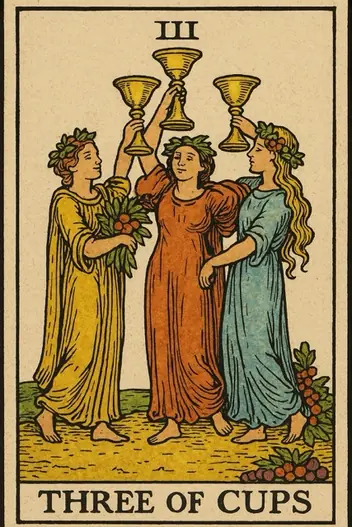
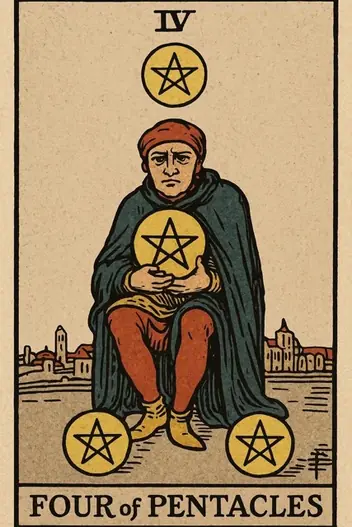
When the Three of Cups—a card of celebration, friendship, and shared joy—meets the Four of Pentacles—a card of hoarding, security, and rigid boundaries—we witness a psychological collision. This pairing often represents the struggle between wanting to belong and connect, versus the fear of losing what you’ve worked hard to protect. In practical terms, it asks: Can you enjoy abundance without clutching it so tightly that you suffocate the very relationships that bring you joy?
This combination is common for individuals who are socially successful but financially cautious, or who feel torn between generous impulses and a need for control. The dynamic is not inherently negative, but it demands conscious integration of two opposing drives: the desire for communal celebration and the instinct for self-preservation.
Three of Cups and Four of Pentacles: How These Energies Interact
The core psychological state here is ambivalence toward vulnerability. The Three of Cups invites you to open up, share resources, and celebrate with others. The Four of Pentacles, however, whispers that sharing equals risk—that you must hold onto your time, money, or emotional energy to avoid being drained. This creates a push-pull dynamic where you may feel generous one moment and miserly the next.
From a Jungian perspective, this is the tension between the social self (persona) and the shadow of scarcity. You may fear that if you let your guard down, others will take advantage. Alternatively, you might be overcompensating for past losses by building emotional or financial walls. The key insight: true security does not come from hoarding, but from knowing you can rebuild if you lose.
In real-world terms, this combination often appears when you are invited to a social event but worry about the cost, or when a friend asks for a favor and you feel resentful. The healthy path forward involves setting clear boundaries without closing yourself off entirely. Ask: What am I afraid will happen if I give freely? The answer reveals the root of the tension.
Ask your question and flip the cards
or simply focus on it
What Do Three of Cups and Four of Pentacles Say About Love?
If you are single:
This pair suggests you may be evaluating a potential partner through a lens of scarcity—focusing on what you might lose rather than what you could gain. Practice giving small, low-risk gestures of trust to see if the connection feels safe.
If you are in a relationship:
A power struggle may be emerging around money, time, or emotional availability. One partner may feel the other is too guarded, while the guarded partner fears being overwhelmed.
In relationships, this combination often signals a misalignment of love languages. One person expresses love through shared experiences (Three of Cups), while the other prioritizes stability and control (Four of Pentacles). The result can be resentment: the generous partner feels rejected, and the protective partner feels pressured.
The critical relationship advice here is to negotiate explicit agreements. For example, agree on a budget for social activities so the protective partner feels safe, while the social partner still gets to enjoy connection. Avoid passive-aggressive withholding—if you need alone time or financial boundaries, say so directly. This combination thrives on transparency, not silent resentment.
Get a personalized interpretation
Unlock the combined meaning of your cards in the context of your unique question — for free.
Career and Finances
Strategic Opportunities:
Leverage your social network for business referrals, but set a clear limit on how much time or money you invest in each connection.
Strategic Opportunities:
Use team celebrations or client events to build goodwill, but track the ROI of these social investments to ensure they align with your financial goals.
Calculated Risks:
Be wary of overextending yourself to appear successful. Avoid lending money to friends or colleagues without a formal agreement.
Professionally, this pairing points to balancing collaboration with self-protection. You may be in a role that requires both networking (Three of Cups) and resource management (Four of Pentacles). The danger is becoming the person who attends every happy hour but never gets promoted because you’re seen as a social butterfly rather than a strategic asset.
A smart financial strategy is to create a "social fund"—a designated budget for networking, team building, and professional celebrations. This allows you to be generous without guilt, while the Four of Pentacles energy ensures you don’t overspend. In negotiations, don’t give away your expertise for free just to be liked. Instead, offer value in exchange for value.
Three of Cups and Four of Pentacles Reversed: What Changes?
When cards are reversed, internal conflicts become overt and destructive.
Three of Cups Reversed:
Blocked Potential for Joy. You cannot sincerely celebrate the successes of others or your own. Instead of celebration, there is envy, cynicism, or a feeling that joy is "not for you." Advice: Start small. Set yourself the task of finding one moment of joy in the day and consciously acknowledging it. This will reset the emotional center.
Four of Pentacles Reversed:
Internal Resistance and Weakness. This is a state where you cannot hold onto even what you have. Money slips away, boundaries are violated. You become a victim of spendthrifts or manipulators. Warning: This is not generosity, but a loss of control. You urgently need to introduce strict external limits: card spending limits, agreements with a partner, a refusal of impulsive purchases.
BOTH Reversed:
Complete Imbalance. Social isolation (reversed Three) combines with financial instability (reversed Four). This is a crisis where a person is left alone with chaos. The logical way to correct it: find one stable point. First, restore control over your budget (even if just for 30 days), then take one step towards rebuilding social connections (meet with one friend). Do not try to fix everything at once.
What Are the Risks of Three of Cups and Four of Pentacles?
When this energy is blocked, the shadow manifests as emotional hoarding. You may isolate yourself from friends or colleagues, believing that protecting your resources (time, money, energy) is more important than connection. This can lead to loneliness disguised as self-sufficiency. Alternatively, you might swing to the opposite extreme: oversharing or overspending to buy love, then resenting the cost.
A common cognitive bias here is the scarcity mindset—believing that there isn’t enough to go around, so you must clutch what you have. This can cause you to miss opportunities for genuine abundance that come through trust and reciprocity. If you notice yourself saying "no" to every social invitation or feeling anxious when someone asks for help, check your underlying fear. Are you protecting yourself from a past wound, or from a realistic present threat?
Another pitfall is performative generosity—giving to others in a way that secretly expects repayment or recognition. This creates toxic dynamics where relationships feel transactional. True generosity, like the Three of Cups, expects nothing in return.
Synthesis: Strategic Conclusion
How can the energy of the Three of Cups be used constructively to balance the Four of Pentacles? The key lies in redefining the concept of "resource". The Four of Pentacles sees a resource as a static object (money, time) that can be lost. The Three of Cups sees a resource as a dynamic flow (energy, connections) that grows through exchange. Your task is to find a third point of view.
Strategically, you need to create a "protected space for generosity". Do not distribute resources indiscriminately to everyone, but invest them in a narrow circle of trusted people or projects. Use the energy of the Three of Cups to strengthen trust, but do so in measured doses. For example, organize a meeting for business partners, but with a clear agenda and budget.
A deep piece of advice: turn the fear of loss into a selection mechanism. Your fear (Four of Pentacles) is not an enemy, but a filter. It tells you which relationships or expenditures are unsafe. But do not let it block all entrances. Use it to ask the question: "Why am I afraid of losing this right now?". If the answer is "Because I am uncertain about tomorrow," then you need to first strengthen your foundations (Four of Pentacles). If the answer is "Because I do not trust this person," then the Three of Cups is inappropriate here. Clarity on this question is the primary tool for making the right decisions.
Applying This to Your Situation
The core message of Three of Cups and Four of Pentacles is clear: you can enjoy connection without losing control, and you can protect your resources without becoming isolated. The challenge is to find the middle path—one where you give freely within clear boundaries, and hold tightly only to what truly matters.
Want to know exactly how this combination applies to your unique situation? While this article gives you the general archetype, the real insight comes when you apply it to your specific question. The Fortune Cards app offers deep, personalized Tarot interpretations based on your exact context. Whether you're navigating a relationship dilemma, a career choice, or a financial decision, the app tailors the meaning of Three of Cups and Four of Pentacles to your life. Use it on the web or download it now to get a custom reading—no guesswork, just practical clarity.
Interpretation by the Fortune Cards editorial team, based on the Rider–Waite tradition and Jungian archetypes. About our methodology · Updated: 2026-08-01
Other Combinations with Three of Cups
Other Combinations with Four of Pentacles
Explore Individual Card Meanings
Table of Contents
- Three of Cups and Four of Pentacles: How These Energies Interact
- What Do Three of Cups and Four of Pentacles Say About Love?
- Career and Finances
- Three of Cups and Four of Pentacles Reversed: What Changes?
- What Are the Risks of Three of Cups and Four of Pentacles?
- Synthesis: Strategic Conclusion
- Applying This to Your Situation
Ready to Discover Your Path?
Join thousands of seekers who have found clarity and guidance through our platform. Your cosmic journey awaits.