Love Tarot: Three of Wands and Ten of Wands
- Arcana
- Three of Wands — Minor Arcana, Wands; Ten of Wands — Minor Arcana, Wands
- Elements
- Three of Wands — Fire; Ten of Wands — Fire
- Elemental interaction
- Same element — energies intensify each other
- Numerology
- 3 + 10 = 13 → 4
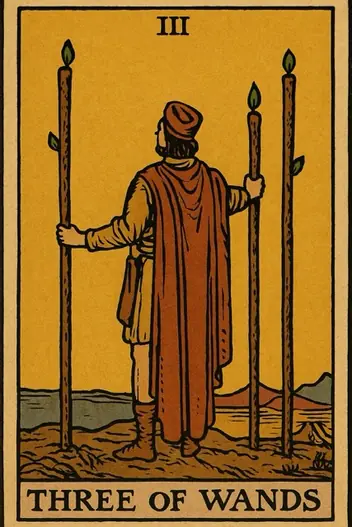
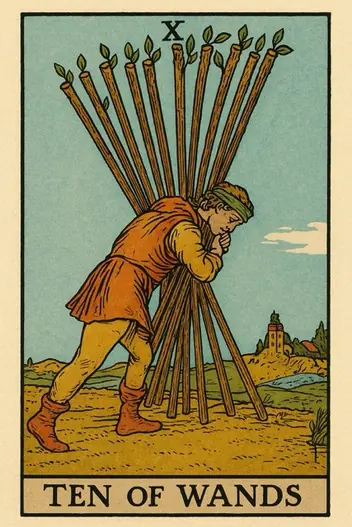
When the Three of Wands—the archetype of foresight, planning, and outward exploration—collides with the Ten of Wands—the archetype of overload, responsibility, and carrying a heavy load—the result is a powerful psychological tension. You are not simply dreaming of horizons; you are actively struggling under the weight of the steps required to reach them. This combination reveals a moment where ambition meets its logistical cost.
Psychologically, this pairing highlights the gap between your vision (Three of Wands) and your capacity to execute (Ten of Wands). You may have a clear strategic map, but you are also feeling the physical and emotional fatigue of carrying too many tasks alone. The key insight here is not to abandon your plans, but to re-evaluate your carrying capacity and delegate or shed what is no longer essential.
What Do Three of Wands and Ten of Wands Mean Together?
The core dynamic of the Three of Wands and Ten of Wands is a paradox of progress. On one hand, the Three of Wands represents active planning, long-term vision, and the confidence to look beyond your current situation. On the other hand, the Ten of Wands signals that you are overburdened by the very efforts meant to realize that vision. This is not a passive state; it is a call to strategic optimization.
Psychologically, this combination often appears when you have over-committed to a single path. The Three of Wands’ expansive energy can lead to scope creep—you see so many possibilities that you try to pursue them all at once. The Ten of Wands then manifests as the physical and mental strain of holding all those threads. The critical insight is that burden is not a badge of honor; it is a signal that your strategy needs refinement. Effective leadership here means prioritizing which wands to put down so you can carry the most important ones forward.
This dynamic also triggers a cognitive bias called the “sunk cost fallacy.” You may feel that because you have already invested so much effort (Ten of Wands), you cannot afford to change course now (Three of Wands). The truth is the opposite: the most courageous act is to recalibrate your plan based on current data, even if that means letting go of some initial investments. The Three of Wands invites you to see the bigger picture, while the Ten of Wands forces you to ask: “What is the most efficient way to get there?”
Your pair is already on the table. Ask your question and draw the clarifying card
or simply focus on it
Career and Finances
Strategic Opportunities:
Re-evaluate your current workload. The Three of Wands suggests you have a strong vision for your career or business. Now, use the Ten of Wands to audit which tasks are truly necessary and which can be delegated, automated, or eliminated.
Strategic Opportunities:
Seek partnership or collaboration. This combination strongly indicates that you are trying to do too much alone. A strategic partner, mentor, or employee can help you share the load and accelerate your expansion.
Calculated Risks:
Avoid taking on more debt or resources to fuel growth. The Ten of Wands warns that over-leveraging yourself (time, money, energy) will lead to burnout, not success. Instead, focus on efficiency before expansion.
For career and finances, this pairing is a powerful warning against over-optimism. The Three of Wands can make you feel like you are on the verge of a breakthrough, but the Ten of Wands reminds you that every new opportunity comes with a price tag. The most pragmatic move is to pause new initiatives until you have cleared your current load. Ask yourself: “What is the one project that, if completed, would create the most momentum?” Then, direct all your energy there.
Important financial warning:
Do not mistake activity for progress. The Ten of Wands often represents busywork that drains resources without adding real value. If you are spending more time managing logistics than executing your core strategy, you are losing money and time. Cut the fat now to free up capital for the Three of Wands’ next move.
What Do Three of Wands and Ten of Wands Say About Love?
If you are single:
This combination suggests you are idealizing a potential partner or scenario (Three of Wands) while simultaneously carrying emotional baggage or unrealistic expectations (Ten of Wands). You may need to ground your vision in reality and assess whether your pursuit is worth the emotional weight.
If you are in a relationship:
You and your partner may be over-functioning in one area while neglecting balance. One of you might be carrying the lion’s share of planning or emotional labor, leading to resentment.
In relationships, the Three of Wands and Ten of Wands often highlight a power imbalance in responsibility. The Three of Wands partner is the visionary, always talking about future plans, vacations, or career moves. The Ten of Wands partner is the practical executor, handling the day-to-day logistics, emotional support, and problem-solving. This can create a dynamic where one person feels inspired but detached, while the other feels burdened and unseen.
Key relationship advice:
Schedule a “strategy session” with your partner. Use the Three of Wands energy to jointly map out your shared future, but explicitly assign tasks (Ten of Wands) in a balanced way. Healthy relationships require both vision and execution. If you are single, avoid projecting a fantasy onto a new connection. Instead, use the Ten of Wands to honestly evaluate what you are truly willing to carry for a relationship—and what you are not.
Get a personalized interpretation
Unlock the combined meaning of your cards in the context of your unique question — for free.
Reversed Three of Wands and Ten of Wands Explained
If the Three of Wands is Reversed:
Strategic vision is blocked by fear or overconfidence. You either fail to see obvious paths for growth, or conversely, you grab at adventures without a plan. In combination with the upright Ten of Wands, this creates "blind stubbornness": you are carrying an unbearable burden but refuse to admit you chose the wrong direction. Advice: Stop and re-check the facts. Your intuition is unreliable right now.
If the Ten of Wands is Reversed:
Internal resistance and sabotage. You feel the weight of responsibility but refuse to carry it. This can manifest as procrastination, retreating into illusions, or dropping obligations. Together with the upright Three, this creates a gap between grandiose plans and zero action. Warning: You risk losing the trust of those around you, as you will be perceived as an unreliable person.
If BOTH are Reversed:
Complete imbalance and chaos. You are overwhelmed but see no way out. Plans are crumbling, and responsibility weighs you down. This is a state of paralysis of the will. A logical way to correct it: radical simplification. You need neither to plan nor to carry, but to drop 80% of your current tasks and start from scratch. Focus on basic needs (sleep, food, order) to restore your cognitive resources.
Shadow Side & Pitfalls
The shadow side of this combination is martyrdom disguised as ambition. You may believe that your suffering (Ten of Wands) is a necessary price for success (Three of Wands). This is a cognitive distortion known as the “effort justification bias,” where you overvalue outcomes simply because you worked hard for them. In reality, overwork is not a virtue; it is a sign of poor strategy.
Another pitfall is analysis paralysis. The Three of Wands’ expansive vision can lead to endless planning without execution, while the Ten of Wands keeps you stuck in the weeds of logistics. You may find yourself oscillating between grand ideas and crushing fatigue, never actually moving forward. The solution is to set a timer for planning and then commit to action, even if imperfect.
Finally, beware of resentment. If you are the one carrying the Ten of Wands burden, you may start to blame others or circumstances for your exhaustion. This is a projection of your own inability to set boundaries. The Three of Wands energy requires radical accountability: you are the one who chose this path. Own the burden, or change the plan.
Three of Wands and Ten of Wands Combined Message
Constructive use of this dynamic requires a paradigm shift from "doing more" to "doing what matters." The energy of the Three of Wands (vision) should be directed not toward seeking new opportunities, but toward optimizing the current path. Your task is not to expand the horizon, but to deepen and clear the territory already claimed. Use your foresight to see which of your current projects will yield the maximum return with minimal effort, and ruthlessly cut away everything else.
In this synthesis, the Ten of Wands becomes not an enemy, but an indicator of your boundaries. It teaches you to respect your limits. Instead of trying to shed the burden (which is often impossible without consequences), begin delegating responsibility. The Three of Wands is about leadership, and leadership is the ability to distribute tasks, not to perform them for everyone. A deep strategic piece of advice: imagine your resource is a budget that will run out in a month. What two actions would you take right now to ensure maximum survivability? Take them.
Applying This to Your Situation
The Three of Wands and Ten of Wands combination delivers a clear, pragmatic message: Your vision is valid, but your current method of execution is unsustainable. The path forward requires strategic pruning, not blind perseverance. You must differentiate between the essential weight of your goals and the unnecessary baggage of outdated plans. The most successful people are not those who carry the most; they are those who carry the right things.
Ready to apply this insight to your specific situation? While this article provides the general archetype, the true power of Tarot lies in its application to your unique life. The Fortune Cards app allows you to input your exact question—whether about a relationship, a career decision, or a personal challenge—and receive a deeply personalized interpretation of the Three of Wands and Ten of Wands in your specific context. Download the app or use it on the web to get your customized reading right now. Your next step is only a click away.
Interpretation by the Fortune Cards editorial team, based on the Rider–Waite tradition and Jungian archetypes. About our methodology · Updated: 2026-08-26
Other Combinations with Three of Wands
Other Combinations with Ten of Wands
Explore Individual Card Meanings
Table of Contents
Ready to find answers to your questions?
Start your first reading now and look at your situation with fresh clarity. The cards are ready to reveal deeper meaning.