The Tower and Seven of Swords Together in Tarot
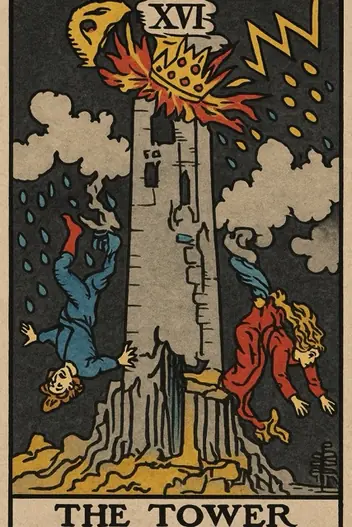

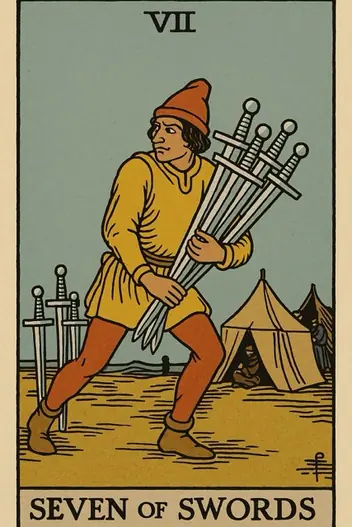
- Arcana
- The Tower — Major Arcana; Seven of Swords — Minor Arcana, Swords
- Elements
- The Tower — Fire; Seven of Swords — Air
- Elemental interaction
- Friendly elements — energies support each other
- Numerology
- 16 + 7 = 23 → 5
When the Tower meets the Seven of Swords, you are facing a psychological and situational collision: a sudden, disruptive collapse (The Tower) hitting a pattern of secrecy, evasion, or calculated maneuvering (Seven of Swords). This is not a gentle warning—it is a reality check where hidden truths are exposed, often through a crisis that forces you to see what you have been avoiding.
The core dynamic here is disruption of a strategic illusion. You may have been relying on a clever plan, a half-truth, or a quiet workaround to maintain stability. The Tower represents an external event—a job loss, a breakup, a financial shock—that rips away the facade. The Seven of Swords reveals the internal pattern: you knew something was off, but you chose to navigate around it rather than confront it directly. The result is a painful but necessary recalibration of your integrity and strategy.
Core Dynamics & Interpretation
The psychological state created by The Tower and Seven of Swords is one of cognitive dissonance and forced clarity. You are caught between the desire to control the narrative (Seven of Swords) and the raw, uncontrollable reality of sudden change (The Tower). This combination often appears when a person has been "borrowing time"—using cleverness to avoid a hard truth, only to have that truth crash through the door. The key insight is that the crisis is not the enemy; the deception is.
In practical terms, this pair demands a ruthless audit of your own motivations. Ask yourself: What have I been hiding from myself or others? Where have I been using strategy to avoid accountability? The Tower clears the debris, but the Seven of Swords warns that if you try to sneak back into old patterns, you will only rebuild on unstable ground. The path forward requires radical honesty and a willingness to abandon any plan that relied on secrecy or manipulation.
The archetypal conflict here is between the Trickster (Seven of Swords) and the Destroyer (The Tower). The Trickster believes he can outsmart fate; the Destroyer shows him that reality has its own agenda. Your next move is not to outrun the collapse, but to salvage what is real and build a new strategy based on transparency, not cunning.
Your pair is already on the table. Ask your question and draw the clarifying card
or simply focus on it
What Do The Tower and Seven of Swords Say About Love?
If you are single:
This combination suggests that a sudden revelation about a potential partner’s past or character may force you to re-evaluate your attraction. Do not romanticize the drama—the collapse is revealing a fundamental mismatch or a hidden agenda.
If you are in a relationship:
Expect a confrontation about trust, secrets, or a power imbalance. The Tower may manifest as an unexpected argument or discovery that shatters a comfortable but dishonest dynamic.
In relationships, The Tower and Seven of Swords point to a crisis of transparency. One or both partners may have been withholding information, playing games, or avoiding difficult conversations. The collapse forces the issue: you can no longer maintain the illusion of harmony. The healthiest response is to acknowledge the breach of trust openly, without blame or deflection. This is not about punishing the "deceiver"—it is about deciding whether the relationship can be rebuilt on a foundation of honesty.
Key relationship advice:
Do not use the crisis as an excuse to manipulate or control the outcome. The Seven of Swords energy can tempt you to "win" the argument through cleverness or emotional withdrawal. Instead, practice vulnerability and direct communication. If the trust is broken, the only way forward is a mutual commitment to transparency—or a clean, honest breakup.
Your unique Tarot reading
See how these cards interact with your destiny. Start a free personal reading now.
Career and Finances
Strategic Opportunities:
The collapse of a project, deal, or reputation creates a clean slate to rebuild with integrity. Use the disruption to cut ties with unethical practices or unreliable partners.
Strategic Opportunities:
The Seven of Swords energy can be redirected toward competitive intelligence—not to deceive, but to understand your rivals’ weaknesses and protect your own blind spots.
Calculated Risks:
Avoid any quick-fix schemes or shortcuts to recover losses. The Tower warns that trying to "cheat" your way out of a crisis will only deepen the damage.
In your professional life, this combination signals a reckoning with hidden risks. You may have been aware of a looming problem—a toxic colleague, a shaky contract, a financial leak—but chose to ignore it or handle it indirectly. The Tower forces the issue: a sudden audit, a resignation, a lawsuit, or a market shift that exposes the flaw. The strategic move is to take ownership of the situation before it takes ownership of you.
Financially, this is a warning against deception—by others or yourself. If you are tempted to hide losses, manipulate numbers, or rely on insider information, the Tower will expose it. The Seven of Swords also warns of theft, fraud, or sabotage; review your accounts and contracts carefully. The best financial strategy is conservative, transparent, and defensive: cut unnecessary expenses, secure assets, and avoid high-risk gambles.
Shadow Side & Pitfalls
The shadow side of The Tower and Seven of Swords is self-sabotage through denial and blame. The seeker may rationalize the crisis as an "unfair attack" while ignoring their own role in creating the instability. Cognitive biases like confirmation bias (seeing only evidence that supports your side) and the illusion of control (believing you can outsmart the consequences) are heightened. You might be tempted to scapegoat others or engage in revenge fantasies rather than facing your own complicity.
Another pitfall is over-correcting into paranoia. After the collapse, the Seven of Swords energy can turn into hyper-vigilance, where you assume everyone is deceiving you. This leads to isolation and poor decision-making. The shadow here is not the crisis itself, but the refusal to learn the lesson of integrity. If you respond with more secrecy, more manipulation, or more blame, you will only invite another, more destructive Tower moment.
Reversed The Tower and Seven of Swords Explained
If the Tower is reversed, the destruction is prolonged. Instead of a swift collapse, you get a viscous, agonizing process of decline. Advice: Do not wait for a "magical blow" that will solve everything. Begin the evacuation right now, even if everything still seems stable. Procrastination will intensify the suffering.
If the Seven of Swords is reversed, you lose your ability to adapt. This is a paralysis of will and an inability to make a tough decision. Instead of a clever maneuver, you choose self-deception or passive aggression. Warning: Your unwillingness to "get your hands dirty" will lead to you simply being crushed by the rubble. You need to overcome moral discomfort and act pragmatically, rather than waiting for a miracle.
If both cards are reversed, this is complete disorientation. You can neither escape nor stand your ground. This is the state of a victim who sees the collapse but does nothing. Correction: The only way out is to acknowledge that you created this trap yourself. Stop looking for an external enemy. Return to basic principles: honesty with yourself and a willingness to start from scratch, even if it is humiliating.
The Tower and Seven of Swords Combined Message
Constructive use of this pair requires the courage to admit defeat and a cool head for planning a retreat. The Tower's energy is fuel for radical change. It burns the bridges you can no longer cross. The Seven of Swords is the card that allows you to salvage the most valuable things from the fire: information, experience, and connections.
Strategic advice: Do not try to save everything. Identify the 20% of assets (relationships, knowledge, money) that hold real value and focus on evacuating them. The rest must burn. Accept that your reputation may suffer in the short term. The Seven of Swords teaches that it is better to be alive and cunning than dead and honest. Your task is not to win this battle, but to secure your place in the next war. Use the chaos to change the rules of the game, not to mourn what has been destroyed.
Applying This to Your Situation
The core message of The Tower and Seven of Swords is that truth, even when disruptive, is the only foundation for lasting stability. You are being called to abandon any strategy that relies on hiding, dodging, or outsmarting reality. The collapse is not your enemy—it is a painful but precise surgeon, cutting away what was never truly yours to keep. Your next step is to embrace radical honesty with yourself first; then, rebuild with transparency and strategic clarity.
However, this interpretation is only a map—your specific situation holds the treasure. The true power of Tarot lies in applying these archetypes to your unique question, your specific relationship, your exact career crossroads. That is why I recommend using the Fortune Cards app to get a deep, personalized interpretation of The Tower and Seven of Swords for your exact question. Whether on the web or via download, the app combines Jungian psychology with AI-driven insight to give you a reading tailored to your context—not just generic advice. Stop guessing and start understanding: use Fortune Cards now to see what this combination means for you, right now.
Interpretation by the Fortune Cards editorial team, based on the Rider–Waite tradition and Jungian archetypes. About our methodology · Updated: 2026-08-26
Other Combinations with The Tower
Other Combinations with Seven of Swords
Explore Individual Card Meanings
Ready to find answers to your questions?
Start your first reading now and look at your situation with fresh clarity. The cards are ready to reveal deeper meaning.