Two of Cups and Four of Swords Together in Tarot
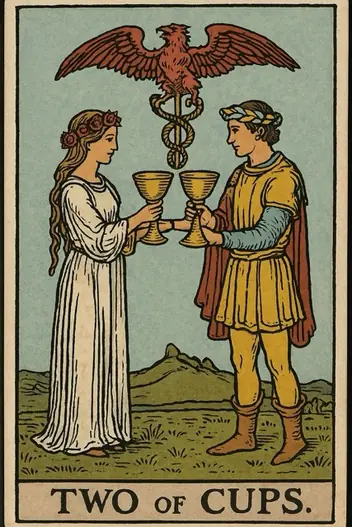

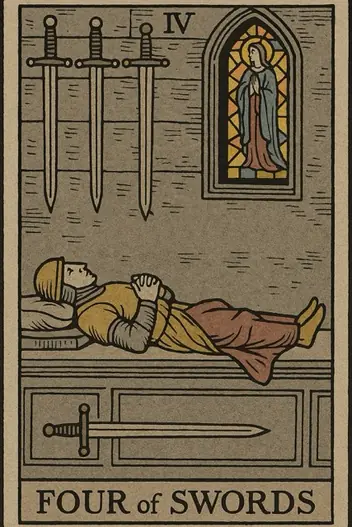
- Arcana
- Two of Cups — Minor Arcana, Cups; Four of Swords — Minor Arcana, Swords
- Elements
- Two of Cups — Water; Four of Swords — Air
- Elemental interaction
- Neutral elements — energies coexist without conflict
- Numerology
- 2 + 4 = 6
When the Two of Cups—the archetype of mutual attraction, emotional reciprocity, and partnership—meets the Four of Swords—the archetype of mental retreat, strategic rest, and enforced stillness—a fascinating psychological tension emerges. This combination suggests a relationship or personal dynamic that requires deliberate pauses to sustain its quality. It is not about conflict or breakup, but about intentional distance as a form of emotional hygiene.
In practical terms, this pairing often appears when a strong bond exists but is threatened by overthinking, burnout, or unresolved mental fatigue. The seeker may feel deeply connected to someone yet simultaneously overwhelmed by the mental chatter surrounding the relationship. The challenge is to honor both the connection and the need for solitude without guilt or anxiety.
Core Dynamics & Interpretation
The core dynamic here is a dialectic between intimacy and individuation. The Two of Cups represents a mutual recognition of emotional value—a partnership where both parties see and affirm each other. The Four of Swords, however, signals a necessary withdrawal into one’s own mind to process, recover, and gain clarity. Together, they create a rhythm of connection followed by conscious retreat, which is essential for long-term relational health.
Psychologically, this combination points to the danger of merging too quickly without adequate mental boundaries. The Two of Cups can tempt the seeker to lose themselves in the other, while the Four of Swords insists on reclaiming personal mental space. The key insight is that true intimacy requires periods of self-containment. Without these pauses, the relationship becomes emotionally cluttered and mentally exhausting.
In real-world terms, this means scheduling deliberate downtime after intense emotional exchanges. It suggests that silence is not rejection—it is a form of processing. The seeker must learn to trust the bond enough to step away temporarily, knowing that stillness will deepen rather than weaken the connection. Strategic rest is the path to sustainable partnership.
Your pair is already on the table. Ask your question and draw the clarifying card
or simply focus on it
What Do Two of Cups and Four of Swords Indicate for Your Career?
Strategic Opportunities:
Use this period to analyze a partnership or negotiation from a detached, objective perspective. Step back from the emotional pull of a deal to assess its long-term viability.
Strategic Opportunities:
Prioritize mental recovery after a high-stakes collaboration. Schedule time to process what worked and what didn’t before moving to the next project.
Calculated Risks:
Avoid making major financial commitments based solely on relational goodwill. The Two of Cups can blind you to red flags in a business partnership; the Four of Swords demands due diligence and quiet reflection.
In career and finances, this pairing signals a time to pause before signing contracts or deepening professional alliances. The Two of Cups suggests a promising collaboration or client relationship, but the Four of Swords warns that your judgment may be clouded by enthusiasm or emotional attachment. Bold financial advice: Do not let a charming counterparty rush you into a decision. Take at least 48 hours of “mental silence” before committing to any financial agreement.
Professionally, this combination is ideal for roles that require both empathy and analytical detachment, such as therapy, mediation, or strategic consulting. It suggests that your greatest asset is the ability to connect deeply while maintaining mental boundaries. However, if you are feeling burned out by a collaborative project, request a temporary reassignment or a solo task to restore your cognitive resources. Strategic withdrawal is not weakness—it is a form of risk management.
Deepen your understanding
Find out exactly what this reading means for your current life situation with our oracle.
Two of Cups and Four of Swords in Love Tarot
If you are single:
This pair suggests that a potential connection may feel promising, but you need to slow down and observe before committing. Give yourself permission to withdraw mentally to assess compatibility without emotional pressure.
If you are in a relationship:
Your bond is likely strong, but mental exhaustion or unresolved communication patterns may be creating distance. The solution is not to push harder, but to take a structured break to reset your inner dialogue.
In love, the Two of Cups and Four of Swords indicate a relationship that thrives on emotional intelligence and deliberate boundaries. Partners may feel deeply connected yet find themselves repeating the same mental arguments or feeling drained by constant emotional labor. The advice is to schedule regular “offline” periods where both partners focus on their own mental restoration. Bold relationship advice: Do not confuse physical proximity with emotional availability. Sometimes the most loving act is to say, “I need to rest my mind before I can truly be with you.”
This combination also warns against using silence as punishment. The Four of Swords must be a conscious, communicated choice—not a passive-aggressive withdrawal. If you are the one needing space, explain that it is not about them, but about your own mental clarity. If your partner needs space, respect it without interpreting it as rejection. Mutual understanding of this dynamic transforms potential conflict into deeper trust.
What If Two of Cups or Four of Swords Appears Reversed?
If the Two of Cups is reversed:
Emotional blackmail and dependency. The need for a partner becomes obsessive, and the Four of Swords is perceived as rejection. Warning: you risk destroying the relationship by demanding intimacy at a moment when your partner needs a pause. Advice: learn to distinguish between "being alone" and "being abandoned."
If the Four of Swords is reversed:
Insomnia of mind and body. Inability to stop, chronic anxiety. You are not allowing yourself rest, leading to exhaustion. Advice: introduce mandatory "digital detoxes" and rituals of disconnecting 2 hours before sleep. Ignoring this card leads to a nervous breakdown.
If BOTH are reversed:
Complete imbalance of dynamics. You simultaneously crave intimacy and fear it, while rest seems like an unattainable luxury. Logical method of correction: start small. Set aside 15 minutes a day for complete inaction, without gadgets or thoughts of work. Only by restoring a basic level of peace can you adequately assess what kind of relationships you truly need.
What Are the Risks of Two of Cups and Four of Swords?
The shadow manifestation of this combination emerges when the seeker uses the Four of Swords as an excuse to avoid emotional intimacy. Instead of taking a conscious, temporary pause, they may withdraw permanently, rationalizing it as self-care when it is actually fear of vulnerability. Conversely, the shadow of the Two of Cups can manifest as codependent clinging, where the seeker refuses to give or take any space, suffocating the relationship with constant emotional demands.
A common cognitive bias here is the “all-or-nothing” fallacy: believing that any distance means the connection is broken. This leads to anxiety-driven over-communication or resentful silence. Another pitfall is idealizing the partner while ignoring the need for personal mental hygiene. The seeker may expect the relationship to heal their inner exhaustion, which is an unrealistic burden that the Four of Swords explicitly warns against.
To avoid these pitfalls, set explicit boundaries for your retreat periods. Use a timer or calendar to ensure the withdrawal is temporary. Communicate your need for space clearly before you disconnect. And most importantly, do not use mental fatigue as a reason to ghost—that is avoidance, not wisdom.
What Is the Overall Message of Two of Cups and Four of Swords?
How can the energy of the Two of Cups be used constructively to balance the Four of Swords? The answer lies in creating a ritual. Emotional connection (Two of Cups) should not be spontaneous and chaotic. It must be encapsulated within strict timeframes so that it does not drain the resources needed for recovery (Four of Swords). Imagine you have a "reservoir" of social energy. This combination teaches you not to waste it on empty talk, but to use it only for deep, meaningful interactions.
The deep strategic advice: use the principle of "anchoring." Choose one specific day per week (e.g., Sunday morning) when you fully dedicate yourself to a partner or close friend. The rest of the time, you are "in retreat." This gives you the freedom to be alone (Four of Swords) without guilt, because you know you have scheduled time for connection (Two of Cups). This transforms a chaotic need into order.
This combination is not about "eternal happiness." It is about resilience. About the ability to build relationships that withstand periods of isolation. Your task is not to choose between intimacy and peace, but to learn to switch between them consciously. Only then can you avoid burnout and build truly mature, rather than codependent, relationships. Clarity comes when you acknowledge: sometimes the best way to be together is to part ways for a time.
Applying This to Your Situation
The core message of the Two of Cups and Four of Swords is that true connection requires conscious rest. This combination is not a warning against love or partnership—it is a guide to making them sustainable. Honor both your need for intimacy and your need for mental stillness. The relationship that can withstand deliberate pauses is the one that will grow deeper over time.
While this article provides the general archetype, the true magic happens when Tarot is applied to your unique situation. Your specific question, your personal history, and the exact positions of these cards in a spread will reveal a nuanced, actionable message. Use the Fortune Cards app on the web or download it to get a deep, personalized interpretation of this exact combination for your specific question right now. Stop guessing—get the clarity you need to move forward with confidence.
Interpretation by the Fortune Cards editorial team, based on the Rider–Waite tradition and Jungian archetypes. About our methodology · Updated: 2026-10-08
Other Combinations with Two of Cups
Other Combinations with Four of Swords
Explore Individual Card Meanings
Table of Contents
- Core Dynamics & Interpretation
- What Do Two of Cups and Four of Swords Indicate for Your Career?
- Two of Cups and Four of Swords in Love Tarot
- What If Two of Cups or Four of Swords Appears Reversed?
- What Are the Risks of Two of Cups and Four of Swords?
- What Is the Overall Message of Two of Cups and Four of Swords?
- Applying This to Your Situation
Ready to find answers to your questions?
Start your first reading now and look at your situation with fresh clarity. The cards are ready to reveal deeper meaning.