Two of Wands and Seven of Pentacles Together in Tarot
- Arcana
- Two of Wands — Minor Arcana, Wands; Seven of Pentacles — Minor Arcana, Pentacles
- Elements
- Two of Wands — Fire; Seven of Pentacles — Earth
- Elemental interaction
- Neutral elements — energies coexist without conflict
- Numerology
- 2 + 7 = 9
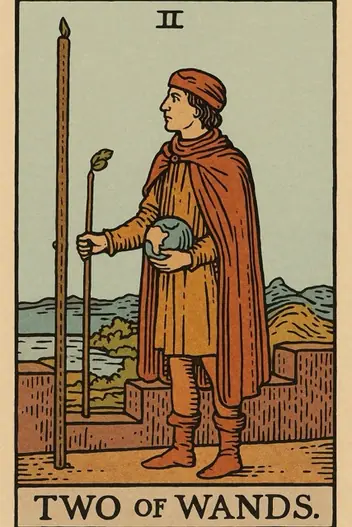
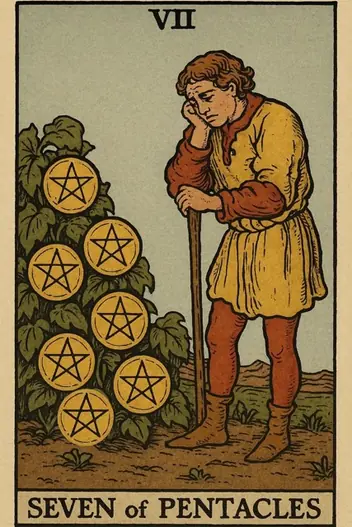
When the Two of Wands crosses paths with the Seven of Pentacles, you are standing at a crossroads of ambition and assessment. The Two of Wands represents the archetype of the Visionary—the part of you that surveys the horizon, sets long-term goals, and prepares to expand into new territories. The Seven of Pentacles embodies the Cultivator—the disciplined inner voice that insists on evaluating results, measuring effort against reward, and deciding whether to persist or pivot. Together, they create a tension between forward momentum and the need for a strategic pause.
Psychologically, this pairing activates what Jung called the "reality function"—the ego’s capacity to test inner visions against outer conditions. You may feel a strong urge to launch a new project or relationship phase, yet the Seven of Pentacles demands you first audit your current resources. This is not a time for impulsive leaps but for calculated patience. The core question becomes: Is my current plan yielding sustainable growth, or am I mistaking activity for progress? The answer requires both courage to see the big picture and humility to acknowledge what isn't working.
What Do Two of Wands and Seven of Pentacles Mean Together?
The core dynamic here is a strategic feedback loop between planning and evaluation. The Two of Wands provides the long-term vision—a clear sense of where you want to go, whether in career, relationships, or personal development. The Seven of Pentacles supplies the data—the tangible evidence of what your past efforts have produced. Together, they create a psychological state of grounded ambition. You are not abandoning your dreams; you are refusing to pursue them blindly.
This combination often appears when you have been working diligently on a goal (Seven of Pentacles) and are now at a decision point about its future direction (Two of Wands). The key insight is that patience does not mean passivity. The Seven of Pentacles asks you to assess your return on investment—time, energy, money, emotional labor—before the Two of Wands commits to a new path. In practical terms, this means reviewing budgets, project milestones, or relationship patterns before expanding. Beware the cognitive bias of "sunk cost fallacy" where you continue investing in a failing strategy simply because you've already invested so much. The combination urges you to ask: Is this still aligned with my vision, or am I just afraid to change course?
What Do Two of Wands and Seven of Pentacles Say About Love?
If you are single:
This pair suggests you are evaluating a potential partner or a new dating approach. You have a clear vision of what you want (Two of Wands), but the Seven of Pentacles warns you to look at the actual evidence—are they consistent, reliable, and emotionally available? Don't get lost in future fantasies; check the reality of their past behavior.
If you are in a relationship:
You and your partner may be at a strategic decision point—discussing moving in together, marriage, or a major lifestyle change. The Seven of Pentacles asks you to honestly assess the health and sustainability of your current dynamic before committing to expansion.
In relationships, this combination highlights the tension between vision and maintenance. The Two of Wands partner wants to dream big—plan trips, start a family, or redefine the relationship structure. The Seven of Pentacles partner (or your own inner voice) insists on checking the foundation: Are we communicating effectively? Are our emotional needs being met? Are we financially stable enough? The key relationship advice is to create a structured "state of the union" conversation. Use a specific time to review what's working, what's not, and what each person needs to feel secure before moving forward. Avoid making promises based on potential alone—demand evidence of mutual effort. If one person is doing all the emotional labor (Seven of Pentacles) while the other dreams without action (Two of Wands), resentment will build. Balance is found when both partners share the work of cultivation and the thrill of vision.
Your pair is already on the table. Ask your question and draw the clarifying card
or simply focus on it
Career and Finances
Strategic Opportunities:
Audit your current projects for ROI before taking on new ones. This is an excellent time to review quarterly or yearly goals and cut what isn't working.
Strategic Opportunities:
Plan a 6-12 month expansion of a proven income stream or skill set. The Two of Wands gives you the courage to scale, but only after the Seven of Pentacles confirms the foundation is solid.
Calculated Risks:
Avoid launching a new venture without a pilot phase. The Seven of Pentacles warns against overconfidence. Do not commit resources to a "shiny object" that distracts from your core business or career trajectory.
For career and finances, this combination is a powerful decision-making framework. The Two of Wands represents strategic foresight—identifying new markets, promotions, or side projects. The Seven of Pentacles represents operational diligence—tracking metrics, managing cash flow, and evaluating team performance. The most profitable action is to create a "go/no-go" checklist based on past performance data. For example, before asking for a raise, document your measurable contributions. Before investing in a business, run a break-even analysis. Financially, this pair warns against "hope-based spending." Just because you have a big vision doesn't mean the money will follow automatically. The pragmatic approach is to reinvest profits (Seven of Pentacles) into growth (Two of Wands), not the other way around. If you're self-employed, this is a critical time to review client retention rates and project profitability before expanding your services.
Get a personalized interpretation
Unlock the combined meaning of your cards in the context of your unique question — for free.
Shadow Side & Pitfalls
The shadow side of this combination manifests as analysis paralysis or premature abandonment. When the Seven of Pentacles' evaluative energy becomes obsessive, you may endlessly second-guess yourself, refusing to make any decision until you have "perfect data." This leads to missed opportunities and stagnation—the very opposite of the Two of Wands' forward momentum. Alternatively, the Two of Wands' visionary energy can become reckless overconfidence, where you ignore the Seven of Pentacles' warning signs and charge ahead with a flawed plan.
Cognitively, you may fall prey to the "optimism bias" (believing your vision is immune to failure) or the "negativity bias" (seeing only flaws and never feeling ready). Another common pitfall is impatience with the process—you want the harvest (Seven of Pentacles) immediately, but the Two of Wands reminds you that true growth takes time. If you feel frustrated, check if you are comparing your "behind-the-scenes" work to others' "highlight reels." Self-sabotage occurs when you either stop planning (fear of failure) or stop evaluating (fear of reality). The healthy path is to integrate both: plan ambitiously, but check your progress with ruthless honesty.
What If Two of Wands or Seven of Pentacles Appears Reversed?
When cards appear in a reversed position, the tension between planning and execution intensifies, shifting into dysfunction.
If the Two of Wands is reversed:
This indicates blocked potential or recklessness. You are either afraid to make a choice, endlessly analyzing options, or conversely, grabbing at everything without a strategy. Advice: narrow your focus to one, most important goal.
If the Seven of Pentacles is reversed:
This is a signal of internal resistance and weakness. You have invested resources, but refuse to see the real results, preferring illusions. This can manifest as perfectionism that paralyzes action. Advice: accept the imperfection of the current result as a stage.
If BOTH are reversed:
This is a complete imbalance of dynamics, leading to apathy and loss of meaning. You don't know where to go (reversed Two), and you don't see the point in what you are doing (reversed Seven). Advice: return to basic values. Ask yourself the question: "What is important to me right now, not in a year?" Start small, restore at least one working process.
What Is the Overall Message of Two of Wands and Seven of Pentacles?
How to constructively use the energy of the Two of Wands to balance the Seven of Pentacles? The key lies in cyclical thinking. Stop perceiving the situation as a straight line from point A to point B. Imagine it as a spiral: you return to the same questions, but at a new level.
Your strategy now is "active waiting." This is not passive sitting, but a state in which you simultaneously hold two things in focus: the overall direction (Two of Wands) and the immediate task (Seven of Pentacles). You look at the map, but you don't forget to clean your weapon.
A deep piece of advice: use the "80/20" principle (Pareto). Identify the 20% of your current actions that yield 80% of the results. Double down on them. Delegate, automate, or temporarily freeze the remaining 80% of actions that consume 80% of your time but yield only 20% of the results. This will allow you to stay true to your strategy without drowning in routine. You are not changing course; you are optimizing your movement along it.
Where to Go From Here
The intersection of Two of Wands and Seven of Pentacles is a call to balance foresight with feedback. Your big vision is valid, but its success depends on your willingness to assess current reality honestly. Whether you are planning a career move, evaluating a relationship, or managing your finances, the message is clear: Dream big, but check your data first. The most powerful decisions come from marrying ambition with evidence.
For a truly personalized reading of this combination, context is everything. The same cards can mean "time to pivot" for one person and "stay the course" for another. Use the Fortune Cards app to get a deep, individualized interpretation based on your specific question and life circumstances. Whether you access it on the web or download it, the app applies the archetypes to your unique situation—helping you see exactly where to push forward and where to pause. Don't guess; get clarity tailored to your path.
Interpretation by the Fortune Cards editorial team, based on the Rider–Waite tradition and Jungian archetypes. About our methodology · Updated: 2026-08-26
Other Combinations with Two of Wands
Other Combinations with Seven of Pentacles
Explore Individual Card Meanings
Table of Contents
- What Do Two of Wands and Seven of Pentacles Mean Together?
- What Do Two of Wands and Seven of Pentacles Say About Love?
- Career and Finances
- Shadow Side & Pitfalls
- What If Two of Wands or Seven of Pentacles Appears Reversed?
- What Is the Overall Message of Two of Wands and Seven of Pentacles?
- Where to Go From Here
Ready to find answers to your questions?
Start your first reading now and look at your situation with fresh clarity. The cards are ready to reveal deeper meaning.