Two of Wands and Ten of Wands Tarot as Feelings
- Arcana
- Two of Wands — Minor Arcana, Wands; Ten of Wands — Minor Arcana, Wands
- Elements
- Two of Wands — Fire; Ten of Wands — Fire
- Elemental interaction
- Same element — energies intensify each other
- Numerology
- 2 + 10 = 12 → 3
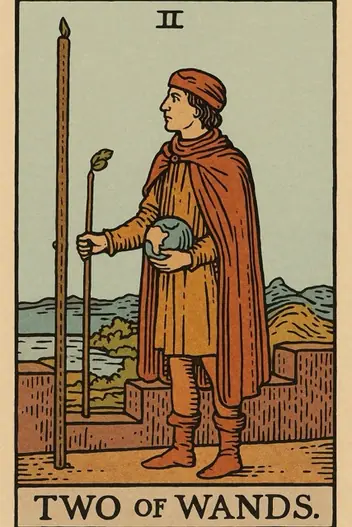
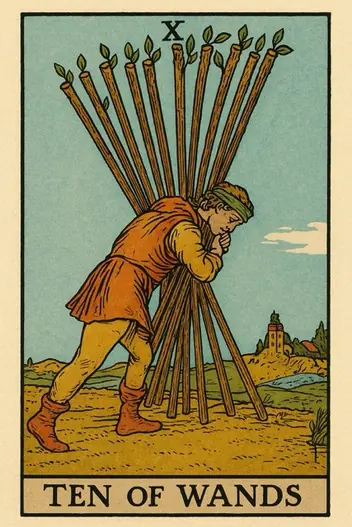
These two cards create a powerful psychological tension. The Two of Wands represents the spark of vision, future planning, and the audacity to look beyond the horizon. It is the archetype of the Explorer or the Entrepreneur—the moment when you decide to expand your territory. The Ten of Wands is the archetype of the Burdened Bearer—the embodiment of responsibility, completion, and the physical weight of carrying your ambitions. When they collide, you are not just dreaming; you are executing a large-scale plan, and the sheer effort required is now making itself known.
This combination signals a critical phase: you are moving from pure ideation into the heavy lifting of implementation. The psychological state is one of strategic overload. You are likely a high-achiever who has shouldered too much in pursuit of a grand goal. The question is not whether your vision is valid—it likely is—but whether your current resource allocation and boundaries are sustainable. This is a call for ruthless prioritization and a hard look at the cost of your expansion.
Core Dynamics & Interpretation
The core dynamic here is the friction between infinite possibility and finite capacity. The Two of Wands gives you a panoramic view of success, while the Ten of Wands reminds you that you still have to walk the path. Psychologically, this creates a risk of "Founder's Fatigue" —where the excitement of the initial idea is replaced by the grind of daily logistics. The key insight is that this burden is self-imposed. The Ten of Wands is rarely forced upon you; it is the result of saying "yes" to too many opportunities from the Two of Wands.
The most important psychological shift is moving from a heroic mindset to a managerial mindset. The hero tries to carry everything alone; the manager delegates, automates, and eliminates. This combination urges you to distinguish between what is essential and what is merely urgent. The vision (Two of Wands) is not the problem. The problem is your method of carrying it (Ten of Wands). You must ask: "What can I put down, postpone, or hand off to someone else so I can move forward without breaking?"
In practical terms, this is a stress test for your ambition. The cards suggest that your plan is viable, but your current approach is unsustainable. You need to break the large goal into smaller, manageable phases. The Ten of Wands does not mean failure; it means the final stretch is heavy. The Two of Wands gives you the foresight to see the finish line. Your task is to lighten the load strategically without abandoning the destination.
Your pair is already on the table. Ask your question and draw the clarifying card
or simply focus on it
What Do Two of Wands and Ten of Wands Indicate for Your Career?
Strategic Opportunities:
Delegation and outsourcing are your most powerful tools. Identify tasks that only you can do and offload the rest.
Strategic Opportunities:
Phased implementation. Break your big project into 3 distinct phases. Complete phase one before starting phase two.
Calculated Risks:
Avoid taking on new clients or projects until you have cleared your current backlog. Overcommitment will lead to quality drops and burnout.
This is a high-stakes career reading. You are likely a manager, entrepreneur, or senior professional who is overwhelmed by success. The Two of Wands indicates you have a clear, ambitious vision—perhaps a new business line, a major product launch, or a career pivot. The Ten of Wands says you are carrying the weight of previous commitments, unfinished tasks, and operational inefficiencies. Your financial risk is not lack of opportunity, but lack of bandwidth.
The most important financial warning is to avoid "shiny object syndrome." The Two of Wands can tempt you to start yet another initiative, but the Ten of Wands warns that your resources are already stretched thin. Calculate the true cost of your ambition—not just in money, but in time, energy, and team morale. A strategic pause is not a sign of weakness; it is a sign of wisdom. Focus on completing current deliverables before expanding. If you are in a negotiation, do not agree to new terms unless they come with additional support or resources to handle the load.
What Do Two of Wands and Ten of Wands Say About Love?
If you are single:
This pair suggests you are overthinking a potential connection. You have a grand vision of an ideal partner, but you are carrying too many past expectations or fears. Focus on the first step rather than the entire future.
If you are in a relationship:
You or your partner is feeling burdened by the relationship's responsibilities. One person may be doing all the planning and emotional labor, while the other feels the weight of unspoken expectations.
In relationships, the Two of Wands combined with the Ten of Wands often indicates unequal distribution of responsibility. One partner is the "visionary" (Two of Wands) who plans the future—the dream home, the vacations, the family goals—while the other partner (or both) feels like they are carrying the weight of making it all happen (Ten of Wands). This is a classic recipe for resentment. The relationship dynamic becomes transactional: "I do all the work while you dream."
The key relationship advice is to renegotiate the workload. If you are the visionary, you must also be the logistics manager—or delegate tasks fairly. If you are the bearer of the burden, you must communicate your limits before you collapse. The psychological risk is that the burdened partner will eventually drop everything, sabotaging the shared vision. Bold, honest conversations about capacity and boundaries are non-negotiable here. Both partners need to agree on a smaller, more manageable set of shared goals to prevent burnout.
Deepen your understanding
Find out exactly what this reading means for your current life situation with our oracle.
What Are the Risks of Two of Wands and Ten of Wands?
The shadow of this combination is the martyr complex. You may secretly enjoy the drama of being overburdened, viewing it as proof of your importance or dedication. This is a cognitive bias known as "effort justification" —you believe that because something is hard, it must be valuable. The danger is that you will burn out before you cross the finish line, sabotaging your own vision. Another pitfall is paralysis by analysis: you spend so much time planning (Two of Wands) that you never actually start the heavy work (Ten of Wands), or you start and immediately feel crushed.
Self-sabotage manifests as poor judgment in priorities. You might take on a task that is urgent but not important, simply because it feels productive. This combination also warns against isolation. The Ten of Wands often shows a figure carrying the burden alone, but the Two of Wands shows a figure with a global perspective. If you are not seeking help, you are ignoring the data. The shadow side is a refusal to delegate because of a lack of trust or a need for control. Recognize that your vision will die if you do not share the load.
Reversed Two of Wands and Ten of Wands Explained
If the Two of Wands is reversed, it indicates blocked potential or recklessness. You either fear taking the first step, rejecting opportunities due to fear of the burden (the Ten), or conversely, you act impulsively, without a map or compass. Advice: return to strategic planning. Do not move forward until you understand where you are going and why.
If the Ten of Wands is reversed, it often signifies internal resistance or weakness. You acknowledge that the burden is too heavy, but instead of redistributing it, you dump everything in a heap and sabotage the process. Warning: this is not liberation, but escape. The risk of losing what has already been achieved (the results of the Two) is very high.
If BOTH cards are reversed, this is a complete imbalance of dynamics. You simultaneously do not know what you want (distorted Two) and are unable to bear what you already have (distorted Ten). The logical way to correct this: a complete halt. You need to exit the "doing" mode and enter the "observing" mode. No new projects, no heroics. Only reflection and restoration of a basic energy level.
Two of Wands and Ten of Wands Combined Message
How can the energy of the Two of Wands be used constructively to balance the Ten of Wands? The key to the solution lies in shifting roles from "executor" to "architect". The Two of Wands is a card of choice and power. Use this power not to take on a new burden, but to redistribute the existing one. Your task is not to carry the load, but to build a system that carries itself.
A deep strategic advice: conduct an "audit of ambitions". Take a sheet of paper and divide it into two columns: "My Goals" and "My Actions". Honestly correlate which of your current actions truly lead to your goals, and which are merely noise and habit. Throw away everything that does not serve the main goal. This is painful because it requires admitting that part of your "heroic" labor was in vain. But this is the only way to transform an exhausting burden into a manageable project.
Understand the main point: the Ten of Wands is not punishing you. It signals that your strategy (the Two) needs revision. Do not try to carry more—learn to choose better. By freeing yourself from the excess, you will regain the ability to see the horizon clearly and move toward it without the risk of burning out.
Applying This to Your Situation
The core message of Two of Wands and Ten of Wands is clear: your ambition is valid, but your current method of execution is unsustainable. You must step back, re-evaluate your priorities, and offload what you can. This is not a time to abandon your goals; it is a time to re-engineer your approach to make the journey manageable. The key to success lies in strategic delegation and phased action.
While this article provides a deep understanding of the general archetypes, the true power of Tarot lies in applying it to your specific situation. The Fortune Cards app allows you to input your exact question—whether about a relationship conflict, a career decision, or a personal block—and receive a detailed, personalized interpretation of this exact card combination. You can use it right now on the web or download it to get the clarity you need to move forward with confidence and strategy.
Interpretation by the Fortune Cards editorial team, based on the Rider–Waite tradition and Jungian archetypes. About our methodology · Updated: 2026-08-26
Other Combinations with Two of Wands
Other Combinations with Ten of Wands
Explore Individual Card Meanings
Table of Contents
- Core Dynamics & Interpretation
- What Do Two of Wands and Ten of Wands Indicate for Your Career?
- What Do Two of Wands and Ten of Wands Say About Love?
- What Are the Risks of Two of Wands and Ten of Wands?
- Reversed Two of Wands and Ten of Wands Explained
- Two of Wands and Ten of Wands Combined Message
- Applying This to Your Situation
Ready to find answers to your questions?
Start your first reading now and look at your situation with fresh clarity. The cards are ready to reveal deeper meaning.