Love Tarot: Wheel of Fortune and Eight of Swords

- Arcana
- Wheel of Fortune — Major Arcana; Eight of Swords — Minor Arcana, Swords
- Elements
- Wheel of Fortune — Fire; Eight of Swords — Air
- Elemental interaction
- Friendly elements — energies support each other
- Numerology
- 10 + 8 = 18 → 9
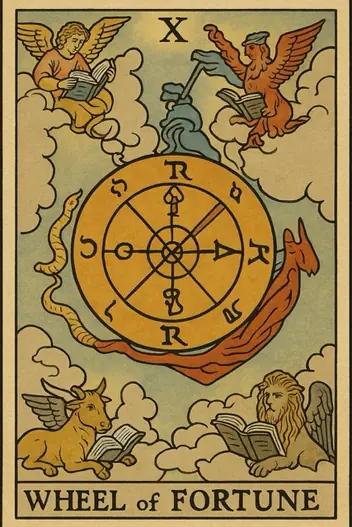
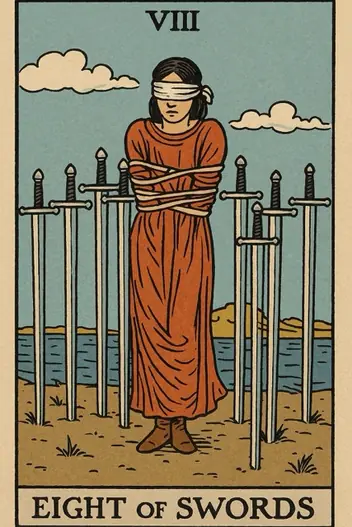
When the Wheel of Fortune—the archetype of cyclical change, destiny, and uncontrollable external forces—meets the Eight of Swords—the card of self-imposed restriction, mental paralysis, and victimhood—a powerful psychological tension emerges. This combination often appears when a person is experiencing a major life shift but feels trapped by their own thoughts or circumstances. The Wheel says "change is coming," while the Eight of Swords whispers "you can't escape."
In practice, this pairing reveals a critical juncture: the seeker's mindset is the primary obstacle to navigating inevitable change. The external situation may be shifting beyond their control, but their internal narrative of helplessness is what truly binds them. This is not a time for passive resignation; it is a call to recognize that perceived limitations are often cognitive distortions, not concrete barriers.
What Do Wheel of Fortune and Eight of Swords Mean Together?
The core dynamic here is a collision between external inevitability and internal resistance. The Wheel of Fortune represents the flow of life—opportunities, losses, and cycles that arrive regardless of personal readiness. The Eight of Swords, however, depicts a figure blindfolded and surrounded by swords, symbolizing a state of learned helplessness. When these cards combine, the seeker may feel that fate is conspiring against them, when in reality, they are interpreting change through a lens of fear and self-doubt.
This pairing often emerges during career transitions, relationship shifts, or personal crises where the seeker feels powerless. The key insight is that the Wheel is not inherently negative—it merely brings change. The Eight of Swords amplifies the anxiety around that change, making the seeker focus on worst-case scenarios rather than potential opportunities. Cognitive reframing is essential here: the blindfold can be removed, and the swords are not traps but tools waiting to be used.
Psychologically, this is a classic conflict between the ego (Eight of Swords) and the Self (Wheel of Fortune). The ego wants control and certainty; the Self demands surrender to life's rhythms. The practical takeaway: you cannot control what happens, but you can control how you respond. The first step is to identify which thoughts are realistic constraints and which are self-imposed limitations.
Your pair is already on the table. Ask your question and draw the clarifying card
or simply focus on it
Love and Relationships
If you are single:
This combination suggests you may be idealizing or fearing a potential partner based on past cycles. The Wheel indicates a destined meeting or change in your love life, but the Eight of Swords warns that your own insecurities or rigid expectations could block genuine connection. Focus on distinguishing between real red flags and projected fears.
If you are in a relationship:
The pairing points to a power imbalance or communication breakdown where one partner feels trapped by the other's expectations or by repetitive arguments. The Wheel of Fortune signals that the relationship is entering a new phase—whether growth or dissolution—but the Eight of Swords indicates that fear of change is preventing honest dialogue.
In relationships, this combination often manifests as a cycle of stagnation masked by fear. One or both partners may feel stuck, blaming external circumstances (work stress, family obligations) for their unhappiness, when the real issue is internal resistance to vulnerability. The Wheel of Fortune asks you to acknowledge that relationships naturally evolve; the Eight of Swords challenges you to stop playing the victim.
Key advice: Break the pattern by speaking your truth, even if it feels risky. The blindfold is self-imposed—remove it by asking direct questions. If you're single, stop waiting for fate to deliver the perfect partner; take calculated action. If coupled, schedule a structured conversation about where the relationship is heading, and commit to listening without defensiveness.
What Do Wheel of Fortune and Eight of Swords Indicate for Your Career?
Strategic Opportunities:
Reevaluate your career trajectory—the Wheel indicates a shift is coming, possibly a promotion, layoff, or industry change. Use this time to update your skills or network while you still have the power to choose.
Strategic Opportunities:
Identify one cognitive bias (e.g., imposter syndrome, fear of failure) that is currently limiting your decision-making. Reframe it as a data point, not a verdict.
Calculated Risks:
Avoid making major financial decisions from a place of panic. The Eight of Swords can amplify risk aversion, leading to missed opportunities. Conversely, the Wheel may tempt you to gamble on a "lucky break"—stick to evidence-based strategies.
Professionally, this combination warns against passive acceptance of a bad situation. If you feel stuck in a dead-end job or toxic work environment, the Wheel of Fortune suggests that change is possible—but the Eight of Swords reveals that your own narrative of helplessness is the real cage. Perhaps you believe you lack options, but a closer look shows you've overlooked networking, skill-building, or negotiation.
Financial warning: Do not confuse the Wheel's cycles with random luck. While the Wheel can bring windfalls, it also brings downturns. The Eight of Swords advises you to build an emergency fund and diversify income streams before making risky moves. If you're considering a career pivot, test the waters with a side project or part-time course before quitting.
Deepen your understanding
Find out exactly what this reading means for your current life situation with our oracle.
What If Wheel of Fortune or Eight of Swords Appears Reversed?
If The Wheel of Fortune is reversed, this indicates blocked potential or reckless resistance to change. You aren't just afraid — you are actively sabotaging any changes, clinging to what is outdated. Advice: acknowledge that your resistance is a form of control that drains your resources. Release the illusion that you can stop time.
When the Eight of Swords is reversed, this paradoxically intensifies inner resistance and weakness. You know what needs to be done, but you refuse. This is not ignorance, but a conscious choice to remain in the problem. Warning: this is a path to depression and apathy. Don't wait for an external push — take one small action to break the vicious cycle.
If BOTH cards are reversed, a complete imbalance of dynamics arises. Fate offers no clear signs, and you are paralyzed by apathy and self-sabotage. A logical way to correct this: return to basics — start a decision journal, recording what you control and what you don't. Advice: seek not the "perfect moment," but a "good enough" one. One action per day will pull you out of your stupor.
Shadow Side & Pitfalls
The shadow of this combination is fatalistic passivity dressed as wisdom. The seeker may rationalize inaction by saying "it's fate" or "I can't change my circumstances," when they are actually avoiding responsibility. This is a cognitive distortion known as "learned helplessness" —the belief that one's actions have no effect on outcomes, leading to depression and stagnation.
Another pitfall is catastrophizing: the seeker may interpret every small setback as proof that the Wheel is against them, reinforcing the Eight of Swords' narrative of victimhood. This can lead to self-sabotage, where the seeker unconsciously creates negative outcomes to confirm their beliefs. For example, they might reject a promotion because "it's too risky," then blame the system for holding them back.
Beware of magical thinking—the belief that the Wheel will solve problems without effort. The Eight of Swords demands active psychological work: therapy, journaling, or structured decision-making. Without this, the seeker remains trapped in a cycle of complaint without change.
Wheel of Fortune and Eight of Swords Combined Message
Constructively using the energy of the Wheel of Fortune to balance the Eight of Swords requires shifting from a "victim" position to that of a "strategic observer." The Wheel symbolizes objective cycles—seasons, market trends, life stages. The Eight represents the noise in your head that prevents you from seeing these cycles. Your task is not to fight change, but to learn to read it and adapt.
A deep strategic counsel: use the "mental detector" technique. When you feel paralyzed (the Eight of Swords), ask yourself three questions: (1) What changes are objectively happening around me? (2) Which of my fears are based on facts, and which on assumptions? (3) What one action can I take right now to test reality? This transforms abstract fear into a concrete plan.
Remember: the Wheel of Fortune never stands still. Even if you don't move, the world keeps turning. Your choice is either to be swept away by the current without a rudder or sails, or to take the helm, acknowledging that the only real trap is your belief in its existence. Take the blindfold off your eyes—and you will see that the doors that seemed locked are actually open.
Applying This to Your Situation
The Wheel of Fortune and Eight of Swords together deliver a stark message: your fate is shaped by both external events and your internal response. The change is coming; the only question is whether you will meet it as a victim or as an active participant. Remove the blindfold by questioning your assumptions, and use the Wheel's momentum to pivot toward growth rather than resistance.
Get a personalized reading for this exact combination by using the Fortune Cards app. While this article provides the general archetype, the true magic happens when Tarot is applied to your unique situation. The app analyzes your specific question—whether about love, career, or personal growth—and delivers a deep, contextual interpretation. Use it on the web or download it now to break free from the cycle of doubt and take control of your next move.
Interpretation by the Fortune Cards editorial team, based on the Rider–Waite tradition and Jungian archetypes. About our methodology · Updated: 2026-10-08
Other Combinations with Wheel of Fortune
Other Combinations with Eight of Swords
Explore Individual Card Meanings
Table of Contents
- What Do Wheel of Fortune and Eight of Swords Mean Together?
- Love and Relationships
- What Do Wheel of Fortune and Eight of Swords Indicate for Your Career?
- What If Wheel of Fortune or Eight of Swords Appears Reversed?
- Shadow Side & Pitfalls
- Wheel of Fortune and Eight of Swords Combined Message
- Applying This to Your Situation
Ready to find answers to your questions?
Start your first reading now and look at your situation with fresh clarity. The cards are ready to reveal deeper meaning.