Ace of Cups and Eight of Swords Together in Tarot

- Arcana
- Ace of Cups — Minor Arcana, Cups; Eight of Swords — Minor Arcana, Swords
- Elements
- Ace of Cups — Water; Eight of Swords — Air
- Elemental interaction
- Neutral elements — energies coexist without conflict
- Numerology
- 1 + 8 = 9
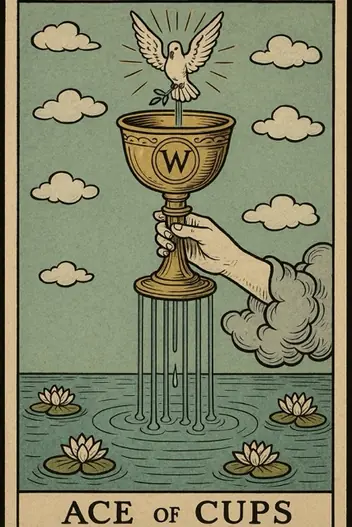
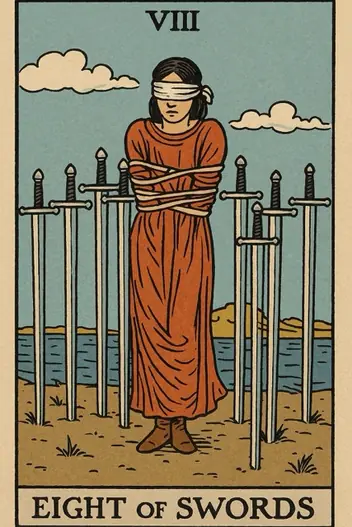
The Ace of Cups represents a raw, unconditional surge of emotional potential—love, intuition, and openness. The Eight of Swords, by contrast, depicts self-imposed mental paralysis—a state of feeling trapped by your own limiting beliefs, guilt, or fear. When these two cards appear together, the central tension is clear: you have access to profound emotional resources, yet your mind is constructing a cage around them.
This is not a straightforward "good" or "bad" combination. Instead, it’s a psychological paradox: your heart knows what it wants, but your head is running a narrative of powerlessness. The key insight here is that the "swords" are not real barriers—they are cognitive distortions born from past wounds or perfectionism. The Ace of Cups offers the cure: a willingness to feel, trust, and act from emotional authenticity rather than intellectual overanalysis.
What Do Ace of Cups and Eight of Swords Mean Together?
The Ace of Cups and Eight of Swords together create a high-stakes internal conflict between emotional truth and mental restriction. The Ace invites you to open your heart—to love, to forgive, to receive. But the Eight of Swords whispers that you are not safe, not good enough, or that expressing your feelings will lead to rejection. This dynamic often manifests as emotional paralysis: you feel a deep, genuine desire for connection, yet you talk yourself out of acting on it.
Psychologically, this mirrors the Jungian concept of the "shadow"—the parts of yourself you suppress. The Ace of Cups represents your authentic Self, while the Eight of Swords symbolizes the inner critic or the "false self" constructed from societal expectations. The practical implication is that your greatest obstacle is not external circumstances, but your own story about them. You may be overanalyzing a relationship, a career move, or a creative project, when the real solution is to trust your emotional intelligence and take a small, courageous step forward.
The core dynamic is a call to action: stop waiting for perfect clarity. The Eight of Swords suggests that clarity will never come from more thinking—it will come from doing. The Ace of Cups provides the emotional fuel to break the cycle of self-doubt. Your task is to recognize that the "prison" is made of your own thoughts, and that the key is already in your hand.
Ace of Cups and Eight of Swords in Love Tarot
If you are single:
This combination warns against idealizing a potential partner while simultaneously fearing rejection. You may feel a strong pull toward someone, but your mind is creating reasons to hold back—fear of vulnerability, past heartbreak, or perfectionism. The advice is to act on your feelings before your inner critic talks you out of it.
If you are in a relationship:
You or your partner may be withholding emotional expression due to guilt, resentment, or fear of rocking the boat. The Ace of Cups offers a chance for renewed intimacy, but the Eight of Swords suggests that silence or avoidance is deepening the disconnect.
In relationships, this combination often points to a power imbalance in emotional honesty. One person (or both) feels trapped by unspoken fears—perhaps a fear of being too needy, or a fear of being seen as weak. The Ace of Cups is a gift of emotional vulnerability, but the Eight of Swords demands that you reframe vulnerability as strength, not weakness. To move forward, you must initiate an honest conversation about what you truly feel, even if it feels risky. The risk of staying silent is far greater than the risk of speaking your heart.
Key relationship advice: If you feel stuck, ask yourself: "Am I protecting myself from a real threat, or from an imagined one?" The answer will reveal whether the "swords" are real or self-imposed. Take the first step toward emotional openness—whether it’s a simple compliment, an apology, or a confession of desire.
Your pair is already on the table. Ask your question and draw the clarifying card
or simply focus on it
Career and Finances
Strategic Opportunities:
Use your emotional intelligence to navigate office politics or negotiations. The Ace of Cups gives you the ability to read people and build trust. This is a powerful asset in team projects or client relationships.
Strategic Opportunities:
Explore a creative or passion-driven project that you’ve been overthinking. The Eight of Swords suggests you have been paralyzed by "what ifs." The Ace of Cups says your intuition is your best guide.
Calculated Risks:
Avoid making major financial decisions driven by guilt or fear. The Eight of Swords can distort your perception of risk, making you either overly cautious or impulsively reckless. Get objective data before committing.
Professionally, this pair signals a conflict between heart and head. You may feel stuck in a job or role that doesn't fulfill you, yet you fear the consequences of change. The Ace of Cups urges you to align your work with your values—to do what you love, not just what is safe. However, the Eight of Swords warns against impulsive quitting without a plan. Instead, use your emotional clarity to identify one concrete step toward a more fulfilling path, such as updating your resume, networking, or starting a side project.
Financial warning: Be wary of spending money to "buy" happiness or to escape feelings of inadequacy. The Ace of Cups is about inner fulfillment, not external validation. Invest in experiences or skills that genuinely expand your emotional well-being, not in status symbols that only feed the inner critic.
Uncover hidden insights
Let our advanced Tarot system interpret these archetypes specifically for your personal path.
What If Ace of Cups or Eight of Swords Appears Reversed?
If the Ace of Cups is Reversed:
The emotional source is blocked. This is not just fear, but apathy and emotional exhaustion. You cannot feel even the potential for love or joy. In combination with the upright Eight of Swords, this creates a toxic mixture of self-criticism and emptiness. Advice: First, restore your resources (sleep, rest, basic needs), then work on your beliefs.
If the Eight of Swords is Reversed:
The mental block begins to break down, but this happens chaotically. You may act impulsively, without a strategy, simply to "break out of the cage." Warning: Do not confuse activity with progress. Your actions can be destructive if they are not supported by the awareness of the Ace of Cups.
If BOTH are Reversed:
Complete imbalance. You are denying your feelings (Ace of Cups reversed) while simultaneously plunging into the chaos of anxious thoughts (Eight of Swords reversed). This is a state of chronic stress and burnout. The only logical way to correct this is a complete stop. Take a "time-out" from making any decisions for 48 hours.
What Are the Risks of Ace of Cups and Eight of Swords?
The shadow of this combination is emotional martyrdom—using your suffering as a justification for inaction. You might think, "I can't act because I'm too hurt," or "If they really loved me, they would save me." This is a cognitive distortion that keeps you stuck in a victim narrative. The Eight of Swords is not about real external barriers—it’s about self-imposed boundaries that you mistake for reality.
Another pitfall is emotional flooding: the Ace of Cups can overwhelm you with intensity, and the Eight of Swords can amplify your fear of losing control. This can lead to impulsive, reactive decisions—such as confessing feelings to someone who isn’t ready, or quitting a job in a moment of frustration. The shadow warns against mistaking emotional intensity for clarity. Not every feeling demands immediate action.
Finally, watch for perfectionism disguised as self-awareness. You may believe you are being "realistic" when you are actually using fear to avoid vulnerability. The shadow asks: Are you truly protecting yourself, or are you avoiding the risk of being fully alive? The answer lies in whether your "analysis" leads to growth or stagnation.
Synthesis: Strategic Conclusion
How can you constructively use the energy of the Ace of Cups to balance the Eight of Swords? The key lies in differentiating feelings from thoughts. The Ace of Cups grants you access to pure experience—it is your compass. The Eight of Swords is the noise, the static that distorts the signal. Your strategy is to learn to hear the compass through the noise.
In practical terms, this looks like: when you feel fear and paralysis (the Eight), ask yourself: "What do I feel on a raw level, before my mind began interpreting it?" The answer might be: "I feel warmth and a desire to approach" (the Ace of Cups). Then ask: "Which specific thought is blocking this action?" The answer: "I'm afraid of being rejected." By recognizing this structure, you cease to be a victim of your own mind. You see that the fear is merely a thought, not a fact.
Your strategic conclusion: Action is the best cure for paralysis. There is no need to wait for the fear to disappear completely. Take a micro-step dictated by the Ace of Cups: give a compliment, send a message, start drawing. Each small action will dismantle the construction of the Eight of Swords. You will not conquer fear by arguing with yourself—you conquer it by proving to yourself, through practice, that the world did not collapse.
Where to Go From Here
The Ace of Cups and Eight of Swords together deliver a powerful message: your emotional potential is real, but your mental prison is an illusion. The only way out is through—by trusting your heart enough to take a small, courageous action. Whether in love, career, or personal growth, the solution is not more thinking, but more feeling and doing.
However, this general interpretation can only go so far. The true meaning of this combination depends on your unique question, your personal history, and the specific cards surrounding them. To get a deep, personalized interpretation that applies directly to your situation, use the Fortune Cards app. You can access it on the web or download it to your device. Enter your exact question, and the app will analyze the Ace of Cups and Eight of Swords in the context of your life—giving you the strategic clarity and emotional insight you need to take your next step with confidence.
Interpretation by the Fortune Cards editorial team, based on the Rider–Waite tradition and Jungian archetypes. About our methodology · Updated: 2026-10-08
Other Combinations with Ace of Cups
Other Combinations with Eight of Swords
Explore Individual Card Meanings
Table of Contents
Ready to find answers to your questions?
Start your first reading now and look at your situation with fresh clarity. The cards are ready to reveal deeper meaning.