Ace of Wands and Five of Cups Tarot as Feelings
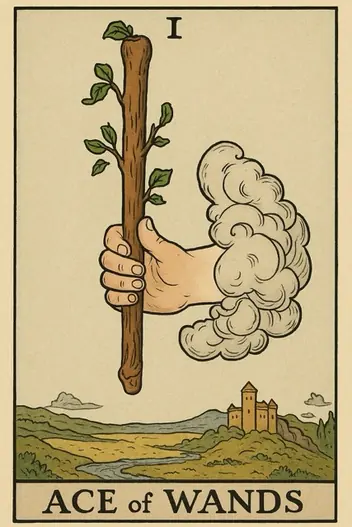

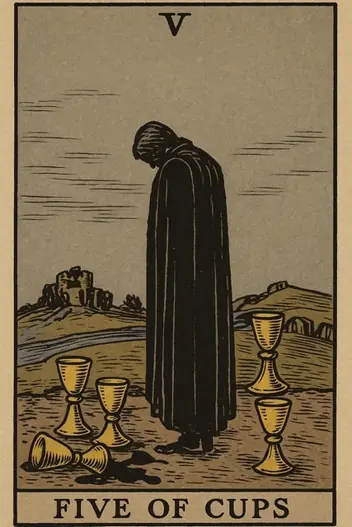
- Arcana
- Ace of Wands — Minor Arcana, Wands; Five of Cups — Minor Arcana, Cups
- Elements
- Ace of Wands — Fire; Five of Cups — Water
- Elemental interaction
- Opposing elements — energies create tension
- Numerology
- 1 + 5 = 6
The Ace of Wands represents a potent surge of creative energy, a new beginning, or a bold inspiration that demands action. It is the spark of a project, the thrill of a new relationship, or the raw potential of an entrepreneurial idea. In contrast, the Five of Cups embodies the psychological state of grief, disappointment, and a focus on what has been lost. It is the archetype of the "spilled milk" syndrome—where the mind fixates on the three fallen cups while ignoring the two still standing behind.
When these two cards appear together, the core dynamic is a collision between forward momentum and backward-looking regret. Psychologically, this combination often manifests as a person who has a brilliant new idea or opportunity (Ace) but is paralyzed by the emotional hangover of a past failure or relationship (Five). The key strategic insight is that the Ace’s fire cannot fully ignite if the seeker remains trapped in a cycle of mourning. The real-world implication is a test of emotional resilience: can you channel the pain of the past into the fuel for a new beginning, or will you let disappointment extinguish your creative spark?
What Do Ace of Wands and Five of Cups Mean Together?
This pairing creates a psychological tug-of-war between the heroic impulse (Ace of Wands) and the wounded inner child (Five of Cups). The Ace of Wands demands you take a leap of faith, while the Five of Cups insists you first acknowledge the injury. The most important insight here is that this is not a conflict to resolve, but a process to manage. The seeker must learn to hold both the grief of the past and the excitement of the future simultaneously without letting one cancel out the other.
From a Jungian perspective, the Five of Cups represents the shadow of the Ace of Wands. The very drive for a new beginning often stems from an attempt to escape or compensate for a previous loss. If you rush into the Ace’s opportunity without processing the Five’s grief, you risk creating a repetitive cycle of starting projects that collapse under unresolved emotional weight. The pragmatic action is to schedule a deliberate period of reflection—perhaps a three-day "grief audit"—before committing to the new path. This prevents the new venture from becoming a reactionary escape rather than a conscious choice.
The real-world implication is a strategic pause. The combined energy says: you have the raw power to create something new, but you must first clear the emotional debris of the old. Think of it as clearing a burned forest before planting new seeds. The most effective approach is to use the Ace’s fire to burn away the Five’s attachments, transforming sorrow into a clarifying force. Ask yourself: What specific lesson from the loss can I directly apply to this new opportunity? This reframes the pain as data, not a prison.
Your pair is already on the table. Ask your question and draw the clarifying card
or simply focus on it
Love and Relationships
If you are single:
This pairing suggests you may be holding a torch for a past relationship, blocking a new, vibrant connection. The new person you meet (Ace) will feel like a breath of fresh air, but your own unresolved grief (Five) will make you hesitant to trust.
If you are in a relationship:
One partner may be excited about a new chapter—moving in, a baby, or a shared project—while the other is still grieving a previous disappointment or lost independence. This creates a power imbalance where one person feels rushed, and the other feels unheard.
The relationship dynamic here is a classic approach-avoidance conflict. The Ace of Wands lover wants to build, explore, and ignite passion, while the Five of Cups partner is stuck in a cycle of "what if" and "if only." The core psychological work is to differentiate between healthy grief and emotional inertia. Healthy grief is processed and released; emotional inertia becomes a permanent state of victimhood that suffocates the relationship.
The most important relationship advice is to practice radical transparency. If you are the Five of Cups partner, you must explicitly state: "I am excited about us, but I need time to fully close a previous chapter." If you are the Ace partner, you must resist the urge to "fix" your partner’s sadness. Instead, offer a structured timeline for processing—e.g., "I will support you in grieving this for two weeks, but after that, we commit to building together." This turns an emotional impasse into a manageable project. Avoid the trap of hoping the new spark will automatically heal old wounds; it won’t.
What Do Ace of Wands and Five of Cups Indicate for Your Career?
Strategic Opportunities:
Launch a passion project or side business that directly uses lessons learned from a past failure. The loss gave you hard-won expertise that makes this new venture more resilient.
Strategic Opportunities:
Pursue a role that allows you to mentor others who have experienced similar setbacks. Your grief has given you emotional authority and empathy that is a rare professional asset.
Calculated Risks:
Avoid investing significant capital into a new venture while still emotionally raw from a previous loss. The risk of "revenge investing" —making impulsive decisions to prove you’re over the failure—is very high.
In a career context, this combination often appears when a professional has just received a rejection, lost a client, or been laid off (Five of Cups) but simultaneously sees a new, exciting opportunity (Ace of Wands). The trap is to either over-idealize the new path (seeing it as the "perfect" solution) or dismiss it entirely (believing you don’t deserve success after failure). The pragmatic frame is portfolio thinking: treat your career as a series of experiments. The Ace is a new experiment, and the Five is the data from the last one.
The key financial warning is to avoid "loss-chasing." Do not try to immediately recoup a financial loss by making a high-risk bet on the Ace of Wands opportunity. Instead, set a "cooling-off" rule: wait 72 hours before making any major financial commitment to the new idea. Use that time to write down exactly what went wrong in the past and create a checklist to ensure the new venture avoids those specific pitfalls. Your best strategic move is to use the Ace’s energy to build a "loss-log" —a document that transforms your grief into a risk-management tool. This is not about being pessimistic; it is about being strategically resilient.
Get a personalized interpretation
Unlock the combined meaning of your cards in the context of your unique question — for free.
Reversed Positions: What Changes?
Reversed cards here act as catalysts, accelerating or distorting the core dynamics.
If the Ace of Wands is reversed:
This is impulsive recklessness without emotional processing. You start a new project without resolving the past. The Five of Cups in its upright position will "scream" that you are running from a problem, not toward a goal. Advice: Stop. Your "new idea" is most likely a form of avoidance. You need to first go through a stage of conscious mourning, otherwise you will fail at the start.
If the Five of Cups is reversed:
This is repressed grief or resistance to acceptance. The person demonstratively says "everything is fine," but the Ace of Wands finds no resonance—the energy strikes a void. This is a dangerous state, as suppressed emotions (the Five) can suddenly destroy the undertaking (the Ace). Advice: Acknowledge your vulnerability. Only through an honest admission of pain can you harness the power of the Ace.
If BOTH are reversed:
Complete imbalance. Chronic procrastination and self-sabotage. You deny both your potential (reversed Ace) and your traumas (reversed Five). This is a state of "energetic paralysis." Correction: Harsh reflection is required. Make two lists: "What I want but am afraid to start" and "What I have lost but am afraid to let go of." Physically destroy the second list. Only after this will the first list have a chance of being realized.
What Are the Risks of Ace of Wands and Five of Cups?
The shadow manifestation of this combination is compulsive "bright-siding" —using the Ace of Wands’ optimism to bypass the necessary grief of the Five of Cups. The seeker convinces themselves that "this new opportunity will make everything better," when in reality they are running away from emotional processing. This leads to a cognitive bias called the "fresh start fallacy" : the belief that a new beginning will automatically erase old patterns. It won’t. The result is a cycle of starting projects, hitting the first real obstacle, and then collapsing because the underlying grief was never addressed.
Conversely, the shadow can manifest as chronic nostalgia (Five of Cups) masquerading as wisdom. The seeker rationalizes their paralysis by saying "I’m being cautious" or "I’m learning from my mistakes," when in truth they are using past trauma as an excuse to avoid risk. This is a form of self-sabotage through over-analysis. The psychological mechanism here is learned helplessness—the belief that because one thing went wrong, all future attempts are doomed. The danger is that this mindset can permanently extinguish the Ace’s creative spark, leading to a life of quiet regret. The antidote is to set a strict deadline for grief and treat the Ace as a non-negotiable experiment.
Ace of Wands and Five of Cups Combined Message
How can this combination be used constructively? Your task is to integrate the experience of the past without dissolving into it. The Ace of Wands is not fuel for escape, but a tool for building a new foundation. The Five of Cups is not a verdict, but a map of the terrain where you have already stumbled.
The "Golden Mean" strategy is as follows: you channel the energy of the Ace into a ritual of farewell. Instead of suppressing grief, you allocate it a strictly limited amount of time and resources. For example, you could write a letter to the past experience (the Five) and burn it, using the flame of the Ace. This is not mysticism, but a psychological technique that breaks the "thought-emotion-inaction" cycle.
Next, shift your focus from "why" to "what for". The Five of Cups is fixated on the question "why did this happen?". The Ace of Wands demands an answer to the question "what is this for me now?". Your next step is to formulate a specific, measurable outcome for the new beginning that is in no way linked to compensating for the past. If you are starting a relationship, it should not be "to forget an ex," but "to explore a new model of attachment."
The main takeaway:
You stand on a threshold where the past no longer holds power over you, yet you continue to obey it. Use the Ace of Wands as a scalpel to sever the emotional umbilical cord of the Five of Cups. Only when you acknowledge the loss as complete will the new energy cease to be a threat and become a resource.
Where to Go From Here
The core message of the Ace of Wands and Five of Cups is that your painful past is the most valuable asset for your creative future, but only if you process it consciously. You are not being asked to choose between grief and growth; you are being asked to integrate them. The new beginning is real, but it demands that you first honor what was lost. Your next step is to write down one specific lesson from a past disappointment and one concrete action you will take to apply that lesson to a current opportunity.
However, this article describes the general archetype. Your specific situation—your unique history, your exact question, your current relationship or career context—changes the interpretation dramatically. The only way to know how this combination applies to your life is to get a personalized reading. Use the Fortune Cards app to draw this exact combination and receive a deep, tailored interpretation for your specific question. You can use it on the web or download it now to turn this abstract insight into actionable, personal guidance.
Interpretation by the Fortune Cards editorial team, based on the Rider–Waite tradition and Jungian archetypes. About our methodology · Updated: 2026-08-26
Other Combinations with Ace of Wands
Other Combinations with Five of Cups
Explore Individual Card Meanings
Table of Contents
Ready to find answers to your questions?
Start your first reading now and look at your situation with fresh clarity. The cards are ready to reveal deeper meaning.