The Chariot and Seven of Swords Meaning in Tarot

- Arcana
- The Chariot — Major Arcana; Seven of Swords — Minor Arcana, Swords
- Elements
- The Chariot — Water; Seven of Swords — Air
- Elemental interaction
- Neutral elements — energies coexist without conflict
- Numerology
- 7 + 7 = 14 → 5
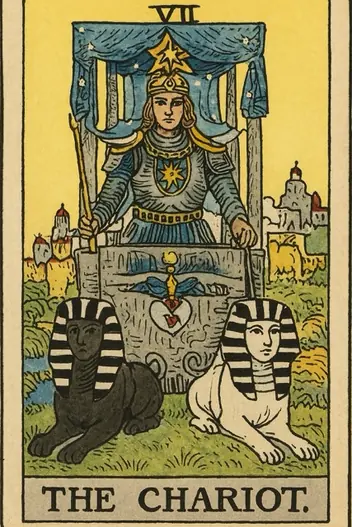
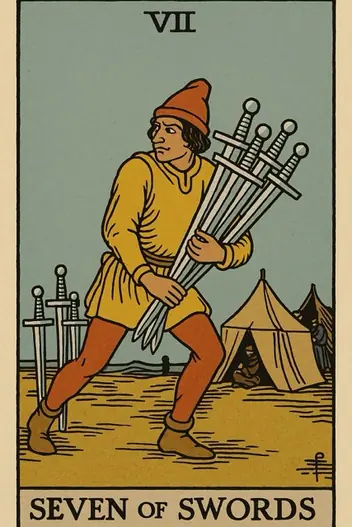
When The Chariot—a card of willpower, victory, and direct confrontation—collides with the Seven of Swords—a card of stealth, deception, and strategic withdrawal—you face a psychological paradox. The Chariot demands forward momentum and assertive action, while the Seven of Swords whispers about the value of cunning, secrecy, and knowing when to retreat. This combination often appears when you are torn between charging ahead and playing a more subtle, indirect game.
In real life, this pairing signals a situation where your determination must be tempered with tactical intelligence. It’s not about brute force; it’s about outmaneuvering obstacles without losing your core direction. You may need to win by not fighting the battle openly, or you might be using your willpower to cover tracks, escape a trap, or execute a plan that requires discretion. The key insight here is that true victory sometimes requires a blend of courage and concealment.
The Chariot and Seven of Swords Card Meaning Explained
The psychological state created by The Chariot and Seven of Swords is one of controlled cunning. You are not acting impulsively or emotionally; rather, you are applying your disciplined will to a strategy that requires stealth. This is a mindset of calculated risk-taking, where you know that full transparency would lead to failure. The Chariot provides the drive and focus, while the Seven of Swords supplies the tactical blueprint—a plan that might involve misdirection, selective silence, or even a justified “white lie” to achieve a larger goal.
This combination often appears when you are navigating a competitive environment where your opponents are equally determined. Instead of a head-on clash, you are advised to use indirect methods: gather intelligence, exploit weaknesses, or withdraw from a losing position to fight another day. The shadow risk is that you may rationalize dishonesty as “strategy,” so you must remain clear on your ethical boundaries. The core dynamic is about balancing ambition with adaptability, ensuring that your willpower serves a smart, not just forceful, outcome.
In practical terms, this pairing suggests a phase of strategic maneuvering. You may feel like a general planning a covert operation: you know the destination (The Chariot), but the path requires dodging patrols and using decoys (Seven of Swords). This is not a time for naive openness; it’s a time for intelligent discretion. The most important takeaway is that your determination is not diminished by secrecy—it is refined by it.
The Chariot and Seven of Swords as Feelings
If you are single:
This pairing suggests you may be drawn to someone who seems elusive or who keeps their intentions hidden. Evaluate whether their mystery is genuine depth or a red flag for dishonesty. Your will to pursue must be balanced with a cautious assessment of their trustworthiness.
If you are in a relationship:
A power dynamic involving secrets or unspoken agendas may be at play. One partner may be using charm or manipulation to avoid conflict, while the other pushes for direct confrontation. Honest communication is critical to prevent resentment.
In relationships, The Chariot and Seven of Swords often indicate a struggle between control and evasion. One partner may feel the need to “win” arguments or steer the relationship in a specific direction, while the other resorts to subtle avoidance or even small deceptions to maintain their autonomy. This can create a cycle of mistrust and power games. The psychological challenge is to recognize that true intimacy cannot be achieved through manipulation or force. Instead, both partners must consciously choose to lower their defenses and communicate directly, even if it feels vulnerable.
Key relationship advice in bold:
Do not mistake strategic withdrawal for emotional distance. If your partner is being evasive, ask yourself if they are protecting themselves from a perceived threat (e.g., your intensity). Conversely, if you are the one using secrecy, question whether your “strategy” is actually a fear of confrontation. The healthiest path is to combine The Chariot’s courage with the Seven of Swords’ self-awareness—own your desires, but also own your fears. This combination warns against using “strategy” as a cover for avoiding real connection. Prioritize transparency over winning.
Your pair is already on the table. Ask your question and draw the clarifying card
or simply focus on it
The Chariot and Seven of Swords for Career and Money
Strategic Opportunities:
Use your willpower to execute a plan that requires discretion. This could involve quietly applying for a new job, negotiating a raise behind the scenes, or developing a competitive edge without alerting rivals.
Strategic Opportunities:
Leverage your network for insider information. Attend events, ask pointed questions, and gather data that others overlook. Your determination to succeed can be channeled into intelligence-gathering.
Calculated Risks:
Avoid overt confrontations with authority or competitors. If you feel blocked, do not force a direct challenge. Instead, find a workaround or a temporary retreat. Beware of the temptation to cut ethical corners for short-term gain.
In the professional realm, this combination is a powerful signal for tactical career moves. You are likely in a situation where open competition is not in your best interest. Perhaps your boss is resistant to change, or a colleague is actively undermining you. The Seven of Swords advises you to work smarter, not harder: document your contributions, protect your ideas, and choose your battles carefully. The Chariot gives you the stamina to execute a long-term plan, but the Seven of Swords reminds you that timing and secrecy are assets.
Financially, this pairing urges caution with hidden costs or deceptive offers. You may be tempted to take a risky investment or a “too-good-to-be-true” deal. Bold financial warning: Do not let your desire for quick victory blind you to potential fraud or hidden fees. Instead, use your strategic mind to audit your finances, check for leaks, and plan a stealthy savings strategy. The best financial move now is to quietly consolidate your resources and avoid flashy risks. This is a time for quiet accumulation, not public displays of wealth.
Negative Meaning of The Chariot and Seven of Swords
The shadow side of The Chariot and Seven of Swords emerges when willpower becomes stubbornness and cunning becomes deceit. You may fall into the cognitive bias of confirmation bias, where you only seek evidence that supports your plan while ignoring ethical warnings. This leads to self-sabotage through overconfidence—you believe you can “outsmart” everyone, but you may end up isolated and untrusted. Another pitfall is paranoia: you might see threats everywhere, leading to unnecessary secrecy that damages relationships.
When this energy is blocked, you may feel paralyzed between action and evasion. You know you need to move forward, but you are terrified of being caught or exposed. This can result in procrastination disguised as “strategy.” Alternatively, you might act impulsively, charging into a situation without the necessary intelligence, and then having to retreat in shame. The shadow asks: Are you using secrecy to protect a legitimate strategy, or to hide from accountability? Honest self-reflection is crucial to avoid these traps.
Ask your specific question
Don't rely on generic meanings. Get a customized reading tailored specifically to your energies.
The Chariot and Seven of Swords Reversed: What Changes?
When cards appear in reversed positions, the internal conflict intensifies and constructive aspects become blocked.
If The Chariot is reversed:
This indicates paralysis of will. The person knows what needs to be done but cannot begin. Cunning (Seven of Swords) in this case turns into endless planning and searching for the "ideal" moment that never arrives. Warning: You risk becoming an "eternal strategist" who never actually starts the game. Advice: Take at least one direct action, even if it is imperfect.
If the Seven of Swords is reversed:
The key risk is exposure or self-destruction. Secrecy stops working, and deception (even for a good cause) is revealed. Will (The Chariot) in this context leads to aggressive defense, which only worsens the situation. Advice: Acknowledge your mistakes or hidden motives. Honesty now is the only way to maintain control.
If BOTH are reversed:
Complete imbalance. The Chariot loses direction (aimless aggression), and the Seven of Swords loses effectiveness (empty self-deception). This is a state of "managed chaos" where a person harms themselves by trying to control what is beyond their power. Method for correction: Complete stop. Cease all active actions and engage in reflection. Ask yourself: "What is my true goal?" You are likely chasing someone else's, not your own.
The Chariot and Seven of Swords: Tarot Advice
How can this union be used constructively? The key to integration is to separate the "what" from the "how". The Chariot is responsible for the "what" (your goal, mission, direction of will). The Seven of Swords is responsible for the "how" (tactics, detours, information management). Problems begin when you start deceiving yourself about the "what."
Strategic Advice:
Use the Seven of Swords only for external maneuvers, but maintain absolute honesty with yourself. Your inner compass (The Chariot) must remain clear. If you feel you have to lie to yourself to justify your actions, you are on the wrong path.
This combination is ideal for situations where open force is useless: complex negotiations, competitive struggles, escaping a toxic environment. It teaches us that true strength is not always brute power, but the ability to adapt and win through intelligence. However, remember the cost: every hidden manipulation leaves a trace in your psyche, requiring emotional expenditure to maintain the illusion.
To balance this energy, practice "conscious transparency" in those areas of life where it is safe. Let your will manifest in clear intentions, and your cunning only in tactical decisions, not in distorting reality. Then, The Chariot and the Seven of Swords will become your most powerful tool for achieving goals in conditions of uncertainty.
Where to Go From Here
The Chariot and Seven of Swords together reveal a path where victory requires both courage and cunning. You are being called to balance direct action with strategic silence, and to ensure your willpower serves a plan that is both effective and ethical. The core message is: win smart, not just hard. But the true meaning of this combination depends entirely on your unique situation—your question, your fears, and your goals.
To get a deep, personalized interpretation of this exact combination for your specific question, use the Fortune Cards app. Whether you are navigating a career challenge, a relationship dilemma, or a personal crossroads, the app applies the archetypes to your real-life context, offering insights that generic articles cannot. You can use it on the web or download it now to unlock the specific guidance you need. Your next step is to apply this wisdom to your own story—start with a personalized reading.
Interpretation by the Fortune Cards editorial team, based on the Rider–Waite tradition and Jungian archetypes. About our methodology · Updated: 2026-08-26
Other Combinations with The Chariot
Other Combinations with Seven of Swords
Explore Individual Card Meanings
Table of Contents
- The Chariot and Seven of Swords Card Meaning Explained
- The Chariot and Seven of Swords as Feelings
- The Chariot and Seven of Swords for Career and Money
- Negative Meaning of The Chariot and Seven of Swords
- The Chariot and Seven of Swords Reversed: What Changes?
- The Chariot and Seven of Swords: Tarot Advice
- Where to Go From Here
Ready to find answers to your questions?
Start your first reading now and look at your situation with fresh clarity. The cards are ready to reveal deeper meaning.