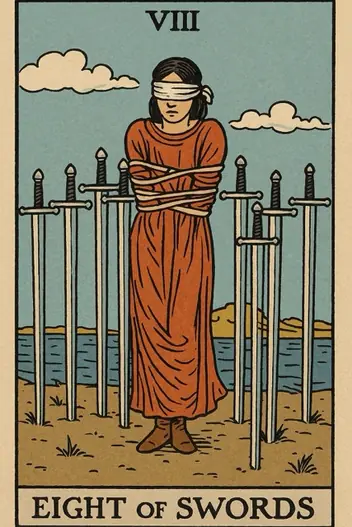
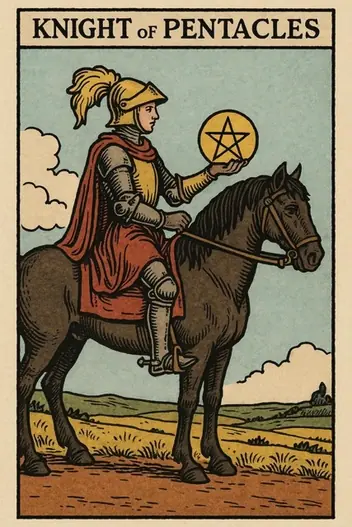
Eight of Swords and Knight of Pentacles Tarot as Feelings
- Arcana
- Eight of Swords — Minor Arcana, Swords; Knight of Pentacles — Minor Arcana, Pentacles
- Elements
- Eight of Swords — Air; Knight of Pentacles — Earth
- Elemental interaction
- Opposing elements — energies create tension
- Numerology
- 8 + 12 = 20 → 2
The Eight of Swords represents a state of mental entrapment—where perceived limitations, self-doubt, and overthinking create an invisible cage. The Knight of Pentacles, by contrast, embodies methodical action, patience, and a grounded commitment to slow, steady progress. When these two archetypes collide, the question becomes: Can deliberate, practical effort break through the illusion of helplessness, or will cautiousness become a rationalization for staying stuck?
This combination often appears when a person feels trapped by their own thoughts but possesses the discipline to take small, tangible steps forward. The tension lies in the gap between cognitive paralysis and behavioral persistence. Understanding how to bridge that gap is the key to unlocking the potential of this pairing.
Core Dynamics & Interpretation
The psychological state created by Eight of Swords and Knight of Pentacles is one of cautious self-awareness mixed with risk-averse action. The Eight of Swords highlights a tendency to magnify obstacles—often rooted in past failures or fear of judgment—while the Knight of Pentacles insists on moving forward, albeit at a glacial pace. This dynamic can be both a strength and a trap.
On the positive side, the Knight’s energy prevents the Eight of Swords from spiraling into complete inertia. Instead of giving up, the seeker may adopt a “one step at a time” approach, focusing on what is immediately controllable. However, the danger is that the Knight’s natural caution can reinforce the Eight’s belief that the situation is more dangerous than it actually is. The result is excessive planning, over-preparation, and a reluctance to take meaningful risks.
The core insight here is that action, no matter how small, is the antidote to mental paralysis. The Knight of Pentacles offers a practical tool: break the problem into manageable tasks and execute them without judgment. The Eight of Swords, however, demands that the seeker first recognize that many of the “bars” in their cage are self-imposed. True progress requires both the courage to question one’s assumptions and the discipline to act despite uncertainty.
Eight of Swords and Knight of Pentacles in Love Tarot
If you are single:
This combination suggests you may be overanalyzing potential partners, creating a mental checklist of flaws that keeps you from taking a chance. The Knight of Pentacles advises you to start with low-pressure interactions—like a coffee date or shared hobby—rather than waiting for a perfect match.
If you are in a relationship:
You or your partner may feel trapped in a routine or stuck in a pattern of unspoken grievances. The Knight of Pentacles encourages consistent, small acts of care to rebuild trust, but the Eight of Swords warns against assuming your partner’s motives without evidence.
In relationships, this pairing often points to a power imbalance rooted in fear. One person may feel bound by obligation or past disappointments (Eight of Swords), while the other is plodding along with unyielding reliability (Knight of Pentacles). The key is to communicate the difference between “feeling stuck” and “being stuck.” If you are the Knight, you may need to slow down and listen. If you are the Eight, you must resist the urge to interpret your partner’s steadiness as indifference.
Relationship advice: Focus on shared, tangible goals. Plan a project together—renovating a room, saving for a trip, or learning a new skill. The act of building something concrete can dissolve abstract fears and reveal whether the relationship is truly stagnant or simply in need of patience.
Your pair is already on the table. Ask your question and draw the clarifying card
or simply focus on it
Career Meaning of Eight of Swords and Knight of Pentacles
Strategic Opportunities:
Use your analytical skills to identify a single, high-impact task you’ve been avoiding. The Knight of Pentacles rewards consistency, not perfection. Start with 15 minutes of focused work on that task each day.
Strategic Opportunities:
Leverage your sense of duty to build a reputation for reliability. In a team setting, volunteer for roles that require follow-through—this will counter the Eight of Swords’ tendency to isolate yourself.
Calculated Risks:
Do not confuse caution with cowardice. If you’ve been researching a career change or investment for months without acting, the Knight of Pentacles energy is being misused. Set a deadline to make a small, reversible move (e.g., updating your resume or opening a savings account).
Professionally, this combination warns against analysis paralysis dressed up as diligence. The Eight of Swords can manifest as a fear of making the wrong decision, leading to endless data collection. The Knight of Pentacles, when healthy, is a methodical executor. Your career growth depends on shifting from “What if I fail?” to “What is the next logical step?” Financially, this pairing favors slow, conservative growth over speculation. However, do not let the Knight’s caution justify ignoring obvious opportunities—if you’ve been holding cash out of fear, it may be time to rebalance your portfolio.
Financial warning: Avoid “waiting for the perfect moment.” The Knight of Pentacles knows that time in the market beats timing the market. Take a small, calculated risk now rather than waiting for certainty that may never arrive.
Uncover hidden insights
Let our advanced Tarot system interpret these archetypes specifically for your personal path.
Reversed Positions: What Changes?
If the Eight of Swords is reversed:
The subjective feeling of being trapped begins to weaken. The person sees a way out, but the Knight of Pentacles may be too slow to take advantage of it. You understand what needs to be done, but you lack the motivation. Advice: Don't wait for inspiration; just mechanically start executing the plan.
If the Knight of Pentacles is reversed:
Practical energy loses its power. Instead of methodicalness, laziness, procrastination, or an inability to see things through appears. The Eight of Swords then amplifies the guilt over inaction. Warning: You risk getting stuck in a toxic cycle of "fear — inaction — even greater fear."
If BOTH are reversed:
A complete imbalance. The person is simultaneously paralyzed by fear and incapable of basic self-discipline. This is a state of deep self-sabotage. Method for correction: The strictest regimen. External control (a mentor, deadlines, financial obligations) that forces you to act until you regain your will.
Eight of Swords and Knight of Pentacles: Warning Signs
The shadow side of this combination emerges when the Knight of Pentacles’ persistence becomes stubbornness and the Eight of Swords’ self-doubt becomes victimhood. The seeker may rationalize inaction by claiming they are being “patient” when they are actually avoiding discomfort. This is a classic cognitive bias known as the “status quo bias” —preferring the familiar trap over the unknown risk of freedom.
Another pitfall is perfectionism masked as responsibility. The Knight of Pentacles may insist that everything must be “just right” before acting, while the Eight of Swords whispers that it never will be. This loop can lead to burnout from over-preparation without execution. The shadow also manifests as resentment toward others who seem to move faster or take easier paths, reinforcing the Eight of Swords’ sense of unfair entrapment.
To avoid these pitfalls, ask yourself honestly: “Am I being patient, or am I being afraid?” The Knight of Pentacles values effort, not suffering. If your persistence is draining your energy without producing results, it may be time to question whether the goal itself is still aligned with your values.
What Is the Overall Message of Eight of Swords and Knight of Pentacles?
Constructive use of this combination demands iron discipline and radical honesty with yourself. Your task is not to wait for fear to disappear, but to act in spite of it, using the Knight of Pentacles' methodical approach as your tool. Imagine your mind is a frightened child (the Eight), and your body is a patient adult (the Knight). Let the adult lead the child by the hand.
The strategy lies in desensitization. If a project frightens you, work on it for exactly 15 minutes a day. If a conversation terrifies you, write a script and rehearse it in front of a mirror. The Knight of Pentacles does not seek easy paths; he seeks the right ones. Your primary resource right now is not intellect, but discipline. The intellect of the Eight of Swords creates the problems that the Knight's discipline solves.
Accept that progress will be slow. You will not break down the wall of fear with a single blow — you will dismantle it brick by brick. Every completed item on your plan, every phone call you make, is a brick you remove from your prison. Clarity will come not through thinking, but through action. Let routine become your medicine for anxiety.
Your Next Step: Personal Context Matters
The Eight of Swords and Knight of Pentacles combination ultimately asks you to distinguish between real barriers and imagined ones. The Knight’s steady hand can help you build a bridge out of your mental prison, but only if you first acknowledge that the door is unlocked. Your next step is to take one small, concrete action that challenges a belief you hold about your limitations.
While this article provides a general archetypal analysis, the true power of Tarot lies in its application to your unique story. The same cards can mean something entirely different depending on whether you are asking about a relationship, a career move, or a personal habit. To get a deep, personalized interpretation of this exact combination for your specific question right now, use the Fortune Cards app. Available on web and for download, it tailors the wisdom of the Tarot to your life—no generic readings, just actionable insights for your next move.
Interpretation by the Fortune Cards editorial team, based on the Rider–Waite tradition and Jungian archetypes. About our methodology · Updated: 2026-08-26
Other Combinations with Eight of Swords
Other Combinations with Knight of Pentacles
Explore Individual Card Meanings
Table of Contents
- Core Dynamics & Interpretation
- Eight of Swords and Knight of Pentacles in Love Tarot
- Career Meaning of Eight of Swords and Knight of Pentacles
- Reversed Positions: What Changes?
- Eight of Swords and Knight of Pentacles: Warning Signs
- What Is the Overall Message of Eight of Swords and Knight of Pentacles?
- Your Next Step: Personal Context Matters
Ready to find answers to your questions?
Start your first reading now and look at your situation with fresh clarity. The cards are ready to reveal deeper meaning.