Eight of Swords and Knight of Swords Reversed in Tarot
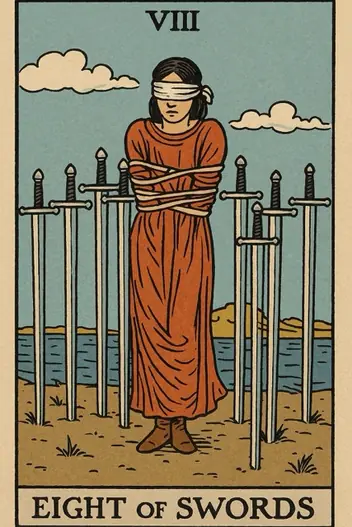
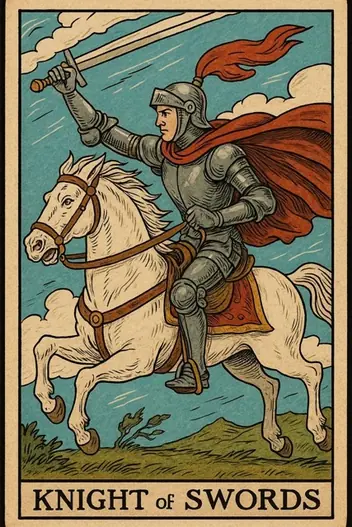
- Arcana
- Eight of Swords — Minor Arcana, Swords; Knight of Swords — Minor Arcana, Swords
- Elements
- Eight of Swords — Air; Knight of Swords — Air
- Elemental interaction
- Same element — energies intensify each other
- Numerology
- 8 + 12 = 20 → 2
The Eight of Swords and Knight of Swords combination represents a powerful psychological conflict: the paralysis of overthinking versus the impulsive rush to action. When these two archetypes collide, you are caught between feeling trapped by your own thoughts and a desperate urge to charge forward without a clear plan. This is not a simple "good or bad" pairing—it is a call for strategic self-awareness and disciplined decision-making.
In practical terms, the Eight of Swords symbolizes the mental cage you have built: self-doubt, perceived limitations, and the stories you tell yourself about what you cannot do. The Knight of Swords charges in with raw, untamed energy—ambition, speed, and a willingness to cut through obstacles. The real question is whether you will use this knightly energy to break the cage mindfully or to smash it recklessly, creating new problems in the process.
Eight of Swords and Knight of Swords Card Meaning Explained
The core tension here is between cognitive entrapment and compulsive action. The Eight of Swords represents a state where your mind has convinced you that escape is impossible—often due to confirmation bias, catastrophizing, or learned helplessness. You may feel bound by circumstances, but the blindfold across your eyes reveals the truth: you cannot see the exits because you are not looking for them. The Knight of Swords arrives as a disruptive force, offering the willpower to break through, but without the patience to assess the situation first.
This combination demands that you distinguish between real obstacles and perceived ones. The Knight’s sword can cut through both, but if you swing blindly, you might sever relationships, opportunities, or your own peace of mind. Psychologically, this is a call to integrate the Knight’s decisiveness with the Eight’s introspection. Instead of acting out of panic or staying frozen in fear, you must pause, assess the blindfold, and then choose one precise action that moves you forward. The key insight: the Knight’s speed is only valuable when aimed at the right target.
Your pair is already on the table. Ask your question and draw the clarifying card
or simply focus on it
Eight of Swords and Knight of Swords as Feelings
If you are single:
This pairing warns against rushing into a connection born from desperation or loneliness. You may feel "trapped" in your single status, but charging at the first person who shows interest could lead to a relationship built on impulse rather than compatibility.
If you are in a relationship:
You or your partner may feel stuck in a cycle of conflict or misunderstanding. The Knight’s energy can escalate arguments through reactive, hurtful words, while the Eight’s energy keeps you silent and resentful.
In relationships, this combination often signals a power struggle between silence and aggression. One partner feels suffocated by unspoken fears (Eight of Swords), while the other wants to "fix" everything with direct confrontation (Knight of Swords). The healthiest path is to name the fear aloud, then commit to one actionable step together—whether that’s a calm conversation, couples therapy, or setting a boundary. Avoid the trap of either blaming yourself or blaming your partner; the real issue is the pattern, not the person. If you are single, use the Knight’s clarity to define what you truly want, rather than what you think you should want.
Eight of Swords and Knight of Swords in Career Readings
Strategic Opportunities:
Identify the one limiting belief holding you back (e.g., "I’m not qualified," "the market is too competitive") and test it with a small, low-risk action.
Strategic Opportunities:
Channel the Knight’s speed into research—gather data quickly to break through information paralysis, then execute.
Calculated Risks:
Avoid making major financial moves or career changes while feeling panicked or cornered. The Knight’s impulsivity here can lead to hasty resignations, bad investments, or burning bridges.
In your professional life, this combination signals a crisis of confidence masked by frantic activity. You may be working long hours, chasing every lead, or making aggressive moves—but underneath, you feel trapped by a lack of clarity or fear of failure. The most effective strategy is to stop and audit your mental models. Ask yourself: "What am I assuming that might be false?" Then, take one bold but calculated step—such as negotiating a raise, pivoting to a new role, or automating a tedious process. Financially, resist the urge to "solve" a cash flow problem with a high-risk gamble. Instead, cut one unnecessary expense and redirect that money toward a clear goal. The Knight wins by speed and precision, not brute force.
Ask your specific question
Don't rely on generic meanings. Get a customized reading tailored specifically to your energies.
The Shadow Side of Eight of Swords and Knight of Swords
When this energy goes unintegrated, the shadow manifests as self-sabotage through overthinking or overreacting. The Eight of Swords’ shadow is rumination—endlessly replaying worst-case scenarios until you feel paralyzed. The Knight of Swords’ shadow is reckless confrontation—starting fights, quitting jobs, or ending relationships on a whim without considering consequences. Together, they create a cycle: you feel trapped, so you act impulsively, which creates new problems, which makes you feel more trapped. Cognitive biases like the "illusion of control" (believing you can fix everything with one dramatic move) and "tunnel vision" (seeing only one solution) are common pitfalls. To avoid this, build a pause into your decision-making process—even 10 seconds of deep breathing can prevent a costly mistake. If you notice yourself thinking in extremes ("I’m completely stuck" or "I have to change everything now"), that is your cue to step back and consult a trusted mentor, therapist, or neutral third party.
Eight of Swords and Knight of Swords Reversed Meaning
Reversed cards in this pair shift the dynamic from active to passive, but no less dangerous.
Eight of Swords Reversed:
The person becomes aware of their "prison" and sees the exits, but lacks the will to act. This is a state of apathy and procrastination. The Knight of Swords cannot break through here because the Eight does not provide the energy for the leap. Advice: You don't need a new idea; you need an external push or a deadline. Find someone who will hold you accountable.
Knight of Swords Reversed:
The energy of attack turns inward. Instead of cutting through obstacles, the person begins self-flagellation and self-destruction. This is an acute crisis of self-esteem. Warning: You are not just in a cage; you are torturing yourself inside it. Stop looking for the guilty party within yourself. Shift your focus from "who is to blame" to "what is to be done."
BOTH Reversed:
Complete imbalance. Passive aggression and paralysis of will. The person is angry at the whole world but afraid to move. This state is dangerously close to depression. How to fix it: Start with micro-steps. Don't try to break down the wall (Knight) or change your thinking (Eight). Just do one small action: clear the clutter on your desk, write one letter. Movement heals paralysis.
Eight of Swords and Knight of Swords: The Combined Message
How to constructively use this energy? The key is to transform the Knight's destructive impulse into surgical precision. The Eight of Swords gives you unique information: it precisely shows where your "blind spots" and fears lie. Do not try to ignore or destroy them. Use them as a map.
Your strategy is "conscious breakthrough". Step one: take a sheet of paper and write down everything that "holds" you (the Eight). These could be beliefs, people, obligations. Step two: instead of slashing at everything indiscriminately (the Knight), choose one, the thinnest bar of the cage. Focus all your aggression and intellect on it. Your task is not to break the prison, but to pick the lock.
The energy of the Knight of Swords becomes your ally only when it is directed towards analysis and planning, not action. Allow yourself to "play out" the breakthrough scenario in your mind. Imagine the consequences of each strike. Only when you can predict the trajectory of every shard should you strike.
A deep strategic advice: use the Eight as a brake, and the Knight as an accelerator. Do not let the Knight drive the car. Let the Eight be the navigator that says: "Stop, this is a dead end, turn left." And let the Knight be the engine that allows you to quickly cover that stretch of road. Wisdom lies in seeing the cage, but not fearing it; instead, use its bars as a ladder for ascent.
Applying This to Your Situation
The Eight of Swords and Knight of Swords combination is a powerful wake-up call: your mind is both the prison and the key. The Knight’s energy offers the courage to act, but only you can decide where to direct that charge. The core message is to move from reactive panic to strategic liberation—identify the one real obstacle, cut through it with precision, and stop fighting imaginary dragons.
While this article gives you the archetypal meaning, your specific situation holds the real answer. The same cards can mean very different things depending on whether you are asking about a relationship, a career move, or a personal habit. That is why Fortune Cards app is the perfect next step. You can use it on the web or download it to get a deep, personalized interpretation of this exact combination for your unique question right now. It will help you see exactly where the blindfold is, where the sword should strike, and how to move forward with clarity and confidence.
Interpretation by the Fortune Cards editorial team, based on the Rider–Waite tradition and Jungian archetypes. About our methodology · Updated: 2026-08-26
Other Combinations with Eight of Swords
Other Combinations with Knight of Swords
Explore Individual Card Meanings
Table of Contents
- Eight of Swords and Knight of Swords Card Meaning Explained
- Eight of Swords and Knight of Swords as Feelings
- Eight of Swords and Knight of Swords in Career Readings
- The Shadow Side of Eight of Swords and Knight of Swords
- Eight of Swords and Knight of Swords Reversed Meaning
- Eight of Swords and Knight of Swords: The Combined Message
- Applying This to Your Situation
Ready to find answers to your questions?
Start your first reading now and look at your situation with fresh clarity. The cards are ready to reveal deeper meaning.