Eight of Swords and Nine of Pentacles Reversed in Tarot
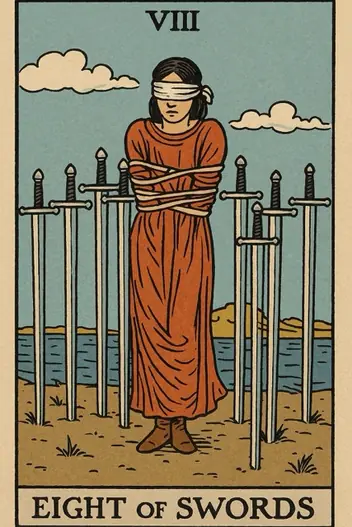

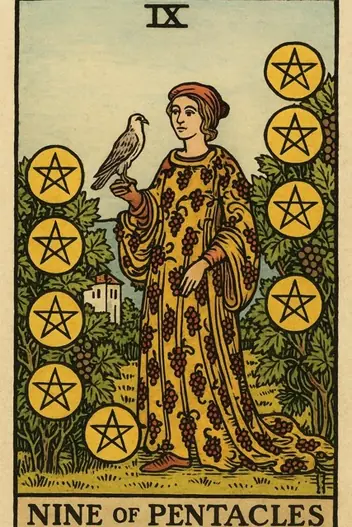
- Arcana
- Eight of Swords — Minor Arcana, Swords; Nine of Pentacles — Minor Arcana, Pentacles
- Elements
- Eight of Swords — Air; Nine of Pentacles — Earth
- Elemental interaction
- Opposing elements — energies create tension
- Numerology
- 8 + 9 = 17 → 8
When the restrictive mindset of the Eight of Swords collides with the material stability of the Nine of Pentacles, we witness a profound psychological paradox: the experience of feeling trapped while standing in a garden of abundance. This combination often surfaces for individuals who have achieved external success—financial security, a comfortable home, a respected career—yet still feel bound by internal limitations. The core tension lies between the objective reality of one's accomplishments and the subjective perception of being stuck, blindfolded, and surrounded by swords.
From a Jungian perspective, this pairing represents a powerful shadow integration opportunity. The Nine of Pentacles embodies the Self's achievement of the "good life," but the Eight of Swords reveals the unconscious belief that this success is precarious, undeserved, or insufficient. The seeker may be trapped not by external circumstances, but by their own cognitive biases—particularly the "impostor syndrome" or a fear of losing control over what they've built. The path forward requires untying the blindfold to see that many of the swords are self-imposed.
Eight of Swords and Nine of Pentacles: How These Energies Interact
The psychological state created by this combination is one of quiet desperation masked by polished composure. Externally, the person appears successful, self-sufficient, and in control—classic Nine of Pentacles traits. Internally, however, they feel paralyzed by overthinking, self-doubt, or a perfectionist loop that prevents them from enjoying their achievements. The Eight of Swords whispers that any move could be catastrophic, while the Nine of Pentacles reminds them that they have the resources to handle whatever comes.
In real-world terms, this often manifests as someone who refuses to delegate at work because they believe only they can do it right, or someone who stays in a comfortable but unfulfilling relationship because they fear the financial or social cost of leaving. The strategic insight here is that the perceived constraints are largely mental constructs. The swords are not real obstacles—they are thought patterns that need to be challenged. The actionable step is to audit one's beliefs: What exactly are you afraid of losing? And is that loss truly catastrophic, or just uncomfortable?
This dynamic also highlights a risk-management paradox. The Nine of Pentacles represents careful planning and resource accumulation, while the Eight of Swords represents analysis paralysis. Together, they suggest a person who has planned so thoroughly for every contingency that they have trapped themselves in a web of hypothetical disasters. The pragmatic solution is to set a time limit on deliberation and take a small, low-risk action to test reality against fear.
Eight of Swords and Nine of Pentacles in Love and Relationships
If you are single:
This combination suggests you may be overvaluing external markers of stability (income, status, lifestyle) while ignoring emotional compatibility. You might be self-sabotaging by setting impossibly high standards that no real person can meet.
If you are in a relationship:
The dynamic often involves one partner feeling smothered by the other's need for control or perfection. The "successful" partner may be using their achievements as a shield against vulnerability, creating a power imbalance where emotional intimacy is sacrificed for material order.
In relationships, this pairing reveals a deep fear of emotional exposure. The Nine of Pentacles partner may have built a beautiful life—a lovely home, shared vacations, financial ease—but the Eight of Swords partner feels isolated within that luxury. The key relationship advice is to recognize that abundance without connection is still poverty. Boldly address the unspoken contract: Are you both committed to the relationship, or just to the lifestyle it provides? If the latter, the "swords" of resentment will eventually cut through the gilded cage.
For couples, the practical intervention is to schedule regular "reality checks" where each partner can voice fears without judgment. The Eight of Swords energy needs permission to be imperfect, while the Nine of Pentacles energy needs to practice receiving vulnerability without trying to solve it. Emotional intelligence here means understanding that feeling trapped is not a sign of failure—it's a signal that the relationship's structure needs updating.
Your pair is already on the table. Ask your question and draw the clarifying card
or simply focus on it
Eight of Swords and Nine of Pentacles for Career and Money
Strategic Opportunities:
Use your accumulated resources (network, savings, skills) to fund a calculated pivot into a role or project that aligns with your values, not just your resume.
Strategic Opportunities:
Audit your mental barriers—ask a trusted mentor or coach to point out where your self-doubt is blinding you to obvious solutions.
Calculated Risks:
Avoid golden handcuffs—the trap of staying in a high-paying but soul-crushing job because you fear losing the lifestyle. The real risk is stagnation of your potential.
In the professional realm, this combination often signals a high achiever who feels stuck at a plateau. You have the pentacles—the promotions, the bonuses, the reputation—but you feel bound by the swords of impostor syndrome, fear of failure, or burnout. The strategic advice is to leverage your abundance as a buffer for risk. Because you have resources, you can afford to fail small. Use your financial stability to fund a side project, negotiate for a sabbatical, or invest in upskilling without the pressure of immediate ROI.
Financially, this pairing warns against hoarding out of fear. The Nine of Pentacles can become miserly or overly conservative when touched by the Eight of Swords' anxiety. Bold financial advice: If you are sitting on cash reserves but feel unable to spend on experiences or investments that would improve your quality of life, you are letting fear dictate your wealth strategy. Consider working with a financial planner to set a "freedom fund" that allows for calculated expenditures that reduce your psychological burden.
Eight of Swords and Nine of Pentacles Reversed Meaning
Eight of Swords Reversed:
This is the lifting of a blockage. The person realizes their fears were illusory. However, paired with the upright Nine of Pentacles, there is a risk of recklessness. Freed from one fear, one can swing to the opposite extreme—impulsive spending or breaking off stable relationships without a second thought. Advice: Use the energy of liberation for planned changes, not for chaos.
Nine of Pentacles Reversed:
The material foundation is shaky or lost (job loss, debt). The upright Eight of Swords here represents a real crisis, not an illusion. The fear is justified. Warning: Do not try to pretend everything is fine. Acknowledge the financial vulnerability and act strictly according to a rescue plan, not by emotion.
Both Reversed:
Complete imbalance. Inner fears (Eight of Swords) are lifted, but the external support (Nine of Pentacles) is destroyed. This is a state of "free fall." The logical way to correct this: Temporarily restore structure to yourself (upright Eight of Swords—self-discipline) and start building the foundation from scratch (upright Nine of Pentacles—accumulation). Do not seek freedom until you have found a foothold.
Uncover hidden insights
Let our advanced Tarot system interpret these archetypes specifically for your personal path.
When Eight of Swords and Nine of Pentacles Signal Trouble
The shadow of this combination is performative self-sufficiency. The seeker may project an image of effortless success while secretly feeling like a fraud, unable to ask for help because it would shatter the illusion. This leads to chronic overwork and emotional isolation. The cognitive bias at play is confirmation bias: the seeker only notices evidence that supports their fear of being trapped, ignoring the many doors that are actually open.
Another shadow manifestation is passive-aggressive control. The Nine of Pentacles person may use their financial or social leverage to subtly dominate others, while the Eight of Swords person plays the victim, refusing to take responsibility for their choices. This creates a toxic dance where neither party is honest about their needs. Self-sabotage is also common—the seeker may unconsciously create crises (a sudden illness, a conflict at work) that justify their feeling of being stuck, rather than facing the fear of change head-on.
The greatest pitfall is mistaking comfort for fulfillment. The Nine of Pentacles offers a beautiful prison, and the Eight of Swords provides the rationalization to stay. The seeker must ask themselves: Am I truly content, or am I just too afraid to disrupt my own carefully constructed life?
Eight of Swords and Nine of Pentacles: Tarot Advice
Constructive use of this dynamic requires a radical shift in focus from "why I can't" to "what I already have". The Eight of Swords is energy trapped in a mental prison. The Nine of Pentacles is the key hanging from your belt, which you refuse to notice. Your strategic task is to take inventory of your resources: time, money, connections, skills. When you objectively see what you possess, the illusion of helplessness will dissipate.
Next, it is necessary to separate the "swords" into real and imaginary ones. Take a sheet of paper and write down all your fears. Opposite each one, write a specific resource from your Nine of Pentacles "treasure chest" that can neutralize that fear. For example: "I'm afraid of being left without money" -> "I have six months of savings and an in-demand profession." This simple yet powerful act shifts you from the position of a victim to that of a manager.
A deep strategic counsel:
use the comfort of the Nine of Pentacles not as a place to rest from your fears, but as a launching pad for overcoming them. Take one small step toward the action that frightens you most. Buy a ticket for that course you've been putting off. Start those negotiations you've been dreading. Your stability is not a reward for inaction, but fuel for movement. Only in this way will you transform the mental prison into a garden where you can walk without looking over your shoulder.
Your Next Step: Personal Context Matters
The core message of the Eight of Swords and Nine of Pentacles is that your greatest cage is often the one you built yourself—and you hold the key. Your external success is real, but it cannot substitute for internal freedom. The path forward requires courageous self-auditing: identify one limiting belief you've been holding as "truth," and take a small action that contradicts it. Your resources are your allies, not your anchors.
While this analysis provides the universal archetypes at play, the true power of Tarot lies in its application to your unique life. Your specific question, your personal history, and the other cards in your spread will shift the meaning. To get a deep, personalized interpretation of this exact combination for your situation right now, use the Fortune Cards app—available on the web or for download. Let the cards speak directly to your path.
Interpretation by the Fortune Cards editorial team, based on the Rider–Waite tradition and Jungian archetypes. About our methodology · Updated: 2026-09-17
Other Combinations with Eight of Swords
Other Combinations with Nine of Pentacles
Explore Individual Card Meanings
Table of Contents
- Eight of Swords and Nine of Pentacles: How These Energies Interact
- Eight of Swords and Nine of Pentacles in Love and Relationships
- Eight of Swords and Nine of Pentacles for Career and Money
- Eight of Swords and Nine of Pentacles Reversed Meaning
- When Eight of Swords and Nine of Pentacles Signal Trouble
- Eight of Swords and Nine of Pentacles: Tarot Advice
- Your Next Step: Personal Context Matters
Ready to find answers to your questions?
Start your first reading now and look at your situation with fresh clarity. The cards are ready to reveal deeper meaning.