Eight of Swords and Three of Pentacles Reversed in Tarot
- Arcana
- Eight of Swords — Minor Arcana, Swords; Three of Pentacles — Minor Arcana, Pentacles
- Elements
- Eight of Swords — Air; Three of Pentacles — Earth
- Elemental interaction
- Opposing elements — energies create tension
- Numerology
- 8 + 3 = 11 → 2
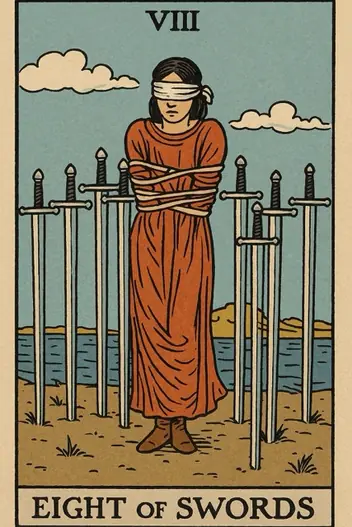
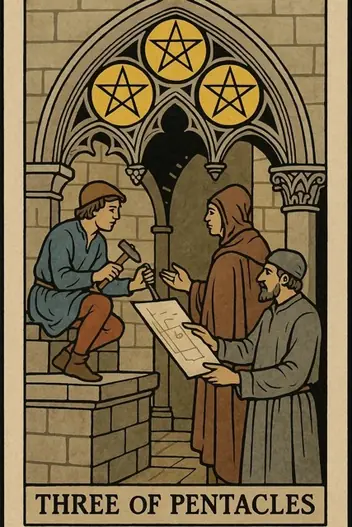
When the Eight of Swords—a card of mental entrapment, self-imposed limits, and perceptual distortion—meets the Three of Pentacles—a card of collaborative skill, craftsmanship, and structured effort—we encounter a powerful psychological tension. This combination represents the conflict between the fear of making mistakes and the demand for flawless execution. It’s the archetype of the perfectionist trapped in analysis paralysis, where the desire to produce high-quality work collides with a critical inner voice that insists you are not ready, not skilled enough, or fundamentally incapable.
In real-world terms, this pairing often surfaces when a person has the talent and the team to succeed, yet feels psychologically bound by invisible constraints. The Three of Pentacles offers a path forward through collaboration and incremental progress, while the Eight of Swords whispers that any step will be the wrong one. Understanding how to navigate this dynamic is crucial for unlocking productivity and authentic self-expression.
Eight of Swords and Three of Pentacles Together: Meaning
The core dynamic here is a battle between objective competence and subjective fear. The Three of Pentacles represents tangible skills, apprenticeship, and the ability to learn from others. It suggests that the groundwork for success is already laid—you have the tools, the mentors, or the team. However, the Eight of Swords introduces a cognitive distortion where the seeker perceives themselves as blindfolded and bound, unable to see the resources or allies around them.
Psychologically, this mirrors the Impostor Syndrome archetype: you are performing at a high level (Three of Pentacles), yet you feel like a fraud who will be exposed at any moment (Eight of Swords). The swords in the Eight are not real restraints—they are beliefs. The key insight is that your perceived incompetence is a mental construct, not a reflection of your actual ability. The Three of Pentacles offers a practical antidote: focus on the task, not the fear. Break the project into small, verifiable steps. Seek feedback from a trusted colleague. Action dissolves anxiety, and this combination demands that you move from rumination to execution.
Another layer involves social pressure. The Three of Pentacles often implies working under the scrutiny of others—a boss, a client, or a team. The Eight of Swords amplifies the fear of judgment. The result is a paralyzing self-consciousness where you second-guess every move. The pragmatic solution is to redefine success as process, not perfection. Ask yourself: “What is one concrete action I can take in the next 10 minutes that moves this forward?” This shifts the focus from the terrifying whole to the manageable part.
Your pair is already on the table. Ask your question and draw the clarifying card
or simply focus on it
Eight of Swords and Three of Pentacles as Feelings
If you are single:
This combination suggests you may be overthinking a new connection. You have the social skills and compatibility to build something real (Three of Pentacles), but you’re trapped by fears of rejection or inadequacy (Eight of Swords). The obstacle is in your head, not in the other person.
If you are in a relationship:
You and your partner may be caught in a cycle of high expectations and self-criticism. One or both of you feels “not good enough,” leading to defensive communication or avoidance of deeper issues.
In relationships, the Eight of Swords and Three of Pentacles often point to a power dynamic based on perceived competence. One partner may feel they are constantly being evaluated or that they must perform perfectly to be loved. This creates a fear-based dynamic where vulnerability is replaced by performance. The Three of Pentacles, however, offers a healthier model: relationships as a shared project. Both partners bring unique skills to the table, and the goal is collaboration, not competition.
Key relationship advice in bold:
Stop treating your partner as a critic and start treating them as a collaborator. If you feel trapped by your own insecurities, communicate that directly. Say, “I’m feeling stuck in my own head about this issue. Can we work on it together?” This reframes the relationship from a test to a workshop. For couples, this card pair warns against perfectionism in romance—the idea that you must have the perfect date, the perfect conversation, or the perfect resolution. Real intimacy grows from imperfection and repair, not flawless performance.
Eight of Swords and Three of Pentacles for Career and Money
Strategic Opportunities:
Leverage mentorship to break mental blocks. The Three of Pentacles suggests that asking a more experienced colleague for input can cut through the Eight of Swords’ confusion. A second opinion can reveal the blindfold you didn’t know you were wearing.
Strategic Opportunities:
Focus on incremental deliverables. Instead of trying to solve the entire problem at once, break it into small, completable tasks. Each finished piece builds evidence against the inner critic. Completion beats perfection every time.
Calculated Risks:
Avoid over-reliance on approval. The Three of Pentacles can tip into people-pleasing if you constantly seek validation before acting. The Eight of Swords then locks you into waiting for permission. Trust your own judgment on routine decisions.
Professionally, this combination is a call to action against analysis paralysis. You likely have the skills, the resources, and the team to succeed—but you are stuck in a loop of self-doubt. The Eight of Swords represents the cost of overthinking: missed deadlines, stalled projects, and lost opportunities. The Three of Pentacles represents the antidote: structured collaboration and hands-on work.
Important financial warning:
Do not let fear of making a mistake prevent you from making any decision. In financial planning, this could mean hesitating to invest, negotiate a raise, or start a side project because you fear you lack the expertise. The reality is that action generates data, and data reduces fear. Start with a small, low-risk step. For freelancers or entrepreneurs, this pairing suggests you are undervaluing your work because you don’t feel “ready.” The Three of Pentacles says you are already a skilled professional. Charge what you are worth, even if your inner critic disagrees.
Your unique Tarot reading
See how these cards interact with your destiny. Start a free personal reading now.
Eight of Swords and Three of Pentacles Reversed Meaning
Eight of Swords Reversed:
Symbolizes sudden insight or a reckless dash for freedom. You are removing the blindfold, but may act impulsively, destroying what you have built (Three of Pentacles). Warning: do not burn bridges until you are certain your "illumination" is not merely a reaction to stress.
Three of Pentacles Reversed:
Indicates incompetence, missed deadlines, or toxic team dynamics. In combination with the upright Eight of Swords, this points to a real, not imagined, problem. Advice: acknowledge that you lack the necessary skills and invest in learning; otherwise, your fear will prove justified.
BOTH Reversed:
Complete imbalance. This is a state of chronic sabotage and apathy. The person not only fears action but also refuses to learn. Logical method of correction: external intervention is required—a strict deadline, a coach, or a mentor who will take on the role of an "external observer" and compel you to act.
Negative Meaning of Eight of Swords and Three of Pentacles
The shadow side of this combination is toxic perfectionism masked as humility. The seeker may say, “I just want to do a good job,” but the Eight of Swords reveals this as a cognitive trap—they are using high standards as an excuse to avoid risk. The shadow manifests as procrastination disguised as preparation. You tell yourself you need one more course, one more review, or one more approval before you act. In reality, you are avoiding the vulnerability of putting your work into the world.
Another pitfall is blaming external circumstances for internal blocks. The Eight of Swords can project its bondage onto others: “My boss doesn’t trust me,” or “My partner is too critical.” While external factors may exist, the Three of Pentacles reminds you that you have agency to reshape the dynamic. The shadow refuses this agency, preferring the comfort of victimhood. Watch for cognitive biases like catastrophizing (“If I make one mistake, my career is over”) or mind-reading (“I know they’ll reject my idea, so why try?”). These distortions are the swords you are holding yourself.
Finally, beware of over-collaboration as avoidance. The Three of Pentacles can be used to diffuse responsibility—endless meetings, constant feedback loops, and never making a solo decision. This is a subtle form of the Eight of Swords: you are binding yourself to the group to avoid personal accountability. True mastery requires moments of solitary execution.
Eight of Swords and Three of Pentacles: The Combined Message
Constructive use of this combination requires the courage to be imperfect. The energy of the Eight of Swords is your inner critic screaming, "Stop! You're not ready!" The energy of the Three of Pentacles is your inner artisan who knows, "Mastery comes only through practice."
Your strategy is to use fear as fuel. Instead of trying to "kill" your fear (which is impossible), acknowledge its presence and act alongside it. Write the first draft of the report, knowing it's bad. Start the conversation, stammering with nervousness. The Three of Pentacles rewards not perfection, but engagement and consistency. Each micro-step taken despite fear strengthens your real competence and weakens the power of illusions.
The deep strategic advice: visualize your fear as a task. Write on paper: "I am afraid of X because of Y." Then, using the logic of the Three of Pentacles, create a plan of 3 steps that objectively reduce the risk of Y. This shifts the problem from the emotional plane to the technical one, where you feel more confident. Clarity comes not from passive contemplation, but from actively structuring chaos.
Where to Go From Here
The Eight of Swords and Three of Pentacles together deliver a clear, pragmatic message: You are more capable than you believe, and the only real barrier is the story you are telling yourself. The path forward is not more thinking—it is more doing. Collaboration, incremental progress, and trust in your existing skills will dissolve the mental bonds. This combination is a powerful reminder that competence is built, not born, and that the best way to escape a trap is to start moving.
To truly integrate this insight, you need to apply it to your specific situation. General archetypes are useful, but the real transformation happens when the cards speak to your unique question. That’s where the Fortune Cards app comes in. Whether on the web or downloaded to your device, the app provides a deep, personalized interpretation of this exact combination for your specific relationship, career, or personal growth question. It factors in your context, your emotional state, and your current challenges. Stop guessing and start acting with clarity. Use the Fortune Cards app now to unlock the precise guidance you need.
Interpretation by the Fortune Cards editorial team, based on the Rider–Waite tradition and Jungian archetypes. About our methodology · Updated: 2026-10-01
Other Combinations with Eight of Swords
Other Combinations with Three of Pentacles
Explore Individual Card Meanings
Table of Contents
- Eight of Swords and Three of Pentacles Together: Meaning
- Eight of Swords and Three of Pentacles as Feelings
- Eight of Swords and Three of Pentacles for Career and Money
- Eight of Swords and Three of Pentacles Reversed Meaning
- Negative Meaning of Eight of Swords and Three of Pentacles
- Eight of Swords and Three of Pentacles: The Combined Message
- Where to Go From Here
Ready to find answers to your questions?
Start your first reading now and look at your situation with fresh clarity. The cards are ready to reveal deeper meaning.