Eight of Wands and Five of Swords Reversed in Tarot

- Arcana
- Eight of Wands — Minor Arcana, Wands; Five of Swords — Minor Arcana, Swords
- Elements
- Eight of Wands — Fire; Five of Swords — Air
- Elemental interaction
- Friendly elements — energies support each other
- Numerology
- 8 + 5 = 13 → 4
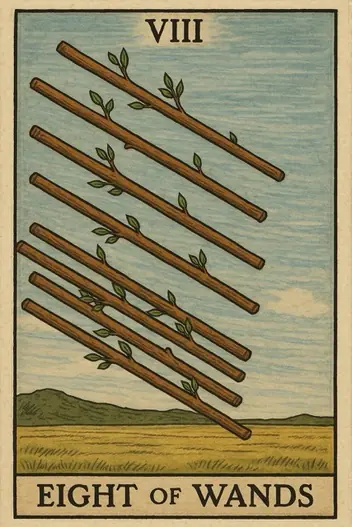
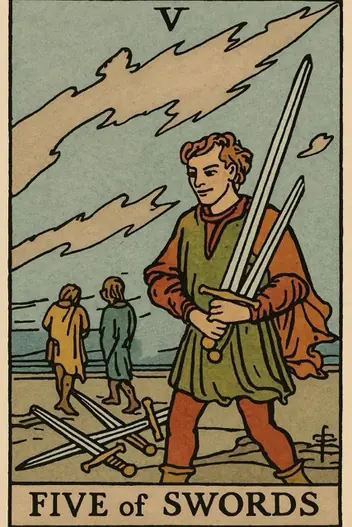
When the Eight of Wands—a card of rapid momentum, quick decisions, and fast-moving energy—meets the Five of Swords—a card of tense conflict, hollow victories, and strategic withdrawals—you get a psychological cocktail of high-speed confrontation. This combination often signals a situation where events are moving faster than your ability to process them, and the pressure to "win" or "act now" may lead to pyrrhic victories. The key insight here is that not all forward momentum is productive; sometimes, the fastest path is the one that creates the most casualties.
Psychologically, this pairing activates the shadow of the competitive ego. The Eight of Wands pushes for immediate action and external results, while the Five of Swords tempts you to prioritize being "right" over being effective. The real challenge is to slow down your decision-making without stopping your progress, and to recognize when a conflict is worth engaging in versus when it’s a trap that will drain your resources.
Eight of Wands and Five of Swords Together: Meaning
The core dynamic of Eight of Wands and Five of Swords is accelerated conflict resolution—but not necessarily healthy resolution. The Eight of Wands brings a sense of urgency, as if time is running out and you must act now. The Five of Swords adds a layer of interpersonal tension, often involving a power struggle or a situation where someone will be left feeling defeated. Together, they describe a scenario where you are racing toward a confrontation or a decision that will leave a bitter aftertaste.
From a Jungian perspective, this combination represents the clash between the Persona (the fast, winning self) and the Shadow (the part that knows the victory is hollow). The Eight of Wands’ speed can override your inner caution, leading you to act on impulse rather than wisdom. The Five of Swords warns that the price of winning this race may be damaged relationships, bruised egos, or a loss of integrity. The practical takeaway is to ask: Is this battle worth fighting? And what am I willing to lose to win it?
In real-world terms, this pair often appears when you are under pressure to make a quick decision in a competitive environment—like a negotiation, a legal dispute, or a workplace rivalry. The best strategy is to use the speed of the Eight of Wands to gather information rapidly, but hold off on the final move until you’ve assessed the long-term consequences of the Five of Swords’ adversarial stance. Speed without strategy is chaos; conflict without purpose is self-sabotage.
Your pair is already on the table. Ask your question and draw the clarifying card
or simply focus on it
Eight of Wands and Five of Swords in Love and Relationships
If you are single:
This combination suggests you may be rushing into a connection that has underlying competitive or conflictual dynamics. Beware of someone who seems too eager to "win" your attention—they may be more interested in the chase than in you.
If you are in a relationship:
You and your partner may be caught in a fast-moving argument or power struggle. The urge to be "right" is stronger than the urge to connect. Slow down the conversation to avoid saying something you’ll regret.
In relationships, the Eight of Wands and Five of Swords together often indicate a communication breakdown that is escalating rapidly. One partner may be pushing for a quick resolution or a decisive "win," while the other feels steamrolled or defeated. The psychological danger here is that the need for speed overrides empathy, leaving the relationship with unprocessed resentment. Bold key relationship advice: The most important action you can take is to pause the momentum and explicitly ask: "What do we both actually need here, beyond just being right?" If you can create a temporary ceasefire, you can transform a destructive argument into a productive conversation. The victory you seek may not be worth the relationship you lose.
Eight of Wands and Five of Swords for Career and Money
Strategic Opportunities:
Use the fast-moving energy of the Eight of Wands to accelerate a project or launch that has been stalled. The Five of Swords’ competitive edge can help you outmaneuver a rival—but only if you do so ethically.
Strategic Opportunities:
This is an excellent time to negotiate from a position of speed—get your offer or proposal in before your competition does. The element of surprise is on your side.
Calculated Risks:
Do not engage in a public feud or a fight you cannot win cleanly. The Five of Swords warns of reputational damage. Avoid making decisions based on ego or a desire to "crush" a colleague.
In a professional context, this combination signals a high-stakes, fast-paced environment where you have a narrow window to act. The Eight of Wands gives you the energy to move quickly, but the Five of Swords warns that not every battle needs to be fought. A smart strategy is to focus on objective outcomes rather than personal victories. For example, if you are in a negotiation, use the speed to present your best offer early, but resist the urge to humiliate the other side. Bold financial warning: Avoid any investment or business deal that relies on "beating" someone else—this is a zero-sum game that will likely leave you with a hollow win. Instead, aim for a mutually acceptable outcome that preserves your network and reputation.
Deepen your understanding
Find out exactly what this reading means for your current life situation with our oracle.
Negative Meaning of Eight of Wands and Five of Swords
The shadow side of this pairing is impulsive aggression. When the Eight of Wands’ speed meets the Five of Swords’ conflict, the worst-case scenario is that you act without thinking, escalate a situation unnecessarily, and then feel guilt, regret, or isolation afterward. The cognitive bias at play here is urgency bias—the belief that if you don’t act immediately, you will lose. This can lead to poor judgment, such as sending an angry email, making a rash financial decision, or cutting off a relationship prematurely.
Another pitfall is self-sabotage through over-competitiveness. You may be so focused on "winning" that you fail to see the bigger picture. The Five of Swords often depicts a figure standing over defeated opponents—but they are alone. The shadow warns that your need to be right may leave you isolated, even if you "win" the argument. If you feel a rush of adrenaline or a sense of righteous anger, pause and ask: Am I acting from strength, or from fear of losing? The fastest path is not always the wisest path.
Eight of Wands and Five of Swords Reversed: What Changes?
When cards appear reversed, the dynamic becomes distorted, but it does not disappear.
The Reversed Eight of Wands points to blocked potential or recklessness. This means the speed has vanished, but the tension remains. You may feel "stuck" in a conflict that isn't moving forward. Warning: Do not try to force events artificially—this will lead to chaotic and thoughtless actions. It is better to take a pause for analysis.
The Reversed Five of Swords speaks of internal resistance and weakness. You are not ready for open conflict, but you continue to mentally replay grievances. This is a state of "quiet war" with yourself. Advice: Acknowledge your unwillingness to fight. Sometimes retreat or compromise is not weakness, but a conscious choice.
If BOTH cards are reversed, a complete imbalance arises. The energy for action is blocked, and aggression is turned inward. This is a classic scenario of self-sabotage and procrastination rooted in fear. A logical way to correct this: you need to find a "safe" outlet for the energy of the Eight of Wands—start with physical activity or tidying up. This will reduce internal tension and allow you to see the conflict (the Five of Swords) in a more objective light.
Eight of Wands and Five of Swords: Tarot Advice
Constructive use of this combination requires a paradoxical approach: consciously slowing down the pace to increase the precision of the strike. The energy of the Eight of Wands is an inertia that cannot be stopped, but can be redirected. Instead of wasting it on fruitless arguments (Five of Swords), channel it into rapid and clear articulation of your terms. Your task is not to defeat an opponent, but to conclude the dialogue with minimal losses to yourself.
The strategic advice that will arm you with clarity is: use speed as a defense, not as a weapon. If you sense that conflict is inevitable, deliver a "preemptive strike" in the form of transparent communication. Say: "I see we are heading toward an argument. Let's establish the rules right away: we speak based on facts and without personal attacks." This will allow you to assume a meta-position and step out of the role of a brawler into the role of a moderator.
The main takeaway: The Eight of Wands and the Five of Swords together teach us that the fastest victory is the one that never happened. If you can avoid conflict without sacrificing your interests, do so. If not, act decisively, but remember that the price of your "victory" may be higher than you are willing to pay. Your strength lies not in aggression, but in the ability to control the tempo of events.
Your Next Step: Personal Context Matters
The Eight of Wands and Five of Swords together tell a story of speed meeting conflict. The core message is to act quickly but wisely, and to remember that the goal is not to defeat others, but to achieve your own objectives without unnecessary damage. Your greatest asset right now is strategic pause—use the momentum to gather data, but don’t rush into battle.
To truly understand what this combination means for your unique situation—whether in love, career, or personal growth—you need a personalized reading that considers your specific question. Use the Fortune Cards app to get a deep, tailored interpretation of this exact combination for your life right now. Available on the web or as a download, the app applies the archetypes to your context, helping you make smarter, more conscious decisions. Don’t guess—let the cards guide your next move.
Interpretation by the Fortune Cards editorial team, based on the Rider–Waite tradition and Jungian archetypes. About our methodology · Updated: 2026-08-26
Other Combinations with Eight of Wands
Other Combinations with Five of Swords
Explore Individual Card Meanings
Table of Contents
- Eight of Wands and Five of Swords Together: Meaning
- Eight of Wands and Five of Swords in Love and Relationships
- Eight of Wands and Five of Swords for Career and Money
- Negative Meaning of Eight of Wands and Five of Swords
- Eight of Wands and Five of Swords Reversed: What Changes?
- Eight of Wands and Five of Swords: Tarot Advice
- Your Next Step: Personal Context Matters
Ready to find answers to your questions?
Start your first reading now and look at your situation with fresh clarity. The cards are ready to reveal deeper meaning.