Eight of Wands and Ten of Swords Tarot as Feelings
- Arcana
- Eight of Wands — Minor Arcana, Wands; Ten of Swords — Minor Arcana, Swords
- Elements
- Eight of Wands — Fire; Ten of Swords — Air
- Elemental interaction
- Friendly elements — energies support each other
- Numerology
- 8 + 10 = 18 → 9
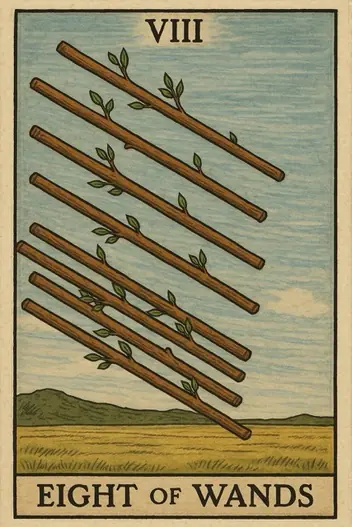
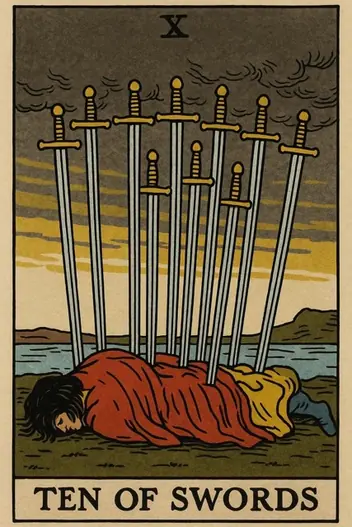
The Eight of Wands represents rapid momentum, swift communication, and the culmination of action. It’s the arrow in flight—unstoppable, direct, and full of kinetic energy. When this card appears, something is moving fast, often beyond your control. The Ten of Swords, by contrast, depicts a final, crushing defeat—a painful ending, a betrayal, or the collapse of a narrative you once believed in. Together, these cards create a stark psychological paradox: the very speed that propels you forward can also be the force that drives you into the ground.
In Jungian terms, the Eight of Wands is the archetype of the Puer Aeternus (the eternal youth) charging headlong into action, while the Ten of Swords embodies the Senex (the old man) who sees the inevitable consequences. The collision is a lesson in ego inflation versus humble acceptance. When you rush without reflection, you may not see the cliff you’re sprinting toward. This combination asks: Are you moving with purpose, or just running away from silence?
Eight of Wands and Ten of Swords Combination Meaning
The core dynamic of Eight of Wands and Ten of Swords is a sudden, decisive shift from acceleration to termination. Psychologically, this mirrors a cognitive dissonance where the seeker feels they are making progress (the wands flying) while simultaneously experiencing a catastrophic collapse (the swords piercing). This is not a slow decline; it’s a rapid, jarring conclusion to a situation that seemed to be moving positively. The key insight here is that the ending was likely baked into the speed itself. When we act with haste, we often skip critical checks, ignore red flags, or fail to integrate feedback. The Ten of Swords is the bill for that rushed decision-making.
Strategically, this pair suggests that the seeker is in a moment of forced reckoning. The Eight of Wands energy can be channeled constructively—but only if the seeker recognizes that the Ten of Swords is not a random tragedy, but a necessary termination of an unsustainable trajectory. The psychological state required here is radical acceptance. Trying to reverse the momentum will only cause more pain; the swords are already in the back. Instead, focus on retrospective analysis and what can be salvaged from the wreckage. The wands indicate that new, rapid developments will follow the ending, but only after a period of stillness and integration. Do not rush into the next sprint without understanding why the last one crashed.
What Do Eight of Wands and Ten of Swords Indicate for Your Career?
Strategic Opportunities:
Pivot quickly from failed projects. The Ten of Swords is a clear signal to cut losses. Use the Eight of Wands energy to redirect momentum into a new, more viable venture.
Strategic Opportunities:
Leverage the speed of communication. Rapid emails, decisions, or negotiations can close a deal—but only if you’ve done the due diligence. Double-check contracts and timelines.
Calculated Risks:
Do not make major financial decisions in a panic. The combination of speed (Eight of Wands) and defeat (Ten of Swords) can lead to impulsive, loss-chasing behavior. Avoid gambling, high-risk investments, or resigning without a plan.
In career and finances, this pair is a red flag for burnout and strategic failure. The Eight of Wands suggests a period of intense activity—multiple projects, fast deadlines, or a rapid climb. The Ten of Swords warns that this pace is unsustainable and will lead to a crash. This could manifest as a sudden job loss, a project cancellation, or a financial loss due to hasty decisions. The practical advice is to immediately triage your commitments. Identify what is essential and what is noise. Bold financial warning: Do not take on new debt or make large purchases during this energy. The crash is coming; preserve liquidity. For entrepreneurs, this is a time to exit failing ventures, not to double down. The Eight of Wands energy is best used for rapidly closing down old operations rather than starting new ones. The strategic move is to let the swords fall, then rebuild from a place of clarity.
Your pair is already on the table. Ask your question and draw the clarifying card
or simply focus on it
Love and Relationships
If you are single:
This combination warns against romanticizing a fast-moving connection. A whirlwind romance may end in a painful, abrupt breakup. Slow down and assess compatibility before investing emotional energy.
If you are in a relationship:
A sudden, dramatic conflict or revelation is likely. This could be a breakup, a betrayal, or a truth that shatters the current dynamic. Communicate with brutal honesty, but prepare for an ending.
In love, the Eight of Wands and Ten of Swords signal a dangerous acceleration of emotional intensity that leads to a painful climax. The relationship may have moved from "perfect" to "over" in a matter of days or weeks. The core issue is often a lack of boundaries or a failure to address underlying problems during the honeymoon phase. The Eight of Wands represents the rush of new love, while the Ten of Swords shows the inevitable crash when reality catches up. Psychologically, this is a pattern of idealization followed by devaluation. For those in a relationship, the key advice is to stop trying to "fix" the situation in real-time. The swords suggest that the ending is already written; your task is to exit with dignity and learn the lesson. For singles, avoid jumping into a new relationship immediately after a breakup. The Eight of Wands energy will tempt you to repeat the cycle.
Uncover hidden insights
Let our advanced Tarot system interpret these archetypes specifically for your personal path.
What If Eight of Wands or Ten of Swords Appears Reversed?
If the Eight of Wands is Reversed:
The energy of movement is blocked or turned inward. Instead of an external crisis, you are experiencing internal panic and paralysis of the will. You know you need to act, but you cannot. Advice: Focus on one, single, simplest action to break the vicious cycle of inaction.
If the Ten of Swords is Reversed:
This indicates resistance to an inevitable ending. You are clinging to a dying relationship or project, refusing to admit defeat. This is a state of a protracted, agonizing crisis. Warning: Prolonging the end will only increase the pain and deplete your resources. Accept the loss as a given.
If BOTH are Reversed:
Complete imbalance — chaos without movement or completion. You are stuck in an endless cycle of "attempts and failures." Energy is scattered, but no goal is achieved. How to fix it: A complete stop and a reassessment of all life strategies are necessary. This is a signal to temporarily abandon any active actions and engage in deep self-analysis.
Shadow Side & Pitfalls
The shadow side of Eight of Wands and Ten of Swords is the compulsion to repeat destructive patterns at high speed. The seeker may experience a cognitive bias called "action bias" —the belief that doing something—anything—is better than doing nothing. This leads to rushing into new projects, relationships, or investments without processing the previous failure. The Jungian shadow here is the victim archetype that secretly enjoys the drama of the crash. The seeker may unconsciously create situations where they are "betrayed" or "defeated" because it provides a narrative of martyrdom that feels more comfortable than taking responsibility for their choices.
Another major pitfall is denial of the ending. The Eight of Wands energy can be used to distract from the Ten of Swords reality—keeping busy to avoid the pain of loss. This leads to prolonged suffering because the seeker refuses to lie down and let the swords be removed. The irrational behavior is to treat a terminal situation as a temporary setback. This combination demands that you stop pretending the wound isn't fatal. The shadow also manifests as vengeance or blame. The seeker may try to "get back" at someone or something, using the speed of the Eight of Wands to launch a counterattack. This only deepens the wound. The healthiest path is to accept the defeat, learn the lesson, and move on with humility.
Eight of Wands and Ten of Swords Combined Message
How can the energy of the Eight of Wands be used constructively to balance the Ten of Swords? The key lies in paradoxical acceptance. The Eight represents speed, but now it must be directed not toward action, but toward the speed of awareness and decision-making. Instead of trying to flee from the crisis, use its impulse to quickly and without regret sever the umbilical cord binding you to the past.
The Ten of Swords is not death, but liberation from an outworn form. Your strategic task is to see in this ending not a conclusion, but a blank slate. The energy of the Eight of Wands, redirected from external activity to inner clarity, allows you to instantly switch from "struggle" mode to "observation" mode. You cannot change what has happened, but you can decide what lesson you will learn in the second before you begin building something new.
This combination demands from you the highest degree of awareness. This is a moment when emotions scream, but the mind must make a cold, pragmatic decision. Your next step is not about "fixing," but about acknowledging and letting go. Only by passing through this "defeat" with dignity can you harness the energy of the Eight for a new, more meaningful surge forward.
Where to Go From Here
The Eight of Wands and Ten of Swords combination is a stark reminder that momentum without wisdom leads to ruin, and endings are not always tragedies—they are often the price of growth. The core message is to stop running, accept the fall, and use the pain as data. The speed of the Eight of Wands will return, but only after you have fully processed the defeat of the Ten of Swords. Your next step is to sit with the discomfort, extract the lesson, and prepare for the next rapid cycle with greater awareness.
While this article provides the general archetype, the true magic happens when Tarot is applied to your unique situation. To get a deep, personalized interpretation of this exact combination for your specific question right now, use the Fortune Cards app. Whether on the web or downloaded, the app offers tailored readings that account for your context, helping you navigate the crash and plan your next move with precision.
Interpretation by the Fortune Cards editorial team, based on the Rider–Waite tradition and Jungian archetypes. About our methodology · Updated: 2026-10-08
Other Combinations with Eight of Wands
Other Combinations with Ten of Swords
Explore Individual Card Meanings
Table of Contents
Ready to find answers to your questions?
Start your first reading now and look at your situation with fresh clarity. The cards are ready to reveal deeper meaning.