Five of Cups and Seven of Cups Together in Tarot
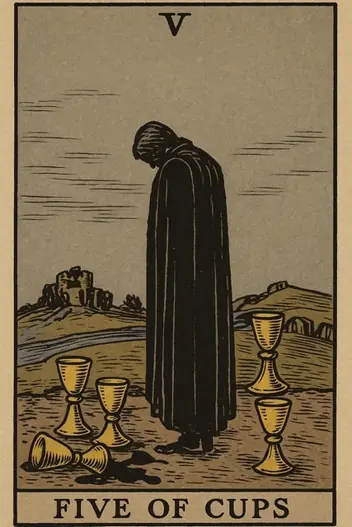

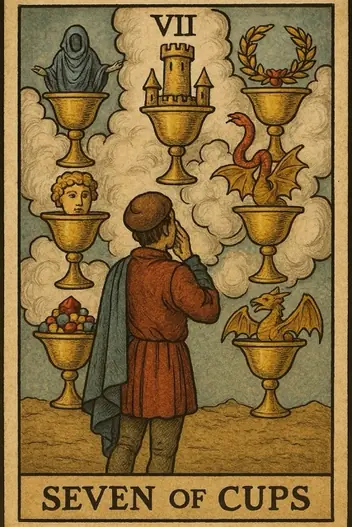
- Arcana
- Five of Cups — Minor Arcana, Cups; Seven of Cups — Minor Arcana, Cups
- Elements
- Five of Cups — Water; Seven of Cups — Water
- Elemental interaction
- Same element — energies intensify each other
- Numerology
- 5 + 7 = 12 → 3
When the Five of Cups—a card of loss, regret, and emotional withdrawal—collides with the Seven of Cups—a card of fantasy, illusion, and overwhelming choices—the result is a powerful psychological tension. This pairing often signals a moment where past disappointments distort your perception of present opportunities. You may be grieving something real, but your mind is filling the void with unrealistic scenarios, making it hard to see what is actually available.
Psychologically, this combination represents a cognitive dissonance between emotional reality and wishful thinking. The Five of Cups says, “I have lost something irreplaceable,” while the Seven of Cups whispers, “But look at all these shiny possibilities.” The danger is that you might chase fantasies to avoid processing grief, or become paralyzed by the fear that nothing will ever be as good as what you lost. Pragmatically, this is a call to ground your emotions in objective facts and make decisions based on what is real, not what you hope will replace the past.
Five of Cups and Seven of Cups Combination Meaning
The core dynamic here is a battle between emotional closure and escapism. The Five of Cups represents a fixed point of sorrow—a concrete loss, whether it’s a relationship, a job, or a dream that died. The Seven of Cups, in contrast, is a diffuse cloud of possibilities, each one tempting but ultimately insubstantial. When these two cards appear together, the seeker is often stuck in a loop: they feel the pain of what is gone, so they retreat into daydreams or false hopes to avoid the discomfort of reality.
This creates a self-sabotaging pattern where no decision feels safe. You may be overanalyzing options because you fear making another mistake. Alternatively, you might be idealizing a future that doesn’t exist—believing a new partner, job, or location will magically heal the old wound. The key insight is that the Seven of Cups’ illusions are not inherently bad; they become dangerous only when they prevent you from taking concrete action. Psychologically, you are being asked to distinguish between healthy hope and toxic fantasy.
The pragmatic takeaway: Grieve first, then choose. Use the Five of Cups to acknowledge what you lost, but do not let it define your entire emotional landscape. Then, use the Seven of Cups as a brainstorming tool—list all your options, but eliminate the ones that lack a realistic foundation. This is a time for disciplined decision-making, not impulsive leaps or avoidance.
Your pair is already on the table. Ask your question and draw the clarifying card
or simply focus on it
What Do Five of Cups and Seven of Cups Indicate for Your Career?
Strategic Opportunities:
Use the Seven of Cups to list every possible career path or side project, then rank them by feasibility and risk. This is a time for creative brainstorming, but only if you commit to narrowing down your options.
Strategic Opportunities:
Channel the Five of Cups’ introspection into learning from a past failure. What specific mistake led to the loss? Document the lesson and use it to avoid repeating it.
Calculated Risks:
Avoid investing in anything that promises quick returns or relies on unverified projections. The Seven of Cups’ illusions can lead to financial scams or overpriced assets.
In your career, this pairing signals a crossroads between regret and ambition. You may be mourning a missed promotion, a failed business, or a job you left behind. At the same time, you are tempted by multiple new opportunities—a startup, a career change, or a freelance venture. The danger is that you will either cling to the past (refusing to move on) or leap into a venture without due diligence. The smartest financial move is to pause and audit your resources. Bold warning: Do not use a new job to escape the emotional fallout of losing the last one. If you are grieving a professional loss, take a structured sabbatical or seek mentorship before making a big financial commitment.
For negotiations, this combination advises extreme caution with contracts. The Seven of Cups can make promises look more attractive than they are. Insist on written terms, third-party verification, and a cooling-off period. The Five of Cups teaches that what is lost is gone—don’t chase it through a risky deal.
Ask your specific question
Don't rely on generic meanings. Get a customized reading tailored specifically to your energies.
Five of Cups and Seven of Cups in Love Tarot
If you are single:
This combination suggests you may be comparing new people to an idealized past partner or a fantasy version of love. Be honest about whether your standards are based on reality or on a memory you have romanticized.
If you are in a relationship:
You or your partner may be emotionally withdrawn due to past hurts, while the other is projecting unrealistic expectations onto the relationship. This creates a gap between what is real and what is hoped for.
In relationships, the Five of Cups and Seven of Cups often indicate a dynamic of unresolved grief and ungrounded expectations. One partner may be holding onto a past betrayal or loss, while the other is offering a future that feels too good to be true. The result is a cycle of disappointment—the grieving partner feels unheard, and the hopeful partner feels rejected. The critical relationship advice here is to establish a boundary between the past and the present. You cannot heal an old wound by chasing a new fantasy.
Bold key advice:
Do not use a new relationship to fix an old one. If you are the grieving partner, seek closure through therapy or honest communication, not through a new romance. If you are the hopeful partner, ask for concrete actions, not promises. This combination warns against emotional infidelity—either with a memory or with a daydream. The only way forward is to face the loss together or acknowledge that you are not ready for a new chapter.
Reversed Five of Cups and Seven of Cups Explained
Five of Cups Reversed:
The person emerges from the stage of acute grief, but risks falling into recklessness. The desire to "numb out" at any cost pushes them toward adventures dictated by the Seven. This could be an impulsive purchase, a job change, or the start of a toxic romance. Advice: Channel your energy into recovery, not into "plugging holes" with new projects.
Seven of Cups Reversed:
The fog of illusions clears, but is replaced by apathy and cynicism. The person sees reality too darkly, which exacerbates the pain of the Five. "I understand it all, it's all a deception—nothing will work out." Advice: This is a chance to see the truth, but do not let the bitter truth paralyze you. Use the clarity for targeted actions, not for global conclusions about the meaninglessness of life.
BOTH Reversed:
Complete imbalance. Internal resistance and denial. The person acknowledges neither their pain nor their illusions. They are stuck in a "gray zone"—unable to let go of the past or create a future. How to fix it: Start by keeping a journal. Write down three facts from your day without any judgments. This will bring you back into contact with reality and show you where you are deceiving yourself.
Five of Cups and Seven of Cups: Warning Signs
The shadow side of the Five of Cups and Seven of Cups is a dangerous cocktail of depression and delusion. When this energy is blocked, the seeker may wallow in self-pity while simultaneously fantasizing about a savior—a person, a lottery win, or a sudden career breakthrough—that will fix everything. This is cognitive distortion at its worst, where the brain confuses emotional pain with objective truth. You might believe, “I will never be happy again,” while also thinking, “If only I could win that contract, everything would be fine.” Both statements are probably false.
Another pitfall is decision paralysis. The Five of Cups makes you fear loss, so you overanalyze every option to avoid another mistake. The Seven of Cups overwhelms you with possibilities, so you freeze and do nothing. This can lead to missed opportunities and deepened regret. The shadow also includes substance abuse or compulsive behavior as a way to numb the grief and escape the pressure of choice. Psychologically, this is a call to break the cycle by taking one small, real action—even a wrong one is better than staying stuck in fantasy.
What Is the Overall Message of Five of Cups and Seven of Cups?
The constructive use of this pair is to transform grief into fuel for realism, and illusions into a source of inspiration for one specific project. Your task is not to suppress fantasies, but to "ground" them. Take one idea from the Seven of Cups and ask: "What is the first small step I can take to test its reality?"
The energy of the Five is a powerful catalyst for change. The pain of loss should become not a reason to escape into a world of dreams, but a signal to reassess values. What exactly have you lost? Perhaps not a person or money, but a sense of security or self-esteem. Work with the cause, not the effect.
Strategic advice: Use the "Two Chairs" method. Sit on one chair and speak out from the perspective of the Five (all the pain and regret). Move to the other chair and respond from the perspective of the Seven (all the fantasies and hopes). Write down both monologues. Then, sit on a third, "real" chair and create a 3-point plan that acknowledges the truth of the first voice and the energy of the second, but is dependent on neither.
Your Next Step: Personal Context Matters
The core message of the Five of Cups and Seven of Cups is this: Your grief is valid, but your fantasies are not a solution. The only way forward is to acknowledge what you lost, learn from it, and then make a grounded choice from a clear-headed list of real options. Do not let the past dictate your future, and do not let daydreams replace reality.
Ready to apply this to your unique situation? While this article provides the general archetype, the true magic happens when Tarot is applied to your specific question. Use the Fortune Cards app on the web or download it now to get a deep, personalized interpretation of this exact combination for your relationship, career, or personal dilemma. Your story is unique—let the cards speak directly to it.
Interpretation by the Fortune Cards editorial team, based on the Rider–Waite tradition and Jungian archetypes. About our methodology · Updated: 2026-08-26
Other Combinations with Five of Cups
Other Combinations with Seven of Cups
Explore Individual Card Meanings
Table of Contents
- Five of Cups and Seven of Cups Combination Meaning
- What Do Five of Cups and Seven of Cups Indicate for Your Career?
- Five of Cups and Seven of Cups in Love Tarot
- Reversed Five of Cups and Seven of Cups Explained
- Five of Cups and Seven of Cups: Warning Signs
- What Is the Overall Message of Five of Cups and Seven of Cups?
- Your Next Step: Personal Context Matters
Ready to find answers to your questions?
Start your first reading now and look at your situation with fresh clarity. The cards are ready to reveal deeper meaning.