The Fool and The Hermit Tarot as Feelings
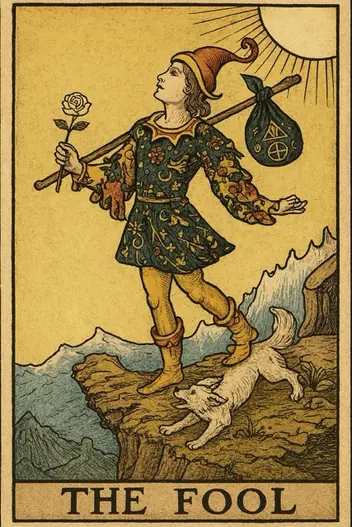

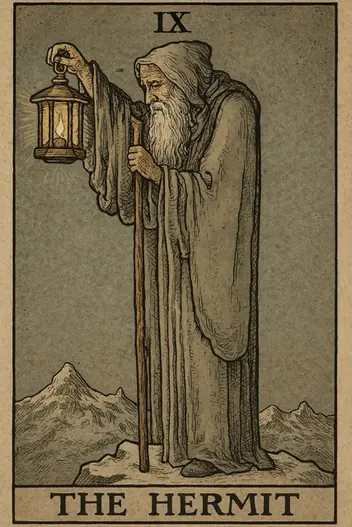
- Arcana
- The Fool — Major Arcana; The Hermit — Major Arcana
- Elements
- The Fool — Air; The Hermit — Earth
- Elemental interaction
- Opposing elements — energies create tension
- Numerology
- 0 + 9 = 9
At first glance, The Fool and The Hermit appear to be opposites. The Fool represents blind optimism, spontaneity, and the thrill of the unknown, while The Hermit embodies introspection, withdrawal, and the search for inner truth. Yet, when these two archetypes collide, they create a powerful psychological state: the courageous decision to venture alone into uncharted territory.
This combination is not about reckless abandon or permanent isolation. Instead, it signals a strategic retreat—a conscious choice to step back from external noise and follow a deeply personal, unconventional path. The Fool provides the trust in the process, while The Hermit supplies the wisdom to know when to go it alone. In real life, this manifests as someone who is willing to leave a stable job to start a business, or who ends a comfortable relationship to discover their own identity.
What Do The Fool and The Hermit Mean Together?
The core dynamic here is a paradox of motion and stillness. The Fool wants to move forward without a map, while The Hermit wants to stop and consult the stars. The resolution lies in intentional wandering—the seeker moves, but with a deliberate, reflective pace. This is not a time for groupthink or following the crowd. You are being called to trust your own judgment, even if it means standing alone.
Psychologically, this fusion activates the Individuation process described by Jung. The Fool represents the ego's leap into the unknown, while The Hermit embodies the Self's guidance from within. The key insight is that true freedom is not found in external adventure, but in internal clarity. The seeker must differentiate their own authentic desires from societal expectations. The practical implication is clear: before you can innovate, you must isolate. This is a period for research, self-study, and careful planning—but with the understanding that the plan will be rewritten as you go.
The most important takeaway is that this combination rewards calculated courage. Do not mistake The Fool’s optimism for naivety, nor The Hermit’s caution for fear. The optimal mindset is one of disciplined experimentation: test small, learn fast, and adjust course based on internal signals rather than external validation.
What Do The Fool and The Hermit Indicate for Your Career?
Strategic Opportunities:
Pursue independent projects that allow for deep focus and creative control. Freelance work, consulting, or research roles are ideal.
Strategic Opportunities:
Use this time to acquire a specialized skill or complete a certification that sets you apart from peers. The Hermit rewards expertise.
Calculated Risks:
Avoid partnerships or joint ventures until you have a clear, solo-tested prototype or plan. The Fool’s trust can be exploited in group settings.
From a career perspective, this combination signals a pivot away from team-dependent roles toward solo expertise. The Hermit’s energy is ideal for deep work, analysis, and strategic planning, while The Fool provides the guts to start something new before you feel fully ready. Bold financial warning: Do not invest in speculative ventures that require a partner’s approval or rely on hype. Instead, fund your own experiment with money you can afford to lose. This is a time for bootstrapping, not borrowing. The best financial strategy is to save aggressively for a “leap fund”—three to six months of runway to test your new direction. The key metric is autonomy, not immediate profit.
Your pair is already on the table. Ask your question and draw the clarifying card
or simply focus on it
Love and Relationships
If you are single:
This pairing suggests you may be drawn to someone who is unconventional, independent, or emotionally unavailable. The real challenge is not finding a partner, but understanding why you are seeking solitude in the first place. Use this time to clarify your own needs before pursuing a connection.
If you are in a relationship:
This combination often indicates a necessary period of emotional distance or a power struggle between the need for freedom and the need for introspection. One partner may feel abandoned while the other feels suffocated.
In relationships, The Fool and The Hermit reveal a tension between independence and intimacy. The Hermit’s energy can create a demand for space that the Fool’s partner may interpret as rejection. However, the deeper message is about emotional maturity: true intimacy requires both partners to maintain their own inner lives. Bold relationship advice: Do not force closeness when one person needs solitude. Instead, agree on a structured separation—set a timeline for checking in, and use the time apart for personal growth. This combination warns against codependency disguised as love. If you are the one pulling away, ask yourself: Am I isolating to protect myself, or to discover myself? If you are the one being left, ask: Can I trust that this distance is temporary and necessary?
Deepen your understanding
Find out exactly what this reading means for your current life situation with our oracle.
Reversed Positions: What Changes?
When The Fool appears reversed, its spontaneity transforms into recklessness or, conversely, into a paralyzing fear of the new. You either act chaotically, ignoring obvious risks, or you are afraid to take the first step, getting stuck in analysis paralysis. Advice: start with micro-actions that require minimal courage (e.g., write one letter or attend one event).
The reversed Hermit points to isolation as a defense, rather than a conscious choice. You withdraw not to seek truth, but to avoid conflicts or responsibility. This is a path toward emotional deafness and a loss of contact with reality. Warning: if you feel that solitude is becoming burdensome rather than restorative, this is a signal to return to society. Find a "safe witness" (a friend, a therapist) who can help you maintain your connection to the outside world.
If both cards are reversed, a complete imbalance arises: you simultaneously fear the new and cannot find an anchor within yourself. This is a state of cognitive dissonance, where no strategy works. How to fix it: temporarily abstain from any significant decisions and focus on basic needs (sleep, nutrition, physical activity). Your task is to lower your anxiety level to the point where you can discern what you truly want.
The Fool and The Hermit: Warning Signs
The shadow of The Fool and The Hermit is solipsistic isolation—a state where the seeker mistakes their own untested ideas for universal truth. The Hermit’s introspection can become paralyzing rumination, while The Fool’s optimism can lead to reckless decisions justified by “gut feelings.” Cognitive biases to watch for include confirmation bias (only seeing evidence that supports your plan) and the Dunning-Kruger effect (overestimating your competence in a new domain). The most dangerous pitfall is mistaking loneliness for wisdom. Just because you are alone does not mean you are right. To avoid this, seek one trusted advisor (a therapist, mentor, or coach) who can challenge your assumptions. Without external feedback, this combination can devolve into a self-fulfilling prophecy of failure where the seeker blames the world for not understanding their “unique” vision.
The Fool and The Hermit Combined Message
Constructive use of this combination requires conscious switching between "exploration" and "analysis" modes. Imagine the Fool as your "engine," launching new projects and connections, while the Hermit is the "navigator," correcting the course based on data received. The key skill here is meta-cognition: you must be able to observe yourself from the outside, noticing when spontaneity becomes chaos and reflection becomes rumination.
Strategic advice: introduce the "three-step rule." Before acting impulsively, ask yourself the Hermit's three questions: "What risks am I ignoring?", "What will I learn if I fail?", "How does this decision affect my long-term values?". Similarly, before retreating into isolation, ask yourself like the Fool: "What new thing can I learn if I stay in contact?", "What opportunity will vanish if I don't respond now?", "Do I truly need silence, or am I just afraid of the noise?".
This combination is not a sentence to loneliness or chaos. It is a tool for calibrating your life to your true nature. If you feel stuck between "I want to drop everything" and "I'm afraid to move," it means you are on the right path. Your task is not to choose between the Fool and the Hermit, but to become the conductor of this inner orchestra. Allow yourself to be simultaneously naive and wise, spontaneous and reflective. It is precisely in this tension that authenticity is born.
Where to Go From Here
The core message of The Fool and The Hermit is this: the most meaningful journeys begin in solitude, but they are sustained by clarity, not fantasy. You are being called to trust your own path, but to do so with the discipline of a scholar and the caution of an explorer. The cards offer a general archetype, but your specific question—whether about a relationship, a career move, or a personal crisis—deserves a personalized reading.
To get the full power of this combination applied to your unique situation, use the Fortune Cards app. While this article provides the psychological framework, the true value of Tarot lies in its ability to speak directly to your life. The app can interpret The Fool and The Hermit in the context of your exact question, your current emotional state, and the other cards in your spread. Download Fortune Cards now or use it on the web to receive a deep, personalized interpretation that turns these archetypes into actionable guidance for your next step.
Interpretation by the Fortune Cards editorial team, based on the Rider–Waite tradition and Jungian archetypes. About our methodology · Updated: 2026-08-26
Other Combinations with The Fool
Other Combinations with The Hermit
Explore Individual Card Meanings
Ready to find answers to your questions?
Start your first reading now and look at your situation with fresh clarity. The cards are ready to reveal deeper meaning.