Love Tarot: Four of Cups and Four of Swords

- Arcana
- Four of Cups — Minor Arcana, Cups; Four of Swords — Minor Arcana, Swords
- Elements
- Four of Cups — Water; Four of Swords — Air
- Elemental interaction
- Neutral elements — energies coexist without conflict
- Numerology
- 4 + 4 = 8
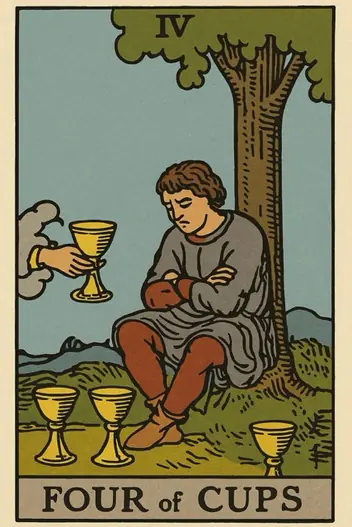
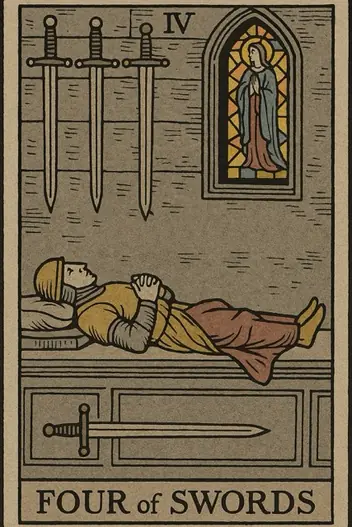
The intersection of the Four of Cups and the Four of Swords creates a powerful psychological state of withdrawal mixed with apathy. The Four of Cups represents a moment of emotional stagnation—a refusal of new opportunities due to a sense of dissatisfaction or entitlement. The Four of Swords, conversely, signals a need for mental retreat, rest, and strategic silence. When these two archetypes collide, you are not just avoiding the world; you are actively resting from your own discontent.
This combination often appears when a person has been burned by unmet expectations or repetitive disappointments. Instead of taking action, they retreat into a protective shell of indifference. This is not a passive state—it is a calculated, often unconscious, defense mechanism. The task is to differentiate between necessary recovery (Four of Swords) and self-sabotaging apathy (Four of Cups). The key is to use the quiet to gain clarity, not to hide from reality.
Four of Cups and Four of Swords Combination Meaning
The core psychological dynamic here is emotional exhaustion combined with mental avoidance. You may feel as though nothing new is worth your energy, while simultaneously needing to shut down to preserve your sanity. This is a high-risk state for decision-making: you are prone to rejecting offers that could actually serve you, simply because you are too tired to evaluate them fairly.
This pairing suggests a deliberate pause—but one that must be managed carefully. The Four of Cups warns against letting cynicism become your default lens, while the Four of Swords insists that you need cognitive rest before any new input. In practical terms, this means you should stop seeking new opportunities for a short period, but also actively question your own dismissiveness. Ask yourself: Am I truly uninterested, or am I protecting myself from further disappointment? The answer determines whether this is a healing retreat or a trap of stagnation.
The strategic implication is clear: use this time to audit your emotional reserves. Do not make major changes or commitments. Instead, treat this as a diagnostic phase—observe your feelings of boredom or rejection without acting on them. The real work is in distinguishing between a genuine need for rest and a refusal to engage with life.
Career and Finances
Strategic Opportunities:
Use this period to review past projects for lessons learned rather than starting new ones. The Four of Swords supports strategic analysis before action.
Strategic Opportunities:
This is an ideal time to renegotiate boundaries at work—say no to extra responsibilities that drain your mental energy.
Calculated Risks:
Do not quit or make a major financial move right now. The Four of Cups can make you undervalue your current position, while the Four of Swords clouds your judgment.
Professionally, this combination is a yellow flag for burnout and disengagement. You may feel underappreciated or bored with your current role, but the Four of Swords warns that your capacity for rational evaluation is compromised. Important financial warning: Do not reject a stable offer simply because it feels uninspiring. The Four of Cups often leads to turning down opportunities that later prove valuable. Instead, use the Four of Swords energy to create a “pause” protocol: for the next 7-10 days, do not make any career or financial decisions. Use that time to journal about what you actually want, not what you are running from. If you must act, seek objective third-party advice from a mentor or coach.
Your pair is already on the table. Ask your question and draw the clarifying card
or simply focus on it
Love and Relationships
If you are single:
This combination suggests you may be overly critical of potential partners due to past disappointments. You are likely to dismiss new connections before giving them a fair chance. The advice is to pause your search and examine why you feel so disenchanted.
If you are in a relationship:
You and your partner may be in a mutual withdrawal phase, where both of you are emotionally unavailable. This can lead to a silent standoff where neither is willing to initiate connection.
In relationships, this pairing signals a dangerous emotional distance. The Four of Cups indicates one partner feeling unseen or undervalued, while the Four of Swords suggests the other partner is retreating mentally to avoid conflict. The result is a cycle of silence and resentment. Key relationship advice: Do not assume your partner knows what you need. The Four of Cups often leads to passive-aggressive withdrawal, where you test your partner by withholding feelings. The Four of Swords, meanwhile, can be a genuine need for space—but it must be communicated. Schedule a low-pressure check-in to express what you are feeling, even if it’s just “I need rest, but I’m not pulling away from you.” Avoid making permanent decisions based on temporary emotional fatigue.
Ask your specific question
Don't rely on generic meanings. Get a customized reading tailored specifically to your energies.
What If Four of Cups or Four of Swords Appears Reversed?
Reversed cards in this pair radically alter the dynamic, transforming passive waiting into active, yet often destructive, action.
Reversed Four of Cups (Upright Four of Swords): Apathy is replaced by a reckless pursuit of new emotions. You emerge from isolation, but grasp at the first opportunity that comes along without filtering its quality. Warning: This impulsive "thawing out" can lead to ill-considered connections and financial mistakes born from emotional hunger.
Reversed Four of Swords (Upright Four of Cups): Mental rest is interrupted, but without lifting the emotional block. You are forced to act and think while feeling completely empty. This is a state of "chronic fatigue" at work or in relationships, where you are physically present but emotionally absent. Advice: Reduce your workload to a minimum to prevent a nervous breakdown.
BOTH reversed:
Total imbalance. This is an explosive mixture of suppressed apathy and forced activity. A person simultaneously wants to change everything and cannot move. This state often leads to abrupt, chaotic decisions—quitting a job "with nowhere to go," ending a relationship without attempting dialogue. Corrective Strategy: An external manager (therapist, coach, trusted friend) is necessary to take on the function of "brakes" and "accelerator" until you regain your self-control.
What Are the Risks of Four of Cups and Four of Swords?
The shadow manifestation of this pairing is chronic indecision masked as wisdom. You may convince yourself that you are being “thoughtful” when you are actually frozen by fear of disappointment. This leads to a cognitive bias called “affective forecasting error”—you overestimate how bad new experiences will feel, based on past hurts. Another pitfall is self-sabotage through withdrawal: you reject help, ignore opportunities, and isolate yourself, which then confirms your belief that “nothing works.” Watch for the trap of intellectualizing your emotions: the Four of Swords can lead to over-analyzing your feelings rather than feeling them. The result is a detached, cynical persona that protects you from vulnerability but also from growth.
Four of Cups and Four of Swords Combined Message
How to use this powerful energy constructively? Your task is to transform the Four of Swords from a "sanctuary" into a "planning headquarters", using the emotional detachment of the Four of Cups as a tool for objective analysis.
First, acknowledge that your state is not an accident, but a necessary stage. Do not fight apathy with willpower. Instead, set yourself strict "working hours" (e.g., 1 hour per day) to sort through accumulated problems. The rest of the time—complete mental rest.
Second, use the principle of "minimum viable feedback". Inform your environment (partner, colleagues) that you are entering a "focus mode" for 3-5 days. This transforms your silence from passive-aggressive into strategically understandable. This lifts the burden of guilt and prevents misunderstandings.
Third, start with one micro-opportunity. The Four of Cups blocks the vision of all opportunities at once. Choose one area (e.g., a colleague's proposal or an invitation to a meeting) and give yourself 24 hours to consider it, without rejecting it immediately. This simple act of "opening" one cup can initiate the process of emerging from a stupor.
Deep strategic advice:
Do not attempt to solve an emotional problem (Cups) and a mental task (Swords) simultaneously. First, restore your sleep schedule and basic rituals (eating, walking)—this satisfies the Four of Swords. Only then, with a clear head, analyze what exactly in your life is causing longing and apathy (Four of Cups). The weakness of this combination lies in the chaotic mixing of rest and suffering. Its strength lies in their clear separation.
Your Next Step: Personal Context Matters
The core message of the Four of Cups and Four of Swords is this: Rest is necessary, but apathy is a choice. You are being asked to step back, but not to check out. Use this stillness to separate genuine exhaustion from emotional avoidance. Your next move is to ask one honest question: “What am I really avoiding right now?” The answer will reveal whether you need more time to heal or a push to re-engage.
While this article provides the archetypal meaning, the true power of Tarot lies in applying it to your unique life. The Fortune Cards app allows you to input your specific situation—whether it’s a relationship conflict, a career crossroads, or a personal block—and receive a deep, personalized interpretation of this exact combination. You can use the app on the web or download it now to get the clarity you need for your exact question, right this moment.
Interpretation by the Fortune Cards editorial team, based on the Rider–Waite tradition and Jungian archetypes. About our methodology · Updated: 2026-10-08
Other Combinations with Four of Cups
Other Combinations with Four of Swords
Explore Individual Card Meanings
Table of Contents
Ready to find answers to your questions?
Start your first reading now and look at your situation with fresh clarity. The cards are ready to reveal deeper meaning.