Four of Cups + Two of Swords: What This Tarot Pairing Means

- Arcana
- Four of Cups — Minor Arcana, Cups; Two of Swords — Minor Arcana, Swords
- Elements
- Four of Cups — Water; Two of Swords — Air
- Elemental interaction
- Neutral elements — energies coexist without conflict
- Numerology
- 4 + 2 = 6
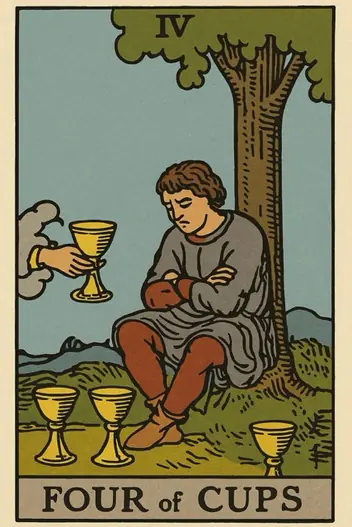
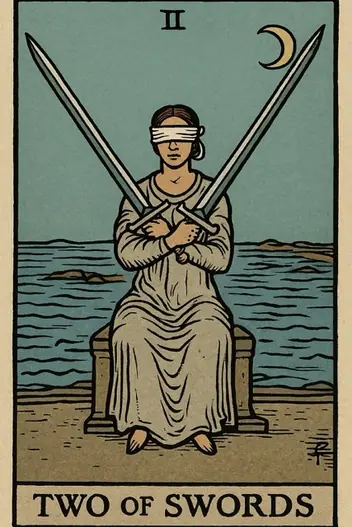
When the Four of Cups meets the Two of Swords, you are looking at a psychological standoff between emotional disengagement and intellectual indecision. The Four of Cups represents a state of apathy, dissatisfaction, and missed opportunities—a withdrawal from the world because nothing seems good enough. The Two of Swords, conversely, is the card of deliberate blindness and internal conflict—a refusal to see the truth or make a choice.
Together, these cards create a feedback loop: you are emotionally checked out, so you avoid the hard decisions that could pull you back in. This combination often signals a period where you are stuck in a comfort zone of avoidance, preferring the known pain of stagnation to the unknown risk of action. The core challenge here is not a lack of options, but a lack of will to engage with them.
Core Dynamics & Interpretation
The psychological state generated by the Four of Cups and Two of Swords is one of learned helplessness disguised as careful deliberation. You may believe you are "thinking things through," but in reality, you are using analysis as a shield against the emotional discomfort of making a choice. The Four of Cups brings a sense of entitlement or a "grass is greener" mentality, while the Two of Swords adds the rigid defense of intellectualizing feelings.
In practical terms, this means you are waiting for a perfect option that doesn't exist. You are rejecting current opportunities (Four of Cups) while refusing to look at the facts that would force a decision (Two of Swords). The real-world implication is a loss of momentum. Time becomes your biggest liability, not your ally. To break free, you must recognize that indecision is itself a decision—a choice to stay stuck.
The key insight here is that your frustration is not caused by external circumstances, but by your internal conflict between what you want and what you are willing to accept. The solution lies in lowering your emotional defenses and admitting that you are afraid to choose, not that you are unable to see clearly.
Ask your question and flip the cards
or simply focus on it
Four of Cups and Two of Swords in Love and Relationships
If you are single:
This pair suggests you are projecting a sense of unavailability even when you appear to be looking. You may be dismissing potential partners because they don't meet an idealized standard, while simultaneously feeling lonely and unsatisfied.
If you are in a relationship:
You and your partner are likely avoiding a critical conversation about needs, boundaries, or the future. One person may feel emotionally starved (Four of Cups) while the other prefers to keep the status quo by refusing to discuss it (Two of Swords).
In relationships, this combination points to a dangerous emotional gridlock. One partner may feel unappreciated and withdraw into apathy, while the other avoids conflict by "not seeing" the problem. The biggest relationship risk here is passive-aggression. Instead of stating needs clearly, you might punish your partner with silence or coldness. To move forward, you must name the elephant in the room. Schedule a time to talk without distractions. The goal is not to win an argument, but to break the cycle of avoidance. If you are single, examine whether you are using "high standards" as a socially acceptable excuse for fear of intimacy. You may need to accept that a good-enough partner is better than a perfect fantasy.
Uncover hidden insights
Let our advanced Tarot system interpret these archetypes specifically for your personal path.
What Do Four of Cups and Two of Swords Indicate for Your Career?
Strategic Opportunities:
This is a strong signal to audit your current role or business model. The dissatisfaction you feel is real data—use it to identify what needs to change, not to justify quitting impulsively.
Strategic Opportunities:
You have a window to gather objective information before making a move. Use this time to research, network, and collect data. Knowledge is your antidote to paralysis.
Calculated Risks:
Do not resign or make a major financial commitment right now. Your judgment is clouded by emotional fatigue and cognitive bias. Wait until you can see the situation clearly, but set a hard deadline for your decision.
Professionally, the Four of Cups and Two of Swords warns against the illusion of being stuck. You may feel your job is beneath you, or that no opportunity is worth pursuing. However, this combination often appears when you are overlooking a viable option because it feels unexciting. Your biggest financial risk is letting pride and apathy bleed your resources. You might be spending money to compensate for dissatisfaction (retail therapy) or avoiding a necessary budget review. A practical step is to create a "pros and cons" list for your top three options, then force yourself to choose one within 72 hours. The act of choosing—even imperfectly—will break the paralysis. In negotiations, do not reveal your dissatisfaction; it weakens your position. Instead, use this time to build leverage before you act.
Reversed Positions: What Changes?
If the Four of Cups is reversed:
This is a breakthrough from stagnation. Instead of apathy comes an impulsive desire to "grab" everything at once. Risk: mindlessly accepting offers out of fear of being left with nothing. Advice: don't rush into the first opportunity; use a checklist of 5 criteria for evaluation.
If the Two of Swords is reversed:
The defense crumbles. Internal resistance gives way to a chaotic flow of information and emotions. You may make a decision too quickly, under the influence of anger or panic. Warning: this is not the moment for strategic moves; it is a moment for a "stop signal" and deep breathing.
If BOTH are reversed:
Complete imbalance. Apathy transforms into destructive activity, and avoidance turns into aggressively imposing your will. This is a classic "burning bridges" scenario. A logical way to correct it: consciously slow down for 24 hours and consult an external advisor (friend, coach) to gain an objective perspective from the outside.
The Shadow Side of Four of Cups and Two of Swords
The shadow of this combination is willful ignorance and emotional stagnation. You may be avoiding a truth you already know because it demands a painful decision. Cognitive biases like the "sunk cost fallacy" (staying in a bad situation because you've invested time) and "confirmation bias" (only seeing evidence that supports staying stuck) are at play. Self-sabotage manifests as procrastination disguised as prudence. You might tell yourself you are "being patient" when you are actually afraid to fail. The most dangerous pitfall is letting this state become a lifestyle. Chronic indecision leads to a loss of self-trust and a passive, victimized identity. Watch for signs of depression or burnout—the Four of Cups can indicate a clinical lack of energy, not just a mood. If you find yourself feeling numb for weeks, this is not a tarot reading issue; it is a signal to seek professional support.
What Is the Overall Message of Four of Cups and Two of Swords?
How can the energy of the Four of Cups be used constructively to balance the Two of Swords? The answer is paradoxical: you need not to "want" more, but to "see" more clearly. The Four of Cups speaks of dissatisfaction but offers no direction. The Two of Swords blocks vision. Your task is to connect emotional intelligence with rational analysis.
Begin with the "Reality Map" technique. Take a sheet of paper and divide it into two columns: "What I Have (Facts)" and "What I Want (Emotions)." In the first column, record objective data (salary, status, partner). In the second, note your feelings about these. Then, find specific, measurable actions that will change the facts, not merely soothe the emotions. For example, instead of "I want more respect," write "I will ask for feedback from my supervisor every two weeks."
A deep strategic insight: use the apathy of the Four of Cups as fuel for analysis. Your reluctance to act is a signal that old methods have exhausted themselves. Do not try to artificially "cheer yourself up." Instead, pause for a systematic review of your goals, and then, armed with a new plan, remove the blindfold from the Two of Swords and take one, confident step. Only this way will you break out of the vicious cycle.
Your Next Step: Personal Context Matters
The core message of Four of Cups and Two of Swords is that your paralysis is a choice, not a sentence. You have the power to see clearly and act decisively, but only if you are willing to drop your defenses and accept imperfect options. The cards are not telling you to settle; they are telling you to engage with reality instead of waiting for a fantasy.
While this article provides the general archetype, the true magic happens when Tarot is applied to your unique situation. To get a deep, personalized interpretation of this exact combination for your specific question, use the Fortune Cards app on the web or download it now. Discover exactly what decision you are avoiding, and how to break free with clarity and confidence.
Interpretation by the Fortune Cards editorial team, based on the Rider–Waite tradition and Jungian archetypes. About our methodology · Updated: 2026-08-01
Other Combinations with Four of Cups
Other Combinations with Two of Swords
Explore Individual Card Meanings
Table of Contents
- Core Dynamics & Interpretation
- Four of Cups and Two of Swords in Love and Relationships
- What Do Four of Cups and Two of Swords Indicate for Your Career?
- Reversed Positions: What Changes?
- The Shadow Side of Four of Cups and Two of Swords
- What Is the Overall Message of Four of Cups and Two of Swords?
- Your Next Step: Personal Context Matters
Ready to Discover Your Path?
Join thousands of seekers who have found clarity and guidance through our platform. Your cosmic journey awaits.