Four of Wands and Five of Cups Reversed in Tarot
- Arcana
- Four of Wands — Minor Arcana, Wands; Five of Cups — Minor Arcana, Cups
- Elements
- Four of Wands — Fire; Five of Cups — Water
- Elemental interaction
- Opposing elements — energies create tension
- Numerology
- 4 + 5 = 9
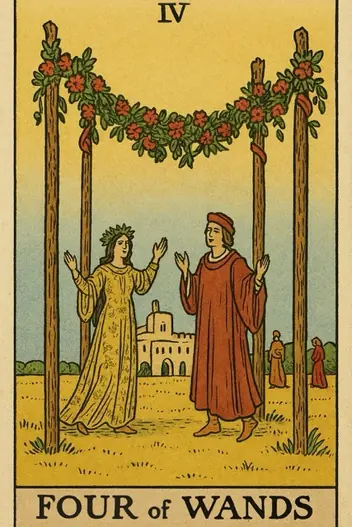
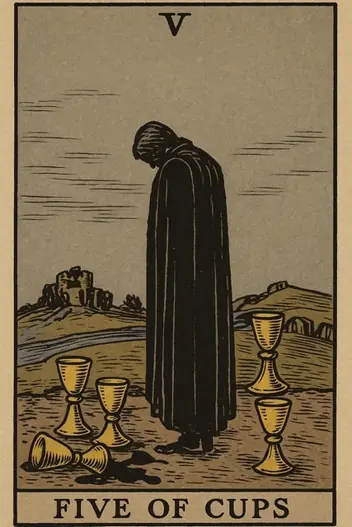
When the Four of Wands—a card of celebration, homecoming, and structural stability—meets the Five of Cups—a card of loss, regret, and emotional withdrawal—the result is a psychological paradox. You have built a solid foundation, yet you feel unable to enjoy it. The party is happening, but you are standing in the corner, staring at a spilled drink.
This combination forces a confrontation between external achievement and internal emotional residue. The Four of Wands represents the container you have created: a stable relationship, a successful project, or a secure home. The Five of Cups represents the content you are still mourning: a past failure, a broken trust, or an unfulfilled expectation. The key insight here is that your current stability is real, but your inability to perceive it is also real.
Four of Wands and Five of Cups: How These Energies Interact
The core dynamic of this pairing is cognitive dissonance between objective success and subjective dissatisfaction. Psychologically, this mirrors the Jungian concept of enantiodromia—the tendency for a psychological state to flip into its opposite when held too rigidly. The Four of Wands energy demands you celebrate and consolidate your wins. The Five of Cups energy insists you process grief before you can move forward. The collision creates a paralysis of appreciation: you cannot enjoy what you have because you are still fixated on what you lost.
From a strategic perspective, this is a high-risk moment for self-sabotage. The stability of the Four of Wands provides a safe platform to finally face the emotional debts represented by the Five of Cups. However, if you ignore the grief, the foundation will feel hollow. If you wallow in the grief, you risk destroying the foundation. The pragmatic path is to acknowledge the loss without letting it define your present reality. You can hold both truths: "I have built something good" and "I am still hurting from something that happened before."
The most important psychological insight here is that the Five of Cups often represents a selective memory bias. You are focusing on the three spilled cups (loss) while ignoring the two standing cups (remaining assets, relationships, or opportunities). The Four of Wands asks you to inventory what is still intact. The Five of Cups asks you to grieve what is gone. Your task is to do both without letting one cancel out the other. This is a maturity test—can you hold two opposing emotions simultaneously without acting out?
Four of Wands and Five of Cups Love Outcome
If you are single:
This combination suggests you are meeting new people from a place of unresolved past hurt. You may be attracted to stable, grounded partners but find yourself emotionally unavailable. Evaluate whether you are projecting past betrayals onto new connections.
If you are in a relationship:
You have a solid partnership, but one or both partners are carrying emotional baggage from a previous relationship, family issue, or shared disappointment. The relationship itself is not the problem—the unprocessed grief is.
In relationship dynamics, the Four of Wands and Five of Cups often indicate a couple that looks perfect from the outside but feels disconnected from the inside. One partner may want to celebrate milestones, host dinners, or plan a future, while the other is withdrawn, melancholic, or preoccupied with a past loss. This creates a cycle of resentment: the "celebrator" feels rejected, and the "mourner" feels pressured to perform happiness.
The key relationship advice here is to schedule grief into your shared reality. Instead of pretending everything is fine, create a ritual to acknowledge the loss—whether it is a miscarriage, a career setback, or a betrayal. Then, consciously choose to return to the celebration. Boundaries are critical: do not let the past grief become the dominant narrative of your present relationship. Use the stability of the Four of Wands as a safe container to have difficult conversations. If you are single, do not start a new relationship expecting it to heal your old wounds. That is a recipe for codependency. Instead, use the Four of Wands energy to build self-stability first.
Your pair is already on the table. Ask your question and draw the clarifying card
or simply focus on it
Four of Wands and Five of Cups in Career Readings
Strategic Opportunities:
Leverage your existing stability to take a calculated emotional risk. You have enough professional foundation (Four of Wands) to finally address a project failure or client loss (Five of Cups) without it destroying your career.
Strategic Opportunities:
Reassess your definition of success. You may have achieved a major milestone but feel empty because you were chasing the wrong metric. Use this moment to realign your work with what actually matters to you.
Calculated Risks:
Avoid making major financial decisions while in a state of emotional withdrawal. The Five of Cups can distort your risk assessment, making you either overly cautious (fearing another loss) or recklessly spending (trying to fill the emotional void).
From a career perspective, this combination often appears when a professional has recently achieved a promotion, completed a major project, or secured a new client—but feels unsatisfied. The Four of Wands represents the tangible reward: the title, the bonus, the public recognition. The Five of Cups represents the hidden cost: the burnout, the team member who left, the ethical compromise you made to get there. You need to audit the emotional price of your success.
Financially, this is a dangerous combination for impulsive behavior. The Five of Cups can trigger a "retail therapy" response—spending money to numb the grief. Conversely, it can trigger a "scarcity mindset" where you hoard resources out of fear of future loss. The Four of Wands suggests you have enough. Your financial strategy should be conservation, not expansion. Do not make big investments or loans right now. Instead, use the stability of your current position to pay down emotional debt first—take a vacation, hire a therapist, or invest in team morale. The best financial move here is to protect what you have built, not to chase what you think you lost.
Four of Wands and Five of Cups Reversed: How to Read It
If the Four of Wands is Reversed:
This indicates blocked potential or chaotic construction. You are trying to create stability, but the foundation is crumbling due to unresolved emotional issues (Five of Cups). Advice: do not build a house on a swamp. First, drain the emotions, then take on the projects. Otherwise, you risk getting a "house that will collapse at the first storm."
If the Five of Cups is Reversed:
This is an internal resistance to healing. The person has become so accustomed to the role of the victim that they refuse to see the good. Warning: you are cultivating your own suffering. The Four of Wands nearby says you have every chance to emerge from the crisis, but you choose to stay in the pit because it is "yours." This is self-sabotage born from a fear of new happiness.
If BOTH are Reversed:
Complete imbalance. A "neither here nor there" dynamic. You cannot achieve stability (Wands down) and cannot let go of the past (Cups down). This is a state of emotional and material chaos. How to fix it: stop. Freeze all projects. You need a total digital detox and a week of silence. The only way to regain control is to artificially create a void, so you can hear what you truly want.
Uncover hidden insights
Let our advanced Tarot system interpret these archetypes specifically for your personal path.
The Shadow Side of Four of Wands and Five of Cups
The shadow manifestation of this combination is performative suffering. You may be using your grief as an identity—the victim, the martyr, the one who "can't be happy because of what happened." This is a cognitive distortion known as emotional reasoning: you feel unhappy, therefore you conclude your life is unhappy, ignoring all evidence to the contrary. The Four of Wands offers you a way out, but your ego prefers the familiar pain of the Five of Cups.
Another major pitfall is passive-aggressive sabotage of your own stability. You might unconsciously ruin a good relationship, quit a stable job, or isolate from supportive friends because their happiness feels like an accusation of your grief. This is a form of self-punishment rooted in survivor's guilt or unworthiness. You believe you do not deserve the Four of Wands because you failed in the past.
Finally, watch for decision paralysis. The Five of Cups can make you so focused on what went wrong that you cannot see the obvious next step. You may over-analyze past mistakes (the spilled cups) while ignoring the clear opportunities in front of you (the standing cups and the stable foundation). The shadow trap is staying stuck in analysis, mistaking it for healing. Real progress requires you to eventually turn away from the spilled cups and walk back toward the celebration.
Overall Meaning of Four of Wands and Five of Cups
Constructive use of this combination requires a strict separation of time and attention. You cannot build and mourn simultaneously. The "two baskets" strategy is the only working method. The first basket is a closure ritual. Set aside one evening to write a letter to the past (do not send it), verbalize your losses, or burn old contracts. Give your Five of Cups exactly two hours of undivided attention. After that — a hard switch.
The second basket is a recognition ritual. Each morning, looking at what you have built (the Four of Wands), speak aloud one specific reason why this is good. Not "I am happy," but "this table stands level, and there is room for a coffee cup on it." Focus on physical, tangible facts.
A deep strategic piece of advice: use the energy of the Five of Cups as fuel for the ambitions of the Four of Wands. The feeling of loss is a powerful motivator. Tell yourself: "I lost X, and I will never let that happen again. Therefore, I will build Y in a way that makes it impossible." Turn your pain into an architectural principle. Do not build a house ignoring a past fire — build a house from fireproof materials. Your regret is not weakness; it is data for the project.
Applying This to Your Situation
The core message of the Four of Wands and Five of Cups is this: You have built something real, but you are not yet ready to enjoy it. The stability is there. The grief is valid. Your task is not to choose one over the other, but to integrate them. Honor what you lost, then turn your attention to what remains. The celebration is waiting for you—but only if you decide you are ready to attend.
While this article provides a deep understanding of the archetypes, the true power of Tarot lies in applying it to your specific situation. Your unique question, your personal history, and the exact positions these cards fall in will change the meaning dramatically. Do not rely on generic interpretations alone.
Get a personalized, AI-powered reading of this exact combination for your specific question right now. Use the Fortune Cards app on the web or download it today. Our advanced system analyzes your unique context and delivers a tailored interpretation that respects your intelligence and your circumstances. Stop guessing. Start understanding.
Interpretation by the Fortune Cards editorial team, based on the Rider–Waite tradition and Jungian archetypes. About our methodology · Updated: 2026-08-26
Other Combinations with Four of Wands
Other Combinations with Five of Cups
Explore Individual Card Meanings
Table of Contents
- Four of Wands and Five of Cups: How These Energies Interact
- Four of Wands and Five of Cups Love Outcome
- Four of Wands and Five of Cups in Career Readings
- Four of Wands and Five of Cups Reversed: How to Read It
- The Shadow Side of Four of Wands and Five of Cups
- Overall Meaning of Four of Wands and Five of Cups
- Applying This to Your Situation
Ready to find answers to your questions?
Start your first reading now and look at your situation with fresh clarity. The cards are ready to reveal deeper meaning.