Four of Wands and Five of Swords Together in Tarot
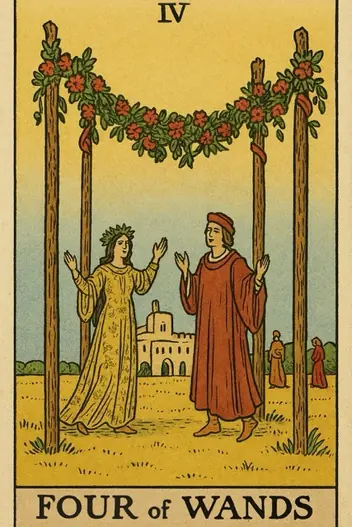

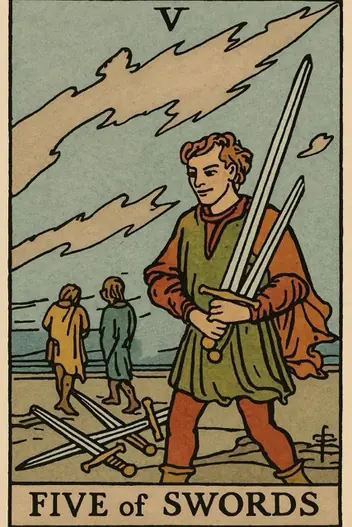
- Arcana
- Four of Wands — Minor Arcana, Wands; Five of Swords — Minor Arcana, Swords
- Elements
- Four of Wands — Fire; Five of Swords — Air
- Elemental interaction
- Friendly elements — energies support each other
- Numerology
- 4 + 5 = 9
The intersection of the Four of Wands and Five of Swords creates a tense psychological landscape: the desire for stability and celebration clashes with the reality of unresolved conflict and strategic retreat. The Four of Wands represents homecoming, emotional security, and shared joy—a moment of rest after effort. The Five of Swords, in contrast, embodies victory at a cost, cognitive dissonance, and the hollow feeling of winning a fight that wasn’t worth having.
In practical terms, this combination suggests a situation where external harmony (a party, a milestone, a settled partnership) masks an underlying power struggle or bruised ego. The seeker may be choosing between preserving the peace and confronting a painful truth. This is not a card pair that signals disaster, but rather one that demands clear-eyed assessment of what you are willing to sacrifice for temporary calm.
What Do Four of Wands and Five of Swords Mean Together?
The core dynamic here is the tension between collective harmony and individual victory. The Four of Wands asks you to celebrate what has been built, while the Five of Swords whispers that someone—possibly you—has paid a price for that stability. You may feel like a gatekeeper of peace, suppressing your own needs to keep the group happy, or conversely, like the strategic victor who won the argument but lost the warmth of connection.
Psychologically, this pairing activates the Persona vs. Shadow conflict. The Four of Wands represents the social mask of contentment, the "happy family" or "successful team" image. The Five of Swords represents the Shadow of resentment or guilt—the unspoken cost of that image. The key insight is that sustainable stability cannot be built on the foundation of a hidden defeat. If you have to "win" against someone else to feel secure, the security is fragile.
The strategic action here is to differentiate between a necessary boundary and a petty victory. Ask yourself: Is this conflict about protecting a core value (Four of Wands), or about proving you are right (Five of Swords)? If it’s the latter, you are likely to win the battle but lose the home you wanted. True stability requires honest reconciliation, not silent surrender.
Four of Wands and Five of Swords in Love Tarot
If you are single:
This combination warns against entering a relationship that feels like a "win" over a rival or a validation of your ego. Look for connections built on mutual respect, not competitive conquest.
If you are in a relationship:
You may be experiencing a period where one partner feels they "won" an argument, leaving the other feeling resentful. The celebration of your shared life is being undermined by unresolved power dynamics.
In relationships, the Four of Wands and Five of Swords together often indicate a power imbalance disguised as partnership. One person may be sacrificing their voice to maintain the "happy home" image, while the other enjoys the comfort without acknowledging the cost. The most important relationship advice here is to name the unspoken tension. If you are the one who "won" the last argument, check in with your partner’s emotional state. If you are the one who "lost," ask yourself if the peace you are preserving is worth the price of your authenticity.
Emotional intelligence is your greatest tool. This card pair suggests that true intimacy requires the courage to have the difficult conversation rather than sweeping it under the rug. The celebration of the Four of Wands can only be genuine if both partners feel heard and valued. If you are single, this combination warns against romanticizing a "victory" over an ex or a competitor—real love is not a trophy.
Your pair is already on the table. Ask your question and draw the clarifying card
or simply focus on it
Career and Finances
Strategic Opportunities:
Use your social capital (Four of Wands) to negotiate a settlement or alliance that benefits all parties, rather than pursuing a zero-sum victory.
Strategic Opportunities:
Recognize that team cohesion is a valuable asset. A win that alienates key colleagues will cost you more in the long run.
Calculated Risks:
Avoid public confrontations or "winning" a debate at the expense of a working relationship. The short-term ego boost is not worth the long-term damage.
In a career context, this combination often appears when you are torn between asserting your position and maintaining team morale. You may be celebrating a project completion (Four of Wands) while simultaneously dealing with a colleague who feels undermined or a client who is unhappy (Five of Swords). The strategic choice is to prioritize long-term stability over short-term victory.
Financial planning under this energy requires caution. The Five of Swords can indicate costly legal disputes or competitive bidding wars where the financial "win" is minimal compared to the emotional and resource drain. A key financial warning: do not spend money to "prove a point" —the celebration of the Four of Wands should be funded by genuine abundance, not by a Pyrrhic victory. Instead, focus on negotiating win-win outcomes where everyone leaves the table with something of value. This is not a time for aggressive tactics; it is a time for strategic diplomacy.
Get a personalized interpretation
Unlock the combined meaning of your cards in the context of your unique question — for free.
Shadow Side & Pitfalls
The shadow manifestation of this pairing is the illusion of harmony masking a toxic power dynamic. You may be so desperate for the security of the Four of Wands—the home, the relationship, the job title—that you tolerate the Five of Swords’ defeat, allowing yourself to be emotionally or psychologically dominated in the process. Alternatively, you may be the one wielding the sword, enjoying the thrill of victory while ignoring the cognitive dissonance of hurting someone you care about.
Common cognitive biases here include the sunk cost fallacy ("I’ve invested too much to walk away now") and the false consensus effect ("Everyone is fine with this arrangement"). Self-sabotage manifests as passive-aggressive behavior—smiling at the celebration while simmering with resentment. If you find yourself "winning" arguments but feeling emptier afterward, or if you are "keeping the peace" but feeling increasingly isolated, you are in the shadow of this combination. The antidote is radical honesty with yourself about what you truly value: the image of stability, or the substance of it.
What If Four of Wands or Five of Swords Appears Reversed?
If the Four of Wands is reversed:
This indicates blocked potential or recklessness in the pursuit of stability. You may destroy your own home (quit your job, get divorced, sell your apartment) under the influence of a momentary conflict (Five of Swords). Advice: freeze any decisions regarding changes to housing or status for 30 days. Your need for "victory" is currently destroying your security.
If the Five of Swords is reversed:
This speaks to internal resistance and passive aggression. You are not entering into open conflict, but you are sabotaging your own success. Instead of asserting boundaries, you allow yourself to be suppressed, which ultimately destroys the stability you value so much. Advice: realize that silence is also a form of warfare. Your inaction is a strategy that leads to defeat.
If BOTH are reversed:
Complete imbalance. This is a state where you are simultaneously destroying and not building. You left your job but haven't found a new one. You broke up but haven't let go. A logical way to correct this: start with small acts of creation (the Four). Do some cleaning, organize your documents. Only after this can you constructively deal with the conflict (the Five).
Four of Wands and Five of Swords Combined Message
Constructive use of this combination requires a paradigm shift from "war of annihilation" to "diplomacy from a position of strength." The energy of the Four of Wands provides your foundation—home, team, resources. The energy of the Five of Swords is your scalpel, not a sledgehammer. Your task is to defend boundaries, not to expand them at the expense of others.
Strategic advice: apply the "Golden Bridge" principle. In any conflict situation where you have nearly won, leave your opponent a dignified way to retreat. This allows you to preserve stability (the Four) and avoid breeding enemies (the shadow side of the Five). Remember: your reputation is part of your home. Destroying your reputation for a single victory leaves you without a roof over your head.
Integration of these archetypes leads to the mature stance of a leader who knows both how to fight and how to make peace. Your strength lies not in breaking your opponent, but in building a system where conflicts are resolved without destroying the shared foundation. This very balance is the true victory.
Where to Go From Here
The Four of Wands and Five of Swords together deliver a powerful message about the cost of peace. You are being asked to choose between a hollow victory and a genuine reconciliation. The core question is not whether you can win the argument, but whether the relationship or situation is worth the fight. True stability comes from integrity, not from suppressing conflict.
While this analysis provides a general framework for understanding this card pair, your specific situation—your relationship history, career stage, and personal values—determines which card’s energy is dominant. To get a deep, personalized interpretation of the Four of Wands and Five of Swords for your exact question, use the Fortune Cards app. Whether on the web or downloaded, the app applies the archetypes to your unique context, giving you actionable, psychologically sound guidance that no generic article can provide. Discover what this combination truly means for you—right now.
Interpretation by the Fortune Cards editorial team, based on the Rider–Waite tradition and Jungian archetypes. About our methodology · Updated: 2026-08-26
Other Combinations with Four of Wands
Other Combinations with Five of Swords
Explore Individual Card Meanings
Table of Contents
Ready to find answers to your questions?
Start your first reading now and look at your situation with fresh clarity. The cards are ready to reveal deeper meaning.