Judgement and Seven of Swords Tarot as Feelings
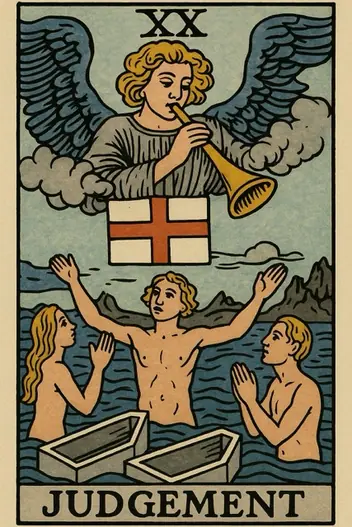
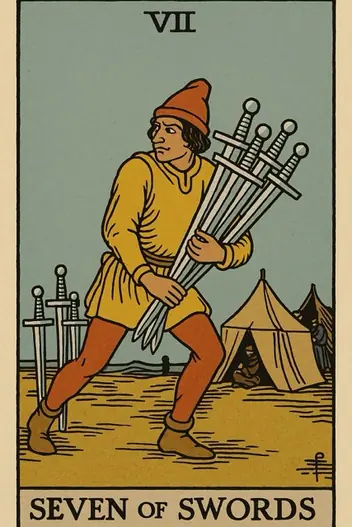
- Arcana
- Judgement — Major Arcana; Seven of Swords — Minor Arcana, Swords
- Elements
- Judgement — Fire; Seven of Swords — Air
- Elemental interaction
- Friendly elements — energies support each other
- Numerology
- 20 + 7 = 27 → 9
When the clarion call of Judgement meets the silent, strategic retreat of the Seven of Swords, you are not witnessing a random collision of archetypes. You are observing a psychological showdown between your higher conscience and your survival instinct. Judgement demands radical honesty and a final accounting of your past choices. The Seven of Swords, conversely, represents the part of you that knows how to escape, manipulate, or hide the truth to avoid that very confrontation.
This combination asks a pragmatic question: Are you using your intelligence to avoid a necessary truth, or are you strategically navigating a complex moral landscape? The tension here is between the desire for a clean, ethical rebirth (Judgement) and the practical skill of moving through the shadows without being caught (Seven of Swords). In real life, this often manifests as a critical moment where a lie, omission, or clever workaround is exposed—forcing you to decide between a painful reckoning or a deeper deception.
Core Dynamics & Interpretation
The psychological state created by Judgement and the Seven of Swords is one of calculated crisis. You are likely standing at a crossroads where a significant truth—about yourself, a project, or a relationship—is about to surface. The Judgement archetype acts as the internal auditor, reviewing your actions against your core values. The Seven of Swords provides the operational intelligence to either manage the fallout or to slip away unnoticed.
This is not a time for blind faith or naive optimism. The core dynamic is about strategic accountability. You are being called to answer for something, but you have the tools to control how that answer is delivered. The key insight here is that truth is not always a blunt instrument. The Seven of Swords suggests that a nuanced, carefully timed revelation might be more effective than a full, unvarnished confession. However, the Judgement energy warns that if you choose to deceive, the eventual reckoning will be far harsher.
In practical terms, this pair indicates a period where your reputation is on the line. You may be tempted to use your intellect to spin a narrative that protects your image. The healthier path involves using that same intelligence to craft a strategy for honest integration—acknowledging past mistakes without self-flagellation, but without evasion. The goal is to transform cunning into wisdom, using your mental agility to navigate the truth, not to bury it.
Career and Finances
Strategic Opportunities:
Use your analytical skills to audit a project or a financial deal that feels "off." Your intuition is sharp; verify the data.
Strategic Opportunities:
This is an excellent time to negotiate a severance, exit, or settlement where you need to protect your interests without burning bridges.
Calculated Risks:
Do not sign a contract without independent legal review. The Seven of Swords warns of hidden clauses or unspoken obligations.
In the professional realm, this combination is a powerful indicator of a turning point in your career strategy. You are being called to make a judgment call about the integrity of your work or your network. The Seven of Swords suggests that office politics, competitive maneuvering, or intellectual property issues are at play. You may have a rival who is working behind the scenes, or you may be the one who needs to strategically withdraw from a toxic situation.
The critical financial warning here is to avoid "creative accounting" or bending the rules to meet a deadline. The Judgement card’s energy of ultimate accountability means that any shortcuts you take now will have a long-term reputational cost that outweighs any short-term gain. Instead, view this as a strategic pivot point. Use your intelligence to identify the weakest links in a failing project and cut them loose. If you are in a negotiation, lead with transparency about your non-negotiables while remaining flexible on the tactics. The best career move is to position yourself as the person who sees the truth and handles it professionally, not the one who runs from it.
Your pair is already on the table. Ask your question and draw the clarifying card
or simply focus on it
Judgement and Seven of Swords in Love Tarot
If you are single:
This combination suggests you are evaluating a potential partner with a skeptical, strategic eye. You may sense they are hiding something, or you are the one withholding your true intentions. The advice is to call a "time-out" for a pragmatic, non-emotional assessment of the facts before you invest further.
If you are in a relationship:
Expect a confrontation about trust and transparency. A secret, a "white lie," or a pattern of avoidance is likely to surface. The key is to focus on the behavior, not the person, to avoid a destructive blame spiral.
In the context of love, this pairing signals a critical audit of the relationship's integrity. The Judgement card forces both partners to look at the relationship with fresh, uncompromising eyes. The Seven of Swords indicates that at least one person has been managing the flow of information—perhaps to avoid conflict, to maintain control, or to protect a fragile ego. The psychological dynamic is one of asymmetric knowledge.
The boldest relationship advice here is to resist the urge to "win" the argument. If you are the one who has been deceptive, the Judgement energy demands that you own the narrative before it owns you. If you are the one who has been deceived, do not let the Seven of Swords energy trick you into a cycle of suspicion and detective work. Instead, use this moment to establish a new standard of accountability. Ask direct, factual questions. The relationship will only survive if both parties agree to trade cleverness for clarity. This is not about punishing the past, but about rebuilding a structure of trust that can withstand future pressures.
Deepen your understanding
Find out exactly what this reading means for your current life situation with our oracle.
What If Judgement or Seven of Swords Appears Reversed?
When cards appear reversed, the dynamic shifts from active actions to internal processes.
If Judgment is reversed (and the Seven of Swords is upright):
You are refusing to acknowledge the obvious. Self-sabotage due to fear of change. You continue to use old manipulative patterns, even though they no longer work. Advice: acknowledge that your strategy is outdated and requires a complete overhaul, not just fine-tuning.
If the Seven of Swords is reversed (and Judgment is upright):
Internal resistance to the truth. You know what needs to be done, but you cannot bring yourself to act. This is a state of "paralysis of will," where the fear of exposure is stronger than the desire to rectify the situation. It is recommended to consult a coach or psychologist to remove the block.
If BOTH are reversed:
Complete imbalance. Chaotic attempts to hide the truth lead to even greater self-destruction. The logical way to correct this is a temporary halt to all active actions. Stop "covering your tracks" and allow the situation to clarify itself naturally.
What Are the Risks of Judgement and Seven of Swords?
The shadow of this combination is Machiavellian self-deception. The most dangerous pitfall is convincing yourself that a clever lie is actually a "strategic truth." This is a classic cognitive bias of rationalization, where you use your intelligence to justify unethical behavior. You may believe you are above the rules, or that the end justifies the means. The Seven of Swords energy, when unanchored from Judgement's moral compass, leads to a lonely, paranoid state where you trust no one because you know how easily you can deceive others.
Another pitfall is paralysis by analysis. You might become so focused on mapping out escape routes and contingency plans that you miss the moment for action. The Judgement card requires a decision, not a plan. If you spend all your energy on the how of avoiding the truth, you will never experience the relief of facing it. Watch for impulsive confessions as well—the shadow of Judgement can manifest as a dramatic, self-flagellating purge that is more about seeking attention than genuine accountability. The goal is sober, quiet responsibility, not a spectacle.
Judgement and Seven of Swords Combined Message
How to constructively use this energy? Judgment is your internal auditor, and the Seven of Swords is your tactical department. Your task is not to let tactics contradict strategy.
A deep strategic piece of advice: use the Seven of Swords not to hide the truth, but to find the best way to communicate it. If you need to fire an employee (Judgment), plan that conversation (Seven of Swords) in a way that minimizes damage to their dignity and your company. If you need to admit a mistake, do it not impulsively, but by preparing the ground and offering a solution.
The synthesis of these cards is the art of diplomacy, not the art of deception. Make your decision (Judgment), but deliver it with maximum caution and strategic precision (Seven of Swords). This is the path where you preserve both your conscience and your reputation.
Where to Go From Here
The core message of Judgement and Seven of Swords is this: You have the intelligence to see the truth, and the courage to face it—but only if you choose to. This is a moment to stop running mental circles around a problem and to make a clear, ethical decision. Your cunning is a tool, not a identity. Use it to navigate the fallout of a necessary truth, not to avoid the truth itself.
While this analysis provides a deep framework, the true power of Tarot lies in how these archetypes apply to your specific situation. A general reading can illuminate the path, but a personalized reading can show you exactly which stone to step on next. The Fortune Cards app allows you to input your exact question—about a relationship, a career move, or a personal dilemma—and receive a custom interpretation of this combination tailored to your life. Whether you use it on the web or download it, you can get the precise guidance you need to turn this moment of reckoning into a strategic advantage.
Interpretation by the Fortune Cards editorial team, based on the Rider–Waite tradition and Jungian archetypes. About our methodology · Updated: 2026-08-26
Other Combinations with Judgement
Other Combinations with Seven of Swords
Explore Individual Card Meanings
Table of Contents
Ready to find answers to your questions?
Start your first reading now and look at your situation with fresh clarity. The cards are ready to reveal deeper meaning.