Judgement and Two of Swords Tarot Combination
- Arcana
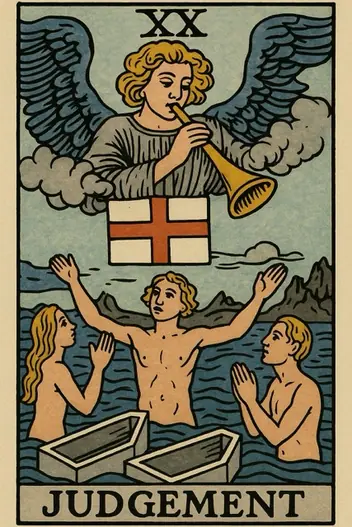
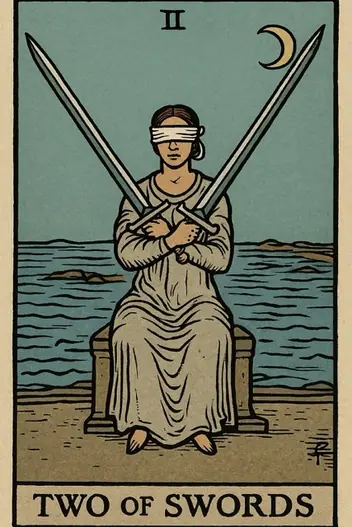
- Judgement — Major Arcana; Two of Swords — Minor Arcana, Swords
- Elements
- Judgement — Fire; Two of Swords — Air
- Elemental interaction
- Friendly elements — energies support each other
- Numerology
- 20 + 2 = 22 → 4
When the archetype of awakening meets the archetype of deliberate indecision, a powerful tension emerges. Judgement demands a reckoning—a moment of truth where past actions, suppressed knowledge, or a higher calling can no longer be ignored. The Two of Swords, however, represents a mind at a crossroads, deliberately blindfolded to avoid seeing the painful choice ahead. Together, these cards depict a person standing at the precipice of a major life decision, but refusing to open their eyes to the full scope of the consequences. This is not a passive waiting period; it is a strategic pause that risks becoming a trap if prolonged.
Psychologically, this combination is a clash between the ego’s need for control (Two of Swords) and the Self’s demand for integration (Judgement). The Judgement card, in Jungian terms, is the moment of individuation—the call to synthesize all parts of the psyche, including the shadow. The Two of Swords represents the defense mechanism of intellectualization, where the seeker uses logic and analysis to avoid emotional truths. The key insight here is that delaying a decision is itself a decision, and one that often carries a hidden cost of stagnation and missed opportunities for growth.
Judgement and Two of Swords: How These Energies Interact
The core dynamic of Judgement and Two of Swords is a battle between inner truth and external paralysis. Judgement brings a sense of urgency, often triggered by a life event—a sudden revelation, a deadline, or a moral crisis—that forces the seeker to evaluate their life path. The Two of Swords responds by creating a mental barrier, a calculated blindness that allows the seeker to maintain the illusion of safety. This is a state of ambivalence where the mind knows what must be done, but the heart and will refuse to act.
In practical terms, this pairing suggests a situation where the seeker has all the information needed to make a sound judgment, but is emotionally or ethically conflicted about the outcome. The Judgement card indicates that the situation is not about right vs. wrong, but about alignment with one’s higher values. The Two of Swords warns that prolonged neutrality is a form of self-deception. The most important insight from this combination is that the decision cannot be made by thinking alone; it requires a leap of faith based on what you already know to be true. The psychological risk is analysis paralysis—using the search for more data as an excuse to avoid the pain of commitment.
Your pair is already on the table. Ask your question and draw the clarifying card
or simply focus on it
Judgement and Two of Swords in Love and Relationships
If you are single:
This combination suggests you are evaluating a potential partner or situation with excessive caution. Your analytical mind is protecting you from a past wound, but it may also be blocking a genuine connection. Ask yourself: Am I waiting for a sign, or am I avoiding a necessary risk?
If you are in a relationship:
You and your partner may be stuck in a cycle of unspoken conflict where both of you avoid a difficult conversation. One person may feel a call for change or commitment (Judgement), while the other deflects with logic or silence (Two of Swords). This is a power struggle over the pace of the relationship.
In relationships, this card pair reveals a dynamic where one partner feels a profound need for resolution or transformation, while the other is emotionally unavailable or defensive. The Judgement card often surfaces when a relationship has reached a critical juncture—perhaps an affair has been discovered, a life goal has changed, or a long-term commitment is on the table. The Two of Swords partner may be withholding their true feelings, using neutrality as a shield. Key relationship advice: Stop trying to force a decision from your partner. Instead, focus on your own clarity. The Judgement card is a call to judge your own integrity, not just your partner’s. If you are the one in the blindfold, acknowledge your fear of the truth. The most compassionate action is honest communication, even if it leads to a painful outcome. Boldly state your needs, but release the need for an immediate answer.
Deepen your understanding
Find out exactly what this reading means for your current life situation with our oracle.
Judgement and Two of Swords: Career and Money
Strategic Opportunities:
This is a prime time to conduct a thorough audit of your career path or financial portfolio. The Judgement card signals a pivotal moment for a major pivot—a new job offer, a business venture, or a financial restructuring. The Two of Swords suggests you have enough information to act, so stop gathering data and start evaluating trade-offs.
Strategic Opportunities:
Use this energy to mediate a conflict or negotiate a settlement. The combination is excellent for legal or contractual decisions where a balanced, objective perspective is needed. Your ability to see both sides is a strength, not a weakness.
Calculated Risks:
Avoid making a decision when you are under intense pressure or emotional duress. The Judgement card can bring a sense of urgency that leads to hasty, regretful choices. The Two of Swords warns against signing anything without understanding the fine print or committing to a partnership where trust is unclear.
For career and finances, this pairing demands a strategic pause, not a permanent stall. The Judgement card often appears when you are being called to a higher purpose in your work, or when you must face the consequences of a past financial decision. The Two of Swords advises you to remove the blindfold and look objectively at the data. Bold financial warning: Do not invest or commit to a new role based on hope alone. You need clear, verifiable facts. If you are in a leadership position, this combination warns against playing politics or remaining neutral in a conflict that requires moral leadership. The best strategic move is to schedule a decision deadline and then commit to the choice that aligns with your long-term values, even if it feels uncomfortable in the short term.
When Judgement and Two of Swords Signal Trouble
The shadow side of this combination is a dangerous blend of self-righteousness and denial. The Judgement card’s shadow can manifest as harsh, unforgiving criticism—of yourself or others—leading to a moralistic stance that prevents empathy. The Two of Swords’ shadow is emotional avoidance and passive-aggression, where the seeker uses logic to rationalize inaction. Together, they create a cognitive trap: you believe you are being fair and balanced, but you are actually suppressing a crucial truth to maintain a fragile peace. The primary cognitive bias at play is the ostrich effect—burying your head in the sand while claiming to be analyzing the situation. This often leads to self-sabotage through missed opportunities or blowing up a relationship or job because you waited too long to act. The greatest risk is that your silence becomes a lie.
Judgement and Two of Swords Reversed Meaning
When cards appear in a reversed position, the dynamic becomes more acute and less controllable.
Judgment Reversed + Two of Swords Upright:
Blocked Potential. You hear the inner calling but do not trust it. This is a state of self-sabotage, where you deny yourself the right to change. Advice: Stop seeking external confirmation of your rightness — the solution is already within you; you are simply afraid to acknowledge it.
Judgment Upright + Two of Swords Reversed:
Internal Resistance Has Broken Through. The defense mechanism of denial is shattered. This can be a chaotic, impulsive decision made under emotional pressure. Warning: Your action may be destructive, as it is dictated by panic rather than conscious choice. It is necessary to pause to separate emotions from facts.
BOTH Reversed:
Complete Imbalance and Chaos. You are not only refusing to make a choice but also failing to hear your inner voice. This is a state of apathy and loss of bearings. Method for Correction: Reduce your cognitive load. Focus on basic needs (sleep, food, rest). Do not make any important decisions until you restore your inner foundation. First, regain a sense of control over your body and daily life; only then, over your destiny.
Overall Meaning of Judgement and Two of Swords
The strategic task of this combination is to transform paralysis into conscious action. The energy of Judgment is a catalyst that must "thaw" the Two of Swords. How to do this? Do not try to see the entire picture at once. Remove the blindfold and look at the single fact you have been ignoring the longest. That is the key to the solution. There is no need to think about the global future—it is enough to acknowledge the obvious in the present.
Your strategic advice: use the energy of Judgment to create an "anchor of reality." Ask yourself one hard question: "If I had to make a decision right now, with no right to postpone, what would I choose?" The answer to this question, no matter how frightening, is your true direction. The Two of Swords fears specifics, so deprive it of that luxury. Transform abstract fear into a concrete action plan with clear deadlines.
Remember, the state of stillness offered by the Two of Swords is an illusion. True stillness comes only after a decision is made, when you stop wasting energy on internal struggle. Judgment offers you liberation through truth. Accept it, and you will gain not only clarity but also the strength to move forward.
Your Next Step: Personal Context Matters
The core message of Judgement and Two Of Swords is clear: The time for deliberation is over. The truth is already known; the only remaining question is whether you have the courage to act on it. This combination is a powerful call to integrate your mind and your soul, to stop using logic as a shield and start using it as a compass. Your next step is not to gather more information, but to make a conscious choice that reflects your deepest values.
While this article provides a detailed map of the archetypal energies at play, the true magic happens when Tarot is applied to your unique situation. Your specific question, your personal history, and the other cards in your spread will reveal the precise path forward. To get a deep, personalized interpretation of this exact combination for your specific question right now, use the Fortune Cards app. You can access it on the web or download it today. Don’t just read about the call—answer it.
Interpretation by the Fortune Cards editorial team, based on the Rider–Waite tradition and Jungian archetypes. About our methodology · Updated: 2026-08-26
Other Combinations with Judgement
Other Combinations with Two of Swords
Explore Individual Card Meanings
Table of Contents
- Judgement and Two of Swords: How These Energies Interact
- Judgement and Two of Swords in Love and Relationships
- Judgement and Two of Swords: Career and Money
- When Judgement and Two of Swords Signal Trouble
- Judgement and Two of Swords Reversed Meaning
- Overall Meaning of Judgement and Two of Swords
- Your Next Step: Personal Context Matters
Ready to find answers to your questions?
Start your first reading now and look at your situation with fresh clarity. The cards are ready to reveal deeper meaning.