Justice and Two of Swords Reversed in Tarot
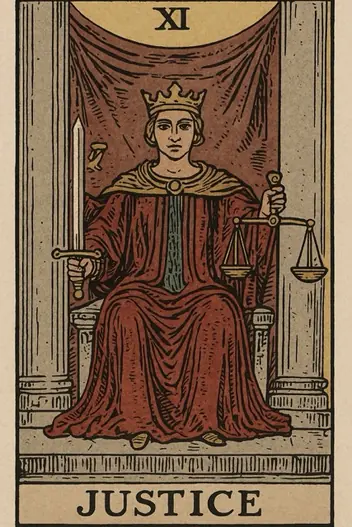

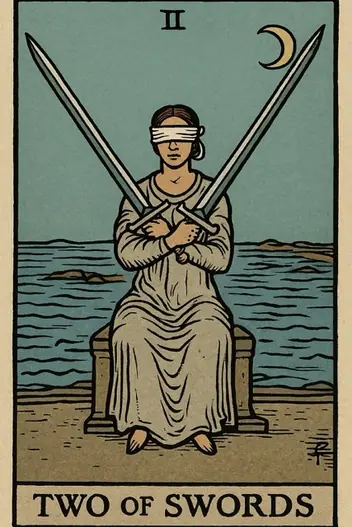
- Arcana
- Justice — Major Arcana; Two of Swords — Minor Arcana, Swords
- Elements
- Justice — Air; Two of Swords — Air
- Elemental interaction
- Same element — energies intensify each other
- Numerology
- 11 + 2 = 13 → 4
When the archetype of Justice—symbolizing objective truth, accountability, and cause-and-effect—collides with the Two of Swords—representing deliberate blindness, emotional paralysis, and a stalemate of the mind—you get a powerful psychological tension. This is not a card of swift action, but of a strategic pause before a critical verdict. The seeker is often caught between two conflicting truths, both of which demand a fair and balanced resolution. The core challenge here is that clarity feels impossible because the emotional cost of seeing things clearly is too high. This combination forces you to confront the uncomfortable reality that not deciding is itself a decision, and one that carries its own karmic weight.
Justice and Two of Swords Together: Meaning
The psychological state created by Justice and the Two of Swords is one of calculated paralysis. You are likely aware that a decision must be made, but you are deliberately withholding judgment because you sense the outcome will be irreversible. This is not a time for impulsive leaps; rather, it is a time for rigorous fact-checking and emotional audit. The Justice card demands that you weigh evidence impartially, while the Two of Swords warns that your own biases—often clouded by fear, guilt, or a desire to avoid conflict—are blocking your view.
In practical terms, this pairing suggests you are at a crossroads where logic and intuition are in direct conflict. You may have all the data you need, but you refuse to look at it because the truth will force you to take responsibility. The key insight here is that your indecision is a form of self-protection, not a lack of intelligence. The solution lies in breaking down the decision into smaller, objective criteria—much like a judge would examine evidence piece by piece. Bold action is not required; bold honesty with yourself is. Once you remove the emotional blindfold, the path becomes clear, even if it is uncomfortable.
Justice and Two of Swords Love Outcome
If you are single:
This combination suggests you are avoiding a difficult truth about a potential partner or a past relationship. You may be idealizing someone or ignoring red flags because the reality would require you to set a firm boundary or walk away. Objective self-reflection is your next step.
If you are in a relationship:
You and your partner may be stuck in a cold stalemate, where both sides are waiting for the other to admit fault or make the first move. The relationship is not broken, but it is frozen by unspoken truths.
In relationships, Justice and the Two of Swords point to a crisis of accountability. One or both partners are likely withholding honest communication to avoid a painful confrontation. The emotional intelligence required here is not about feeling more, but about seeing more clearly. You must ask yourself: What am I refusing to admit? This is not about blame, but about restoring balance through truth. Bold advice: Schedule a neutral, structured conversation where each person speaks uninterrupted for five minutes. Use a timer if necessary. This removes the emotional charge and forces the objective facts onto the table. The goal is not to win, but to re-establish fairness in the dynamic. If you cannot face the truth together, the relationship will remain in a state of cold stagnation.
Your pair is already on the table. Ask your question and draw the clarifying card
or simply focus on it
Justice and Two of Swords for Career and Money
Strategic Opportunities:
Use this period to conduct a formal audit of your projects, contracts, or financial accounts. The Justice card rewards thoroughness. Review all fine print and past agreements before making a move.
Strategic Opportunities:
Seek third-party mediation or a neutral advisor to help you see a professional stalemate from an unbiased perspective. This could be a mentor, a lawyer, or a financial planner.
Calculated Risks:
Avoid signing any document or making a major financial commitment until you have resolved the internal conflict represented by the Two of Swords. Acting under duress or emotional blindness will lead to a karmic backlash.
In your professional life, this combination warns against making decisions based on hope rather than evidence. You may be torn between two job offers, two business partners, or two investment strategies. The Justice card demands that you quantify the trade-offs—write down pros and cons, assign numerical weights, and run the numbers. Bold financial warning: Do not trust a "gut feeling" that is actually just a fear of change. The Two of Swords indicates that you are deliberately ignoring a key piece of data because it would force you to admit a mistake or take a loss. The most pragmatic action is to confront the worst-case scenario head-on. Once you calculate the real risk, the emotional charge dissipates, and you can make a rational choice. Your career growth depends on your willingness to see the truth, not on your ability to delay it.
Get a personalized interpretation
Unlock the combined meaning of your cards in the context of your unique question — for free.
Negative Meaning of Justice and Two of Swords
The shadow of Justice and the Two of Swords is toxic neutrality—a refusal to take a stand that masquerades as fairness. You may convince yourself that you are being "objective" when in reality you are avoiding personal responsibility. The cognitive bias at play is analysis paralysis: you keep gathering more information because you fear the consequences of a wrong decision. This can lead to self-sabotage where you miss crucial deadlines or allow others to make the choice for you. Another pitfall is moral grandstanding—using the language of justice to justify your own rigidity or coldness. If you feel a sense of righteous detachment, check yourself: are you truly being fair, or are you using "truth" as a weapon to avoid intimacy? The shadow here is emotional cowardice disguised as wisdom. The only way out is to choose a side, even if it is uncomfortable.
Justice and Two of Swords Reversed Meaning
When Justice is reversed, the balance shifts toward bias and self-justification. You become a judge who ignores their own mistakes. Warning: you risk making an unfair decision toward others by projecting your inner dishonesty onto them. Advice: examine your motives for any hidden self-interest.
If the Two of Swords is reversed, the defense mechanism collapses, and truth bursts forth in an uncontrollable flood. You can no longer ignore the obvious, but your reaction may be chaotic and destructive. Advice: channel this breakthrough into a constructive outlet — start an open dialogue or make a long-delayed decision.
When both cards are reversed, a complete imbalance emerges: irrational injustice combines with aggressive denial of reality. This is a state of deep self-deception, where you simultaneously suffer from the world's unfairness and refuse to see your role in creating this situation. Corrective strategy: seek external feedback from someone you trust, and be prepared to hear an unpleasant truth.
Overall Meaning of Justice and Two of Swords
Constructive use of this dynamic requires the integration of opposites. The energy of Justice should not suppress the Two of Swords, but rather help it consciously remove the blindfold, not forcibly. Strategic advice: Imagine you are a lawyer defending not one side, but the truth itself. Your task is not to prove someone right, but to see the most complete picture possible.
A practical algorithm for action: First step — acknowledge that a perfect solution does not exist. Second step — define the criteria by which you will evaluate options, and write them down. Third step — make a decision based on 80% of the available information, leaving 20% for inevitable uncertainty.
Deep truth:
Justice is not an event, but a process. You will not find a moment when everything finally falls into place. Instead, you create balance through every decision you make, through every honest communication. The Two of Swords teaches us that sometimes courage lies not in seeing everything, but in admitting that we cannot see everything, yet must still act.
Your strength now lies in the conscious choice of limitations. You are not omniscient, but you are honest within the scope of your knowledge. This is mature justice: not absolute, but sincere.
Where to Go From Here
Justice and the Two of Swords is a powerful call to stop hiding from the truth. The core message is that clarity will not come from waiting, but from actively removing your own blindfold. You must hold yourself accountable for the decision you are avoiding, because the universe will eventually force the issue. Your next step is to write down the one question you are afraid to answer, and then answer it honestly. This is not about being perfect; it is about being real.
While this analysis provides a deep, archetypal understanding of these two cards, your personal situation is unique. The exact meaning of Justice and the Two of Swords shifts depending on your specific question, your history, and the other cards in your spread. To get a truly personalized interpretation that speaks directly to your life, use the Fortune Cards app. Whether you access it on the web or download it, the app will analyze your exact combination and give you actionable, tailored advice for your relationship, career, or personal growth journey. Stop guessing—get your truth now.
Interpretation by the Fortune Cards editorial team, based on the Rider–Waite tradition and Jungian archetypes. About our methodology · Updated: 2026-08-26
Other Combinations with Justice
Other Combinations with Two of Swords
Explore Individual Card Meanings
Table of Contents
Ready to find answers to your questions?
Start your first reading now and look at your situation with fresh clarity. The cards are ready to reveal deeper meaning.