King of Cups and Three of Swords Tarot Combination
- Arcana
- King of Cups — Minor Arcana, Cups; Three of Swords — Minor Arcana, Swords
- Elements
- King of Cups — Water; Three of Swords — Air
- Elemental interaction
- Neutral elements — energies coexist without conflict
- Numerology
- 14 + 3 = 17 → 8
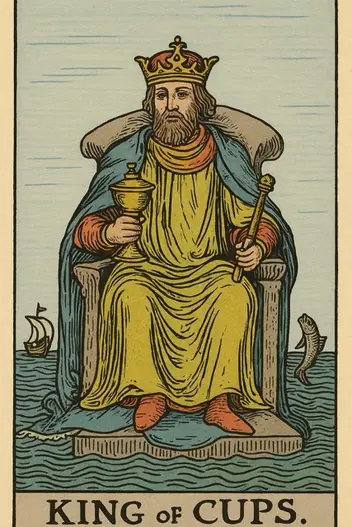
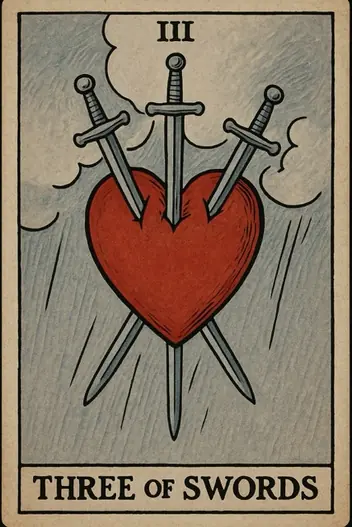
The King of Cups represents emotional sovereignty, calm authority, and the ability to navigate turbulent waters with a steady hand. The Three of Swords, by contrast, is the card of piercing realization, grief, and cognitive dissonance—the moment when a painful truth cuts through illusion. When these two archetypes collide, you are not dealing with raw emotion or blind logic; you are dealing with the conscious integration of heartache. This combination suggests a person who is emotionally mature enough to face a devastating reality without losing composure, or a situation where emotional intelligence is the only tool that can transform a wound into wisdom.
In practical terms, this pairing forces a strategic confrontation with pain. You cannot bypass the Three of Swords; you must sit with it, analyze it, and use the King’s emotional regulation to prevent reactive behavior. This is not about avoiding the hurt—it is about managing the aftermath with precision and self-respect. Whether in love, career, or personal growth, the message is clear: you have the capacity to handle hard truths, but only if you refuse to numb, deflect, or escalate.
King of Cups and Three of Swords Card Meaning Explained
The psychological state created by King of Cups and Three of Swords is one of controlled vulnerability. The King archetype here is the mature ego—the part of you that can hold two opposing truths simultaneously: “This hurts deeply, and I am still in charge of my response.” This is a critical developmental stage in Jungian terms, where the individual moves from being overwhelmed by emotion (the Queen’s domain) to regulating it (the King’s domain). The Three of Swords represents the shadow of the King: the unprocessed grief, betrayal, or cognitive bias that threatens his composure.
The real-world implication is that you are likely facing a situation where emotional suppression is no longer viable. A secret has surfaced. A relationship has revealed its fractures. A career decision has exposed a painful trade-off. The King of Cups demands that you remain the CEO of your inner world, not by ignoring the pain, but by structuring your reaction. This is the moment to ask: “What is the most disciplined way to respond to this truth?” Bold action here is not about aggression—it is about setting boundaries with grace. Avoid the trap of performing stoicism; the King feels everything but chooses his expression wisely.
King of Cups and Three of Swords for Career and Money
Strategic Opportunities:
Use your emotional intelligence to navigate a difficult negotiation or layoff conversation. Your calm demeanor will disarm opposition and reveal hidden agendas.
Strategic Opportunities:
A painful feedback session or failed project is fertile ground for long-term growth. The King’s perspective lets you extract lessons without ego damage.
Calculated Risks:
Do not make major financial decisions while in the grip of grief or anger. The Three of Swords clouds judgment. Wait 72 hours before committing to any contract, investment, or resignation.
In a professional context, this combination signals a high-stakes moment that requires emotional capital. You may be in a position of authority (the King) but facing a professional betrayal, a public failure, or a painful restructuring (Three of Swords). The strategic move is to lead with transparency. If you are a manager, acknowledge the team’s pain without over-promising. If you are an employee, document everything and use your emotional regulation to avoid reactive emails or resignations. Financially, this is a time to consolidate resources rather than speculate. Bold warning: the Three of Swords in career often indicates hidden costs or contractual loopholes—read the fine print twice.
Your pair is already on the table. Ask your question and draw the clarifying card
or simply focus on it
King of Cups and Three of Swords in Love and Relationships
If you are single:
This combination warns against idealizing a new connection. You may be drawn to someone who appears emotionally mature (the King), but a hidden betrayal or incompatibility (Three of Swords) could surface. Proceed with cautious curiosity, not blind hope.
If you are in a relationship:
A painful truth is being held in the emotional space between you. One partner may be acting as the “calm one” while the other is in silent distress. The relationship will not heal until the King acknowledges the wound.
The relationship dynamic here is a test of emotional honesty. The King of Cups can easily become a defense mechanism—using composure to avoid confrontation. The Three of Swords forces that composure to crack. The key insight is that true intimacy requires both partners to show their wounds without weaponizing them. If you are the King in this pairing, your task is to create a safe container for the painful conversation, not to lead it with detached logic. If you are the one carrying the Three of Swords, state your truth without blame. Bold advice: schedule a structured, time-limited conversation (30 minutes) to discuss the specific issue. Do not let the King’s calm silence fool you into thinking it’s resolved.
Negative Meaning of King of Cups and Three of Swords
The shadow of this combination is emotional manipulation disguised as wisdom. The King of Cups can become a cold, calculating controller who uses his understanding of emotions to gaslight others or suppress his own pain. The Three of Swords then becomes a weapon of guilt—he uses the “truth” to wound rather than heal. Conversely, the seeker may fall into victimhood, using the Three of Swords as an excuse to abdicate responsibility. The cognitive bias here is emotional reasoning: “I feel betrayed, so I must be a victim, and therefore I have no agency.” This is a self-sabotaging loop. The true pitfall is refusing to integrate the pain—either by over-intellectualizing it (King’s shadow) or by wallowing in it (Three of Swords’ shadow). Bold insight: the path forward requires you to feel the grief fully, but only for a defined period—then act.
Uncover hidden insights
Let our advanced Tarot system interpret these archetypes specifically for your personal path.
King of Cups and Three of Swords Reversed: What Changes?
When cards appear in a reversed position, the dynamics become more complex, yet more predictable for analysis.
If the King of Cups is reversed:
This points to emotional immaturity and manipulation. The person does not control their feelings, but uses them as a weapon (blackmail, hysterics). In combination with the Three of Swords, this means that pain is being used to gain an advantage. Advice: Do not give in to provocations. This is not genuine pain, but a tool of pressure. Demand facts, not tears.
If the Three of Swords is reversed:
This indicates suppressed pain and self-deception. The person refuses to see the obvious, burying their head in the sand. The King of Cups in this situation represents an attempt to "heal" the wound with positive thinking, which only exacerbates the problem. Warning: Avoiding the truth now will lead to a much more destructive crisis in the future. Acknowledge the problem, even if it seems unsolvable.
If BOTH are reversed:
Complete imbalance. Emotional tyranny meets denial of reality. This is a toxic environment where no one takes responsibility. The only logical way to rectify the situation is a complete paradigm shift. An external arbiter (psychologist, lawyer, independent consultant) is needed to impose objective reality. It is nearly impossible to break out of this cycle on your own.
Overall Meaning of King of Cups and Three of Swords
Constructive use of this combination requires a shift from passive experience to active action. The energy of the King of Cups must be directed not toward "softening the blow" of the Three of Swords, but toward structuring the chaos of pain.
Your strategic plan: First, acknowledge that an event has occurred which is objectively a loss or a rupture. Do not attempt to find a positive in it. Second, use your emotional intelligence to separate facts from interpretations. What exactly was said? What exactly was done? Without judgment. Third, make a decision based on facts, not feelings. The King of Cups allows you to remain human, but the Three of Swords demands you be effective.
This alliance teaches the courage to be vulnerable. You cannot control the pain, but you can control your reaction to it. The best strategy is "emotional hygiene": acknowledge the pain, give yourself time to process it (but do not get stuck in it), and act. The clarity that comes after accepting the truth is your greatest asset. It is worth the pain you have endured.
Remember, the King of Cups is the archetype of maturity. Maturity is not the absence of pain, but the ability to carry it without losing yourself. The Three of Swords is the price paid for illusions. Having paid it, you will become stronger and see reality more clearly. Use this clarity to build more honest and resilient relationships—with the world and with yourself.
Your Next Step: Personal Context Matters
The King of Cups and Three of Swords together deliver a potent message: emotional mastery is not about avoiding pain, but about using it as a compass. You have the inner resources to face this truth with dignity, but only if you refuse to numb, suppress, or retaliate. The combination asks you to sit in the discomfort, extract the lesson, then set a boundary or make a decision that honors both your heart and your head. This is not a time for passive acceptance—it is a time for active, compassionate clarity.
While this article provides the general archetype, the true value of Tarot lies in its specific application to your unique situation. The Fortune Cards app allows you to input your exact question—about a specific person, a career choice, or a personal conflict—and receive a deep, personalized interpretation of this exact combination. You can use the app on the web or download it now to get the insight you need, tailored to your life, in minutes. Don’t settle for generic advice; get your precise answer today.
Interpretation by the Fortune Cards editorial team, based on the Rider–Waite tradition and Jungian archetypes. About our methodology · Updated: 2026-09-17
Other Combinations with King of Cups
Other Combinations with Three of Swords
Explore Individual Card Meanings
Table of Contents
- King of Cups and Three of Swords Card Meaning Explained
- King of Cups and Three of Swords for Career and Money
- King of Cups and Three of Swords in Love and Relationships
- Negative Meaning of King of Cups and Three of Swords
- King of Cups and Three of Swords Reversed: What Changes?
- Overall Meaning of King of Cups and Three of Swords
- Your Next Step: Personal Context Matters
Ready to find answers to your questions?
Start your first reading now and look at your situation with fresh clarity. The cards are ready to reveal deeper meaning.