King of Wands and Five of Swords Tarot Combination
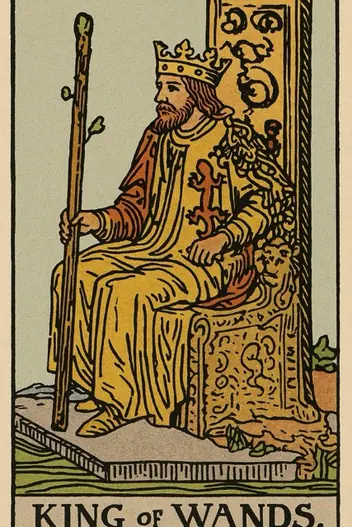

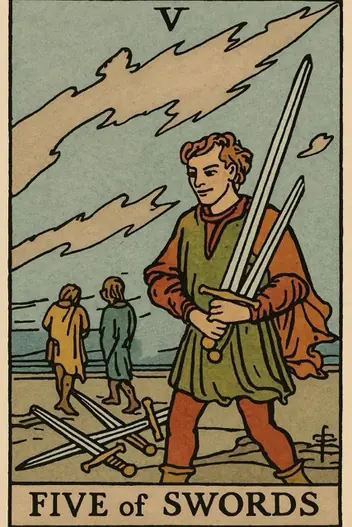
- Arcana
- King of Wands — Minor Arcana, Wands; Five of Swords — Minor Arcana, Swords
- Elements
- King of Wands — Fire; Five of Swords — Air
- Elemental interaction
- Friendly elements — energies support each other
- Numerology
- 14 + 5 = 19 → 1
This combination presents a fascinating psychological collision. The King of Wands embodies visionary leadership, bold initiative, and the unshakable confidence to charge forward. The Five of Swords represents a hollow victory, a win achieved through conflict, betrayal, or cutting losses at a high personal cost. When these two meet, the core question becomes: At what price are you willing to achieve your goal? This pairing often signals a scenario where your ambition and drive for control are forcing you into a win-lose dynamic—where winning may feel like losing.
The pragmatic tension here is between creative expansion (King of Wands) and strategic retreat (Five of Swords). You are likely in a situation where you feel compelled to assert dominance, but the battlefield is littered with bruised egos and severed ties. This is not a time for reckless heroism; it is a time for calculated dominance. The King’s fire must be tempered by the Five’s cold, tactical awareness of who you are fighting and why. The psychological archetype at play is the Shadow Leader—someone who confuses charisma with control, and vision with victory at any cost.
King of Wands and Five of Swords Card Meaning Explained
The psychological state created by this pairing is one of high-stakes, ego-driven decision-making. You feel a surge of power and a clear vision (King of Wands), but you are also acutely aware that others are opposing you, competing with you, or actively trying to undermine your authority (Five of Swords). The result is a mindset of defensive aggression: you are not just acting to create; you are acting to win against someone else. This shifts your focus from long-term growth to short-term conquest.
In real-world terms, this often manifests as a negotiation or a power struggle where you have the upper hand, but the victory feels bitter. You might secure the deal, the promotion, or the argument, but you damage a relationship or your reputation in the process. The core insight here is that the King of Wands’ strength lies in inspiring others, not defeating them. When combined with the Five of Swords, you risk becoming a tyrant in your own domain. The key is to ask yourself: Is this battle necessary for my vision, or is it a distraction from it?
Your pair is already on the table. Ask your question and draw the clarifying card
or simply focus on it
King of Wands and Five of Swords as Feelings
If you are single:
This combination warns against pursuing a connection through competition or one-upmanship. You may be trying to “win” someone’s affection by proving yourself superior to a rival, but this creates a dynamic of tension, not genuine intimacy. Focus on authentic attraction, not conquest.
If you are in a relationship:
You are likely in a power struggle where one partner is trying to dominate the other through arguments or emotional withdrawal. The winner of this fight will find the relationship damaged. Prioritize collaboration over control.
In relationships, this duo often signals a toxic cycle of “winning” arguments at the expense of emotional safety. The King of Wands’ natural charisma can become manipulative if used to gaslight or overpower a partner. The Five of Swords suggests a recent conflict where one person “won” but the other feels resentful, isolated, or defeated. The key relationship advice is to recognize that in love, a win-lose outcome is a lose-lose for the partnership. Shift from being right to being connected. If you are the one who feels defeated, this card pair urges you to set clear boundaries and refuse to engage in battles that compromise your self-respect. The King of Wands energy is best channeled into passionate, supportive leadership, not authoritarian control.
Deepen your understanding
Find out exactly what this reading means for your current life situation with our oracle.
King of Wands and Five of Swords: Career and Money
Strategic Opportunities:
Use your vision and authority to redefine the terms of a conflict. You can turn a competitive situation into a collaborative one by asserting a bigger, shared goal.
Strategic Opportunities:
This is an excellent time to cut a losing deal or sever a toxic business partnership. The Five of Swords gives you the clarity to walk away from a bad investment, even if it feels like a temporary loss.
Calculated Risks:
Avoid burning bridges in a public dispute. A victory today could become a reputation liability tomorrow. Do not gloat or humiliate competitors.
For your career, this combination is a high-risk, high-reward scenario that demands ruthless objectivity. You may be vying for a promotion, leading a contentious project, or negotiating a contract. The King of Wands gives you the confidence to take the lead, but the Five of Swords warns that not every battle is worth fighting. The strategic move is to focus on the “win” that serves your long-term vision, not your immediate ego. For finances, be wary of “cutthroat” investments or deals that require you to screw over someone else. Such gains are often short-lived and come with hidden costs (legal, reputational, or relational). Bold financial warning: If a deal feels like a robbery, it will eventually rob you of peace or credibility.
The Shadow Side of King of Wands and Five of Swords
The shadow manifestation of King of Wands and Five of Swords is the narcissistic tyrant. This is the leader who mistakes fear for respect, and who uses their power to crush dissent rather than inspire growth. The cognitive bias at play is the Dunning-Kruger effect—an overestimation of your own competence and the righteousness of your cause. You may believe you are acting for the greater good, but you are actually acting out of unchecked pride or a need for validation.
Self-sabotage occurs when you refuse to compromise even when compromise would yield a better outcome. You may burn a relationship out of a false sense of “principle” or “honor,” when really you are just unwilling to admit a mistake or share credit. Poor judgment arises from tunnel vision: you see only the victory ahead and ignore the collateral damage. The Five of Swords is a card of isolation—if you win this way, you will stand alone on the battlefield. The shadow question is: Is the victory worth the loneliness?
King of Wands and Five of Swords Reversed: What Changes?
If the King of Wands is reversed:
Blocked potential. You possess the idea and ambition, but cannot realize them due to internal sabotage or fear. The Five of Swords upright here would mean that someone else is "playing dirty" against you. Advice: Stop attacking yourself with self-criticism. Your task is not to defeat an enemy, but to dismantle internal barriers.
If the Five of Swords is reversed:
Passive aggression and weakness. You avoid direct conflict, but sabotage work or relationships covertly. The King of Wands upright here represents energy that dissipates into a void. Advice: You need to muster the courage for open dialogue. Playing the silent game or resorting to petty tricks will only worsen the situation.
If BOTH are reversed:
Complete imbalance. You simultaneously fear taking action and feel ashamed of your weakness. This is a state of "paralysis of will." A person may experience intense irritation towards themselves and others, yet be incapable of making a move. How to fix it: Start small. Choose one, very simple task from your comfort zone and complete it. Don't try to "win the war"—just do one thing.
King of Wands and Five of Swords: Tarot Advice
Constructive use of this energy requires a conscious separation of roles. The energy of the King of Wands is your vision and drive. The energy of the Five of Swords is your analytical mind and readiness for competition. Their union can be destructive if you allow one archetype to consume the other. Your task is to use the Five of Swords as a tool, not as a life philosophy.
The pragmatic approach is as follows: use the assertiveness of the King of Wands to establish clear boundaries and rules of the game. Then apply the strategy of the Five of Swords to defend those boundaries from encroachment. Do not strike first, but be prepared to retaliate. The main secret is to shift the conflict from a personal to a business level. Not "me against you," but "my interests against your interests." This allows you to save face and leave room for future cooperation.
Conclusion:
This combination is a powerful catalyst if you know how to manage your aggression. It gives you the strength to break through any wall, but requires the wisdom not to destroy the house you are building. Your strategic task is to become a leader who is not afraid of conflict but does not seek it for pleasure. Bet on "a hard game in a soft package": be unyielding in your goals, but flexible in your methods.
Applying This to Your Situation
The core message of the King of Wands and Five of Swords is a call to lead with strategic wisdom, not ego. You have the power to achieve your goals, but the method matters as much as the outcome. Choose battles that align with your long-term vision, and refuse to sacrifice your integrity for a short-term win. The true King does not need to prove his power through conflict; he proves it through the loyalty he inspires.
Ready to apply this insight to your specific situation? While this article explains the general archetypes, the real power of Tarot comes from personal context. The Fortune Cards app allows you to input your exact question—about a relationship, a career move, or a personal challenge—and receive a deep, personalized interpretation of this exact card combination. Get clarity on your battlefield. Use the app on the web or download it now to unlock the full psychological strategy behind your cards.
Interpretation by the Fortune Cards editorial team, based on the Rider–Waite tradition and Jungian archetypes. About our methodology · Updated: 2026-09-17
Other Combinations with King of Wands
Other Combinations with Five of Swords
Explore Individual Card Meanings
Table of Contents
- King of Wands and Five of Swords Card Meaning Explained
- King of Wands and Five of Swords as Feelings
- King of Wands and Five of Swords: Career and Money
- The Shadow Side of King of Wands and Five of Swords
- King of Wands and Five of Swords Reversed: What Changes?
- King of Wands and Five of Swords: Tarot Advice
- Applying This to Your Situation
Ready to find answers to your questions?
Start your first reading now and look at your situation with fresh clarity. The cards are ready to reveal deeper meaning.