Knight of Swords and Knight of Pentacles Together in Tarot
- Arcana
- Knight of Swords — Minor Arcana, Swords; Knight of Pentacles — Minor Arcana, Pentacles
- Elements
- Knight of Swords — Air; Knight of Pentacles — Earth
- Elemental interaction
- Opposing elements — energies create tension
- Numerology
- 12 + 12 = 24 → 6
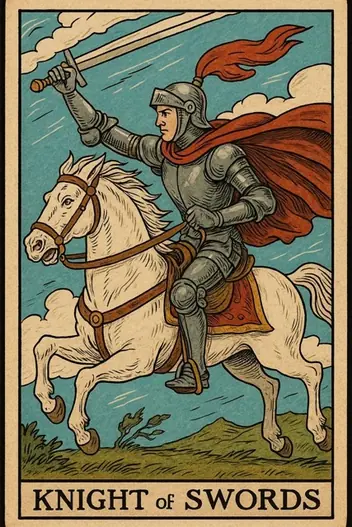
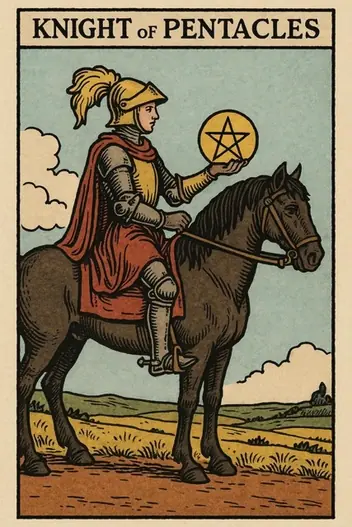
When the swift, intellectual energy of the Knight of Swords collides with the methodical, grounded nature of the Knight of Pentacles, you face a fundamental psychological tension. The Knight of Swords represents the drive for rapid insight, decisive action, and intellectual conquest. In contrast, the Knight of Pentacles embodies patience, discipline, and a relentless focus on tangible results. In real life, this combination describes a person or situation caught between the desire for a breakthrough and the necessity of a slow, steady build.
This pairing often signals a strategic crossroads. You may have a brilliant idea (Swords) but lack the practical resources or patience to execute it (Pentacles). Conversely, you might be stuck in a meticulous routine, yearning for the clarity and speed that only a bold mental leap can provide. The core psychological challenge is integrating vision with execution—learning to move with purpose without sacrificing thoroughness.
Core Dynamics & Interpretation
The core dynamic of this pairing is a productive but volatile clash between theory and practice. The Knight of Swords charges ahead with a clear mental map, often ignoring obstacles or logistical details. The Knight of Pentacles, however, insists on checking every stone on the path before taking a single step. This creates a cognitive dissonance: the mind races while the body moves slowly. The key to unlocking this combination’s potential is to recognize that each knight’s strength compensates for the other’s weakness.
Psychologically, this represents the struggle between the prefrontal cortex (planning, analysis) and the basal ganglia (habit, routine). When these energies are balanced, you gain the ability to strategize quickly but execute methodically. You can test a hypothesis with a small, calculated experiment rather than a full-scale charge. The shadow side emerges when one knight dominates: either you rush into half-baked plans (Swords over Pentacles) or you become paralyzed by over-preparation (Pentacles over Swords). The healthy integration involves using the Swords’ clarity to set a direction, then letting the Pentacles’ discipline carry you there step by step.
Your pair is already on the table. Ask your question and draw the clarifying card
or simply focus on it
Career and Finances
Strategic Opportunities:
Launch a pilot project to test a new idea before committing significant resources. This allows you to honor the Swords’ speed while respecting the Pentacles’ caution.
Strategic Opportunities:
Use data to drive innovation. The Knight of Swords excels at identifying patterns and gaps; the Knight of Pentacles excels at building reliable systems. Combine these to create a continuous improvement cycle.
Calculated Risks:
Avoid over-engineering a simple solution. Don’t let the Pentacles’ need for perfection delay a timely decision. Also, beware of impatiently abandoning a proven strategy just because it feels slow.
In a professional setting, this card pair is a powerful signal for strategic project management. You may be in a role where you must balance rapid ideation with meticulous execution. For example, a product manager (Swords) must work with a quality assurance team (Pentacles) to launch a feature that is both innovative and reliable. The danger is analysis paralysis: spending so much time planning that you miss the market window.
Key financial advice: Diversify your approach. Use the Knight of Swords to identify high-growth, high-risk opportunities (like a startup investment), but balance it with the Knight of Pentacles’ commitment to consistent, low-risk savings. Do not bet everything on a single "brilliant" idea. Instead, allocate 70% of your resources to stable, proven assets, and 30% to calculated experiments. When negotiating, lead with logic and data (Swords), but be prepared to negotiate on terms and timelines (Pentacles). This combination excels in fields like engineering, consulting, logistics, and scientific research.
Love and Relationships
If you are single:
This combination suggests you may be attracted to someone who is intellectually stimulating but emotionally unavailable, or vice versa. Evaluate whether your mind is leading your heart or your routine is blocking genuine connection.
If you are in a relationship:
You are likely navigating a power dynamic between spontaneity and predictability. One partner may crave novelty and debate, while the other prioritizes stability and security.
In a relationship context, the Knight of Swords and Knight of Pentacles can represent two distinct communication styles. The Swords partner wants to solve problems through rapid discussion and logical arguments, while the Pentacles partner prefers to work through issues slowly, with consistent actions and physical reassurance. The greatest risk is emotional disconnection: the Swords partner may perceive the Pentacles partner as boring or stubborn, while the Pentacles partner may see the Swords partner as reckless or dismissive.
Key relationship advice: Create a shared decision-making process. Use the Swords energy to identify the core issue quickly, then use the Pentacles energy to implement a solution with patience and follow-through. Schedule regular check-ins where you can air intellectual frustrations without interrupting the practical flow of daily life. Avoid the trap of "fixing" your partner—instead, recognize that each style offers a necessary perspective. The Swords brings clarity; the Pentacles brings consistency.
Get a personalized interpretation
Unlock the combined meaning of your cards in the context of your unique question — for free.
Knight of Swords and Knight of Pentacles: Warning Signs
The shadow of this combination is a cognitive trap of false efficiency. You may believe you are being productive when you are actually rushing through tasks without quality control (Swords shadow) or over-planning to avoid risk (Pentacles shadow). This can manifest as perfectionism disguised as diligence—you spend hours refining a plan that never gets executed. Alternatively, you might make impulsive decisions that ignore crucial data, leading to costly mistakes.
Another pitfall is intellectual arrogance paired with practical rigidity. You may insist that your "logical" solution is the only correct one, while simultaneously refusing to adapt to new information because it disrupts your routine. This creates a self-reinforcing cycle of frustration: you feel misunderstood (Swords) and undervalued (Pentacles). The cognitive bias at play is confirmation bias—you seek evidence that supports your preferred approach while ignoring warnings from the other knight. To avoid this, actively solicit feedback from those who embody the opposite energy. If you are a Swords-dominant person, ask a Pentacles colleague to review your timeline. If you are Pentacles-dominant, ask a Swords colleague to challenge your assumptions.
Reversed Positions: What Changes?
Reversed cards indicate a dysfunction of the archetype, where its strengths turn into weaknesses.
If the Knight of Swords is reversed:
Blocked potential and recklessness. Instead of clarity, there are empty arguments for the sake of arguing. The person becomes caustic, aggressive, and intolerant of criticism. Advice: Take off the "crown of the know-it-all." Your idea may be brilliant, but without the support of the Pentacles, it will die. Pause for 48 hours before making a decision.
If the Knight of Pentacles is reversed:
Internal resistance and laziness. Routine turns into a swamp. The person fears change, clings to outdated methods, and sabotages any innovation. Advice: Recognize that your desire for stability is a defense against the fear of failure. Find one small area where you are willing to take a risk and start there.
If BOTH are reversed:
Complete imbalance and chaos. You are either oscillating between impulsive decisions or completely paralyzed. Key warning: This state leads to burnout and loss of reputation. Method for correction: Temporarily abandon both strategies. Use the "small steps method" — do one simple action a day without thinking about the global goal until you regain a sense of control.
Knight of Swords and Knight of Pentacles Combined Message
How to constructively use this energy? The Knight of Swords should become the "scout," and the Knight of Pentacles the "rear commander." Do not try to unite them in one person—this will lead to schizophrenic decision-making. Instead, create a "Assault — Siege" cycle.
In the first phase (Assault), you activate the Knight of Swords: set an ambitious goal, generate 10 crazy ideas, conduct a brainstorming session without criticism. In the second phase (Siege), you activate the Knight of Pentacles: take the single best idea, break it down into 100 steps, assign deadlines and resources. Key strategic advice: Never mix these phases. If you think about bureaucracy during the assault, you will kill creativity. If you think about risks during the siege, you will miss the details.
This tandem is an ideal tool for "antifragility." You don't just defend against crises; you use them for growth. The Swords find vulnerabilities in the system, and the Pentacles immediately patch and reinforce them. Together, they create a structure that doesn't break under pressure but becomes stronger. Your task is not to choose between speed and stability, but to learn to switch between them consciously, like shifting gears in a car.
Your Next Step: Personal Context Matters
The Knight of Swords and Knight of Pentacles together offer a powerful lesson: speed without direction is chaos, and direction without speed is stagnation. Your next step is to identify which energy you are over- or under-utilizing in your current situation. Are you charging ahead without a solid foundation? Or are you stuck in a rut, afraid to make a bold move? The answer lies in your specific question and personal circumstances.
While this article provides a general archetype, the true magic happens when Tarot is applied to your unique situation. To get a deep, personalized interpretation of this exact combination for your specific question right now, use the Fortune Cards app. Available on the web and as a download, it offers tailored insights that go beyond generic meanings—helping you integrate the Knight of Swords’ clarity with the Knight of Pentacles’ discipline in the exact area of your life that matters most.
Interpretation by the Fortune Cards editorial team, based on the Rider–Waite tradition and Jungian archetypes. About our methodology · Updated: 2026-08-26
Other Combinations with Knight of Swords
Other Combinations with Knight of Pentacles
Explore Individual Card Meanings
Ready to find answers to your questions?
Start your first reading now and look at your situation with fresh clarity. The cards are ready to reveal deeper meaning.