The Magician and Five of Swords Meaning in Tarot
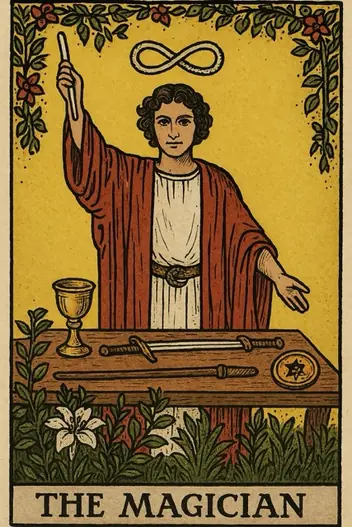

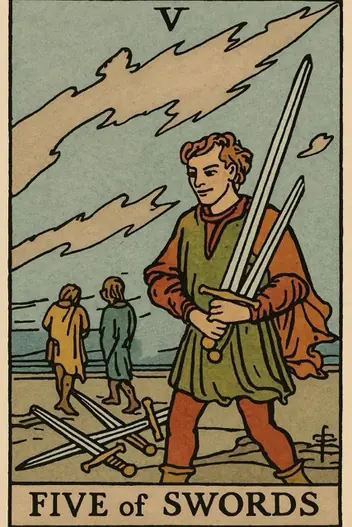
- Arcana
- The Magician — Major Arcana; Five of Swords — Minor Arcana, Swords
- Elements
- The Magician — Air; Five of Swords — Air
- Elemental interaction
- Same element — energies intensify each other
- Numerology
- 1 + 5 = 6
When The Magician—the master of willpower, skill, and resourcefulness—meets the Five of Swords—the card of conflict, hollow victory, and calculated retreat—we enter a psychological arena of high-stakes decision-making. This combination is not about luck; it is about conscious manipulation of outcomes and the ethics of winning. In Jungian terms, this pairing activates the Trickster archetype, where the seeker must decide whether their cleverness serves a higher purpose or merely feeds the ego's need for dominance.
The core tension here is between competence and consequence. The Magician reminds you that you have all the tools to succeed—intelligence, charisma, and timing. The Five of Swords warns that not every battle worth fighting is worth winning. Together, they force a pragmatic question: Are you building a legacy, or are you just collecting trophies?
The Magician and Five of Swords: How These Energies Interact
The psychological state created by The Magician and Five of Swords is one of hyper-focused agency combined with moral ambiguity. You possess a sharp mind and the ability to read a room, anticipate moves, and execute a plan with surgical precision. However, this energy often arises in situations where someone will lose—a negotiation, a rivalry, or a breakup. The danger lies in mistaking tactical wins for strategic success.
In real-world terms, this combination signals a period where your greatest asset is your ability to detach emotionally from the outcome. The Magician gives you the clarity to see all variables; the Five of Swords gives you the cold logic to act on them. Yet, this detachment can become a liability if you start treating relationships as chess games. The key is to use your skills to create win-win scenarios, not to dominate others. If you find yourself enjoying the conflict more than the resolution, you are likely in the shadow of this pairing.
The Magician and Five of Swords Love Outcome
If you are single:
This pairing suggests you may be drawn to a partner who is intellectually stimulating but emotionally unavailable. Evaluate whether the attraction is based on genuine connection or the thrill of a challenge.
If you are in a relationship:
Watch for a dynamic where one partner uses wit or manipulation to "win" arguments. The relationship may feel like a constant power struggle rather than a partnership.
In relationships, The Magician and Five of Swords often indicate a communication style that prioritizes being right over being connected. One partner may use logic and charm to deflect vulnerability, creating a cycle of unresolved conflict. Bold relationship advice: Stop trying to "solve" your partner. Instead, recognize that some disagreements are not problems to be fixed but perspectives to be understood. If you feel the need to prove your intelligence or superiority, ask yourself what fear is driving that need. True intimacy requires you to put down your sword.
Your pair is already on the table. Ask your question and draw the clarifying card
or simply focus on it
The Magician and Five of Swords in Career Readings
Strategic Opportunities:
Perfect for negotiations, competitive pitches, or restructuring where you hold the informational advantage. Use your analytical skills to map out opponents' weaknesses.
Strategic Opportunities:
Ideal for roles requiring persuasion and mental agility, such as sales, law, or crisis management. Your ability to reframe problems is at its peak.
Calculated Risks:
Avoid overplaying your hand in public disputes. Winning a battle may cost you allies. Also, be wary of legal or contractual ambiguity; the Five of Swords warns of hidden traps.
Professionally, this combination is a double-edged sword. You have the clarity to see a path to victory, but the risk is that you focus solely on short-term gains. Bold financial warning: Do not burn bridges for a single deal. The Magician's resourcefulness can help you pivot, but the Five of Swords' "victory at all costs" mentality can isolate you from future collaborators. In negotiations, aim for asymmetric wins—where you get what you need while leaving the other party feeling respected. If you sense a toxic competition in your workplace, consider whether you are feeding it or can strategically exit.
Deepen your understanding
Find out exactly what this reading means for your current life situation with our oracle.
Negative Meaning of The Magician and Five of Swords
The shadow manifestation of this pairing is cognitive arrogance—the belief that your intellect alone can solve any problem, including emotional ones. This can lead to self-sabotage through over-analysis, where you miss obvious human factors. Another pitfall is conflict addiction: you may unconsciously create drama to feel powerful or needed. When blocked, this energy turns into passive-aggressive manipulation, where you use your skills to undermine others while maintaining a facade of innocence. The most dangerous bias here is the illusion of control: you may believe you can manage every variable, ignoring the fact that some battles are not yours to fight.
The Magician and Five of Swords Reversed: How to Read It
If The Magician is Reversed:
Potential is blocked. You want to fight, but lack the resources or skills. This is a state of powerless aggression. Advice: Step back and focus on building your competencies before taking action.
If the Five of Swords is Reversed:
You are losing but refuse to accept it. Or, you are a victim who cannot fight back. This is internal resistance and self-sabotage. Advice: Acknowledge your defeat to free up energy for a new start.
If BOTH are Reversed:
Complete imbalance. Chaotic aggression without purpose or tools. This is a path to self-destruction. The logical way to correct this is a complete halt to any confrontation. Shift your focus from "war" to "study." You need to stop attacking and start learning in order to regain control of the situation.
The Magician and Five of Swords: The Combined Message
How can the Magician's energy be used constructively to balance the Five of Swords? The answer lies in redefining the goal. The Five of Swords is a card of boundaries, not a card of war. Its true task is to clearly define what is unacceptable for you. The Magician provides you with the tools to protect those boundaries, but not to attack.
Your strategic advice: separate the conflict from the person. Use the intellect and will of the Magician to analyze the situation, rather than reacting emotionally. Ask yourself: "What is my true goal? To destroy this person, or to change the system/situation?" If you want to change the situation, the Five of Swords should be a last resort, not the first step.
The deep strategic move is diplomacy from a position of strength. Show that you can win (the Magician), but offer peace (synthesis). This will command respect and allow you to conserve resources. Use the Five of Swords not as a sword, but as a scalpel—for the precise and necessary excision of what hinders you, without damaging the healthy tissue of your relationships or business. Only then can a Pyrrhic victory be transformed into a true triumph.
Your Next Step: Personal Context Matters
The core message of The Magician and Five of Swords is this: You have the power to shape your reality, but every choice has a price. Your greatest strength right now is your strategic mind—use it to build, not to conquer. The question is not can you win, but what are you willing to lose to do so? True mastery lies in knowing when to apply your skills and when to walk away.
To truly understand how this powerful combination applies to your specific life situation—your relationship, career dilemma, or personal crossroads—you need a reading that considers your unique context. Use the Fortune Cards app on the web or download it now. It will give you a deep, personalized interpretation of The Magician and Five of Swords for your exact question. Stop guessing. Start strategizing with clarity.
Interpretation by the Fortune Cards editorial team, based on the Rider–Waite tradition and Jungian archetypes. About our methodology · Updated: 2026-08-26
Other Combinations with The Magician
Other Combinations with Five of Swords
Explore Individual Card Meanings
Table of Contents
- The Magician and Five of Swords: How These Energies Interact
- The Magician and Five of Swords Love Outcome
- The Magician and Five of Swords in Career Readings
- Negative Meaning of The Magician and Five of Swords
- The Magician and Five of Swords Reversed: How to Read It
- The Magician and Five of Swords: The Combined Message
- Your Next Step: Personal Context Matters
Ready to find answers to your questions?
Start your first reading now and look at your situation with fresh clarity. The cards are ready to reveal deeper meaning.