Nine of Swords and King of Pentacles Tarot Combination
- Arcana
- Nine of Swords — Minor Arcana, Swords; King of Pentacles — Minor Arcana, Pentacles
- Elements
- Nine of Swords — Air; King of Pentacles — Earth
- Elemental interaction
- Opposing elements — energies create tension
- Numerology
- 9 + 14 = 23 → 5
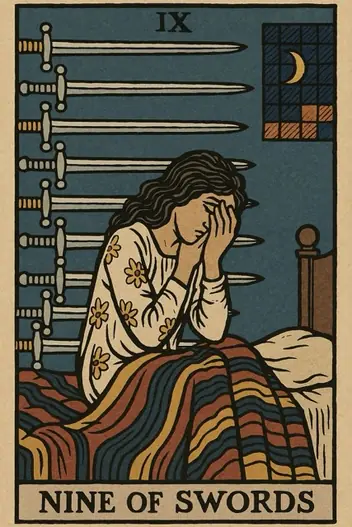
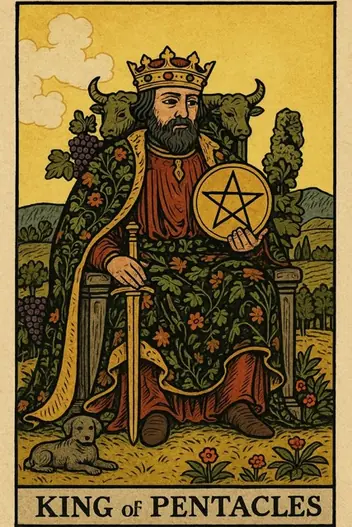
When the Nine of Swords—a card of sleepless nights, mental torment, and catastrophic thinking—collides with the King of Pentacles—the archetype of stability, material mastery, and pragmatic authority—we encounter a powerful psychological tension. This combination represents the struggle between internal chaos and external control, where anxiety threatens to undermine the very foundations of security you have built.
The core conflict here is between perceived threat and proven capability. The Nine of Swords whispers that everything is falling apart, while the King of Pentacles stands as evidence that you have already weathered many storms. This pairing demands a reality check: are your fears grounded in fact, or are they projections of past trauma onto a stable present?
Nine of Swords and King of Pentacles Together: Meaning
The psychological state created by this combination is best described as “paralyzed competence.” You possess the skills, resources, and experience of the King of Pentacles—you have built something real, managed risk, and created tangible security. Yet the Nine of Swords keeps you awake at night, replaying worst-case scenarios that have not happened. This is not weakness; it is a cognitive bias called catastrophizing, where your brain’s threat-detection system overrides your rational assessment of facts.
The key insight here is that anxiety does not equal danger. The King of Pentacles represents objective reality: bank accounts, property, steady income, or a long-term partnership. The Nine of Swords represents subjective reality: fear, guilt, shame, or imagined failure. When these cards appear together, the task is to distinguish between what you feel and what is actually happening. This requires a deliberate shift from emotional reactivity to data-driven decision-making.
In practice, this dynamic often manifests as over-preparation or micromanagement. The King of Pentacles wants to control every variable, while the Nine of Swords suggests that control is an illusion. The healthy integration is to accept uncertainty without letting it paralyze you. Use your competence to build contingency plans, but do not let worry dictate your daily choices.
Nine of Swords and King of Pentacles for Career and Money
Strategic Opportunities:
Use your anxiety as a risk-assessment tool rather than a source of paralysis. The Nine of Swords can sharpen your due diligence—review contracts, stress-test budgets, and audit processes. Your worry is a signal to prepare, not to panic.
Strategic Opportunities:
Leverage the King of Pentacles’ network and reputation to get objective feedback on your concerns. A trusted mentor or financial advisor can provide the reality check you need to separate legitimate risks from imagined ones.
Calculated Risks:
Avoid the temptation to over-control in response to anxiety. Micromanaging employees, hoarding cash, or refusing to delegate will undermine the very stability you seek. Trust the systems you have already built.
Career-wise, this combination often appears when a successful professional is grappling with imposter syndrome or fear of failure. You have the title, the track record, and the resources—but you feel one mistake away from losing it all. This is a classic high-achiever trap. The King of Pentacles reminds you that sustainable success comes from delegation and leverage, not from carrying every burden alone.
Financial warning:
Do not make major financial decisions from a place of fear. Selling investments, downsizing too quickly, or refusing to spend on necessary growth can lock in losses that were only imagined. Run the numbers objectively before reacting emotionally.
Your pair is already on the table. Ask your question and draw the clarifying card
or simply focus on it
Nine of Swords and King of Pentacles Love Outcome
If you are single:
This combination suggests you may be projecting past relationship trauma onto a new potential partner. Your anxiety about being hurt again is louder than the evidence of their reliability. Ask yourself: is this person actually untrustworthy, or is my fear making them seem so?
If you are in a relationship:
You or your partner may be operating from a fear of loss rather than a desire for growth. One person feels overwhelmed by worry (Nine of Swords), while the other tries to fix everything with material solutions (King of Pentacles). This dynamic can create emotional distance if not addressed directly.
In relationships, this pairing often reveals a power imbalance in emotional labor. The King of Pentacles partner may try to solve anxiety with gifts, stability, or logic—saying “we have enough money, why are you worried?”—while the Nine of Swords partner feels unheard and invalidated. The solution is not more reassurance, but active listening. The King must learn that some fears cannot be fixed, only held. The Nine must learn to trust the evidence of consistent, caring actions over internal narratives.
Key relationship advice:
Schedule a weekly “worry check-in” where both partners can express fears without judgment. This transforms anxiety from a private torment into a shared reality, allowing the King’s stability to anchor the Nine’s storms.
Your unique Tarot reading
See how these cards interact with your destiny. Start a free personal reading now.
Negative Meaning of Nine of Swords and King of Pentacles
The shadow manifestation of this combination is paralyzing perfectionism masked as responsibility. You may believe that if you just work harder, worry more, or control tighter, you can prevent any possible failure. This is a cognitive distortion known as the illusion of control, where you overestimate your ability to manage outcomes. The result is burnout, insomnia, and strained relationships—exactly what the Nine of Swords depicts.
Another pitfall is projecting your anxiety onto others. The King of Pentacles, when ungrounded, can become a critical, controlling figure who micromanages employees or partners, believing they are the only competent person. The Nine of Swords amplifies this by convincing you that others will inevitably fail. This is self-sabotage disguised as diligence.
When this energy is blocked, you may see the opposite: a person who has achieved material success but is emotionally hollow, using work and wealth to avoid confronting inner turmoil. The King’s stability becomes a fortress, not a home. The Nine’s anxiety is numbed by overwork or substance use, but never resolved.
Nine of Swords and King of Pentacles Reversed: What Changes?
When cards appear reversed, the dynamic becomes distorted, but does not disappear; instead, it transitions into a more hidden or destructive form.
If the Nine of Swords is reversed:
This points to a blocked potential for awareness. The person denies their anxiety, suppresses fear, pretending that "everything is fine." This is extremely dangerous, as suppressed anxiety can erupt into psychosomatic issues or sudden breakdowns. Advice: stop "keeping up appearances" and acknowledge that you are not coping with the emotional burden.
If the King of Pentacles is reversed:
The archetype of stability becomes tyrannical. This is an abuse of power, miserliness, and rigid control devoid of common sense. Such a person may use resources as a weapon (disinheriting someone, firing someone due to a personal grudge). Warning: you risk losing the respect and trust of those around you due to your authoritarianism.
If BOTH are reversed:
Complete imbalance. Outwardly, this may look like total apathy and loss of status, while inwardly, it manifests as deep depression. The person can neither manage resources nor cope with anxiety. The logical way to correct this: seek professional help (psychologist, coach) and temporarily refrain from any major decisions and financial transactions until your inner foundation is restored.
Overall Meaning of Nine of Swords and King of Pentacles
Constructive use of this energy requires a paradoxical approach: you must acknowledge your vulnerability in order to strengthen your power. The Nine of Swords is not the enemy of the King of Pentacles, but his shadow. If the King learns to listen to his anxiety without succumbing to it, he will transform fear into fuel for more balanced and far-sighted decisions.
Practically, this means implementing a ritual of "reflection without action." Each day, set aside 15 minutes to write down all your fears (Nine of Swords), and then a list of objective resources and assets (King of Pentacles). Compare these lists. You will see that 90% of your fears have no material basis. This simple cognitive act is the bridge between panic and reality.
Your task is not to get rid of anxiety, but to learn to manage it just as you manage your investment portfolio. Use your stability (King) as a platform for safely exploring your fears (Nine). Only then can you turn a crisis of management into a point of growth, rather than a point of destruction.
Applying This to Your Situation
The Nine of Swords and King of Pentacles together deliver a clear message: your anxiety is not a sign of weakness, but a call to ground yourself in facts. You have the resources, experience, and stability to face whatever comes—but only if you stop fighting imaginary battles. The path forward requires you to trust your competence while making peace with uncertainty. This is not about eliminating fear, but about refusing to let it drive your decisions.
To truly understand how this combination applies to your unique situation—your specific fears, your relationship, your career crossroads—you need a personalized reading. The Fortune Cards app allows you to input your exact question and receive a tailored interpretation of this card pair based on your context. Whether you are navigating a financial decision, a relationship conflict, or a moment of self-doubt, the app provides the clarity you need. Use it on the web or download it now to transform this archetypal wisdom into actionable guidance for your life.
Interpretation by the Fortune Cards editorial team, based on the Rider–Waite tradition and Jungian archetypes. About our methodology · Updated: 2026-08-26
Other Combinations with Nine of Swords
Other Combinations with King of Pentacles
Explore Individual Card Meanings
Table of Contents
- Nine of Swords and King of Pentacles Together: Meaning
- Nine of Swords and King of Pentacles for Career and Money
- Nine of Swords and King of Pentacles Love Outcome
- Negative Meaning of Nine of Swords and King of Pentacles
- Nine of Swords and King of Pentacles Reversed: What Changes?
- Overall Meaning of Nine of Swords and King of Pentacles
- Applying This to Your Situation
Ready to find answers to your questions?
Start your first reading now and look at your situation with fresh clarity. The cards are ready to reveal deeper meaning.