Nine of Swords and Queen of Pentacles Together in Tarot
- Arcana
- Nine of Swords — Minor Arcana, Swords; Queen of Pentacles — Minor Arcana, Pentacles
- Elements
- Nine of Swords — Air; Queen of Pentacles — Earth
- Elemental interaction
- Opposing elements — energies create tension
- Numerology
- 9 + 13 = 22 → 4
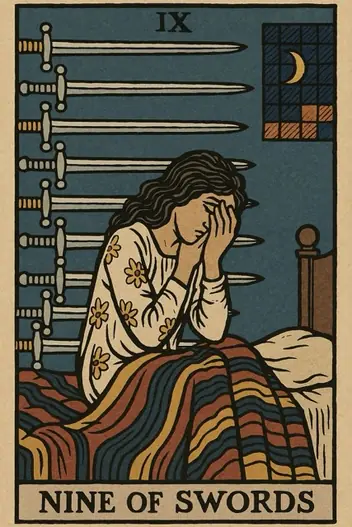
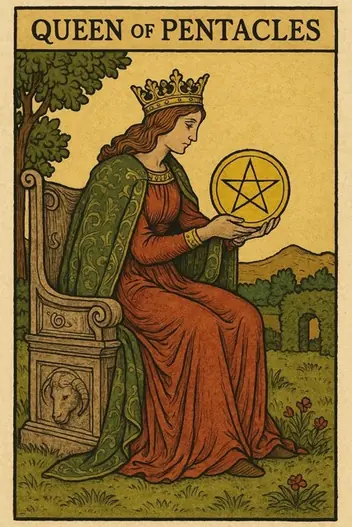
When the Nine of Swords—the card of intrusive worry, sleepless nights, and cognitive catastrophizing—collides with the Queen of Pentacles—the archetype of grounded resourcefulness, financial security, and nurturing stability—we witness a psychological tug-of-war. This combination represents the mind’s tendency to spiral into worst-case scenarios while the practical self demands actionable solutions.
The core conflict here is between overthinking and over-functioning. The Nine of Swords amplifies perceived threats, often without evidence, while the Queen of Pentacles insists on tangible outcomes and material safety. In real life, this manifests as a person who is simultaneously paralyzed by fear and driven to control their environment through work, budgeting, or caretaking. The result is a high-functioning anxiety that can be both productive and exhausting.
Core Dynamics & Interpretation
The psychological state created by this pairing is one of chronic vigilance. The Nine of Swords activates the brain’s default mode network, replaying past failures or future hypotheticals on a loop. The Queen of Pentacles responds by doubling down on what she can control: her bank account, her home, her daily routines. This creates a feedback loop where anxiety drives more practical effort, but practical effort never fully quiets the anxiety—because the root cause is emotional, not logistical.
In Jungian terms, this is the Shadow of the Queen of Pentacles: the belief that if you just do enough, earn enough, or care for enough people, you can outrun your inner demons. The Nine of Swords reveals this strategy’s fatal flaw—no amount of external stability can silence an unresolved internal narrative. The key insight here is that the Queen’s resourcefulness must be turned inward, not just toward managing the external world. She needs to apply her problem-solving skills to her own thought patterns, treating her anxiety as a problem to be solved rather than a threat to be managed.
Practically, this combination warns against over-responsibility. The seeker may be taking on burdens that aren’t theirs to carry, or using productivity as a form of avoidance. The recommended approach is to audit your worries: list what is actually within your control, what is hypothetical, and what requires emotional processing rather than action. This is not a time for grand gestures, but for small, consistent steps that build a sense of mastery over your inner world.
Your pair is already on the table. Ask your question and draw the clarifying card
or simply focus on it
Career and Finances
Strategic Opportunities:
Use your heightened vigilance to identify risks in a project or investment that others overlook. This is a powerful time for due diligence and contingency planning.
Strategic Opportunities:
Channel your anxiety into building systems and routines that create long-term stability. Automate savings, set up emergency funds, or streamline workflows.
Calculated Risks:
Avoid micromanaging or making decisions from a place of scarcity. The fear of loss can cause you to miss genuine opportunities for growth.
In a professional context, this combination is a double-edged sword. On one hand, the Queen of Pentacles’ practicality combined with the Nine of Swords’ foresight can make you an exceptional risk analyst or crisis manager. You see the pitfalls others ignore. Your anxiety can be a superpower if you channel it into preparation rather than paralysis.
However, the shadow side is financial hoarding or risk aversion. You may be so afraid of losing money that you refuse to invest in yourself or your business. A key financial warning: do not let fear of a hypothetical crash prevent you from taking calculated steps forward. The Queen of Pentacles is not about hiding resources; she is about deploying them wisely. If your anxiety is telling you to “save everything,” ask yourself: “Save for what? And at what cost to my growth?”
For entrepreneurs or freelancers, this combination suggests a need to diversify income streams to reduce the psychological weight of financial uncertainty. For employees, it may indicate that your anxiety is tied to performance perfectionism. You are working twice as hard as necessary to feel secure. The strategic move is to delegate, automate, or renegotiate your workload.
Nine of Swords and Queen of Pentacles in Love Tarot
If you are single:
This pairing suggests you may be projecting past relationship trauma onto potential new partners. Your anxiety is creating red flags where none exist, or you’re attracted to people who mirror your own need to “fix” or control. Focus on emotional regulation before dating.
If you are in a relationship:
You or your partner may be over-functioning—one person handles all the practical matters while the other carries the emotional weight. This imbalance leads to resentment and burnout.
In relationships, the Nine of Swords and Queen of Pentacles combination often points to a caretaker dynamic where one partner manages the household, finances, or logistics while the other struggles with anxiety or insomnia. The danger is that the Queen of Pentacles becomes a martyr, sacrificing her own emotional needs to keep the ship afloat. The most critical relationship advice here is to establish boundaries around emotional labor. Just as you would budget money, budget your energy for listening, worrying, and comforting. Ask yourself: “Am I solving my partner’s problems, or enabling their avoidance?”
For singles, this combination warns against entering relationships as a project. You may be drawn to someone who seems “broken” or in need of your stability. Instead, seek a partner who is already emotionally self-sufficient. The healthiest connection will be one where both people can manage their own anxiety without making the other responsible for it.
Get a personalized interpretation
Unlock the combined meaning of your cards in the context of your unique question — for free.
Reversed Nine of Swords and Queen of Pentacles Explained
When cards are reversed, the dynamics shift, but they don't become simpler.
If the Nine of Swords is Reversed:
Anxiety ceases to be overt and retreats into the subconscious. You may deny your fear, displaying a facade of calm. Warning: This is not a solution, but a postponement. Suppressed anxiety will manifest through psychosomatic symptoms. Advice: Start keeping an emotion journal to materialize hidden fears.
If the Queen of Pentacles is Reversed:
This points to an internal resistance to self-care. You may be neglecting your health, ignoring your finances, or creating chaos in your home life. In combination with an upright Nine of Swords, this creates a self-perpetuating cycle: you feel anxious because you don't clean, and you don't clean because you feel anxious. Advice: Begin with one simple, routine action (making the bed, paying a bill) to break the vicious circle.
If BOTH are Reversed:
Complete imbalance. You are simultaneously denying your fears and ignoring your resources. This is a state of "freeze," where a person doesn't act because they are afraid, and doesn't care for themselves because they see no point. Correction: An external support system is necessary—consulting a psychologist or coach. You need someone to temporarily play the role of the "Queen of Pentacles" until you can restore your own capacity for self-care.
Shadow Side & Pitfalls
The shadow manifestation of this pairing is compulsive control masking as competence. The seeker may become rigid, micromanaging, or emotionally closed off, believing that vulnerability is a luxury they cannot afford. This leads to burnout, as the Queen of Pentacles’ nurturing energy is directed outward but never inward.
Cognitive biases at play include catastrophizing (assuming the worst-case scenario is the most likely) and overconfidence in control (believing that perfect planning can eliminate all risk). The seeker may also suffer from imposter syndrome, where the Nine of Swords whispers that they are not good enough, and the Queen of Pentacles responds by working even harder to prove otherwise—creating an endless cycle of exhaustion.
Self-sabotage appears when the seeker refuses help because they believe no one else can handle things as well as they can. This is the Queen of Pentacles at her worst: a lonely, overburdened caretaker who has forgotten that receiving support is also a form of strength. The pitfall is treating your anxiety as a sign that you need to do more, when in reality, it’s a sign that you need to think differently.
What Is the Overall Message of Nine of Swords and Queen of Pentacles?
Constructive use of this dynamic requires a "Grounding Anxiety" strategy. Your task is not to get rid of the Nine of Swords (that's impossible), but to use its energy to strengthen the position of the Queen of Pentacles. Anxiety is a signal, not a sentence. If you fear losing money — create a reserve fund. If you fear for your health — get a checkup. If you fear for your relationships — set clear boundaries and articulate expectations.
A deep strategic advice: stop looking for the cause of your anxiety in the past and start looking for the solution in the present. The Queen of Pentacles is the archetype of "Here and Now." She doesn't dwell on catastrophes; she feeds the family, pays the bills, and makes the bed. Connect these two energies: allow fear to become fuel for action. Afraid of failure — plan every step. Afraid of criticism — improve your product. Clarity comes not when fear disappears, but when you know exactly what you will do if it materializes. This is the true power of this combination: to transform destructive anxiety into a pragmatic plan for survival and prosperity.
Applying This to Your Situation
The core message of Nine of Swords and Queen of Pentacles is this: Your anxiety is not a command to act, but a signal to reflect. You have the practical skills to manage your life, but you must also apply those skills to your inner world. Stop trying to outrun your fears with productivity. Instead, sit with them, question their validity, and then take one small, grounded step forward.
While this article provides a general archetypal analysis, the true power of Tarot lies in its application to your unique situation. Your specific question, emotional state, and life context will shift how these cards manifest. To get a deep, personalized interpretation of this exact combination for your specific question right now, use the Fortune Cards app. Available on the web or as a download, it offers tailored insights that go beyond generic meanings—helping you turn psychological patterns into actionable strategy.
Interpretation by the Fortune Cards editorial team, based on the Rider–Waite tradition and Jungian archetypes. About our methodology · Updated: 2026-08-26
Other Combinations with Nine of Swords
Other Combinations with Queen of Pentacles
Explore Individual Card Meanings
Table of Contents
Ready to find answers to your questions?
Start your first reading now and look at your situation with fresh clarity. The cards are ready to reveal deeper meaning.