Love Tarot: Nine of Wands and Five of Swords

- Arcana
- Nine of Wands — Minor Arcana, Wands; Five of Swords — Minor Arcana, Swords
- Elements
- Nine of Wands — Fire; Five of Swords — Air
- Elemental interaction
- Friendly elements — energies support each other
- Numerology
- 9 + 5 = 14 → 5
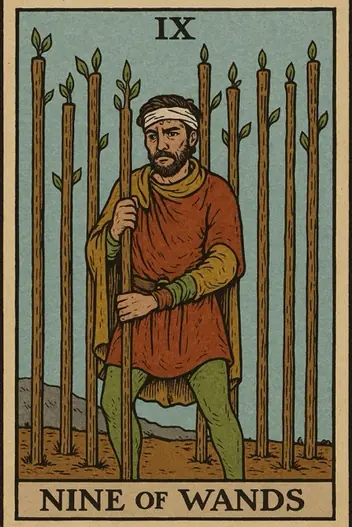
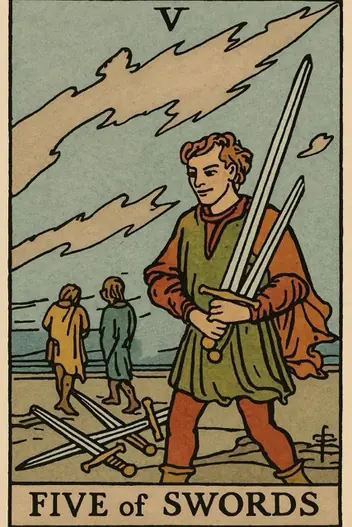
When the Nine of Wands—the archetype of the wounded guardian—meets the Five of Swords—the archetype of the hollow triumph—we witness a psychological collision of exhaustion and ethical compromise. The Nine of Wands represents the final stand of a defender who has fought hard and is now bruised, paranoid, and hypervigilant. The Five of Swords, conversely, depicts a victory that leaves everyone—including the "winner"—isolated and diminished. Together, these cards create a narrative of strategic overreach where the cost of winning may exceed the value of the prize.
This combination typically emerges when a person has been fighting a prolonged battle—whether internal or external—and is now tempted to take a shortcut that sacrifices integrity for resolution. The psychological state is one of defensive aggression: you feel justified in striking first because you believe the next attack is imminent. The key insight here is that you may be fighting a ghost—the real battle may no longer exist, only your conditioned fear of it.
Core Dynamics & Interpretation
The core dynamic of Nine of Wands + Five of Swords is a paranoid win-lose mentality that creates a self-fulfilling prophecy of conflict. The Nine of Wands brings the energy of hypervigilance—you are scanning for threats, bracing for impact, and operating from a place of depleted resilience. The Five of Swords then supplies the impulse to preemptively strike or to "win" at any cost, even if that victory is hollow. The result is a person who may win the argument but lose the relationship, or secure the deal but destroy the trust.
Psychologically, this is a cognitive distortion known as "fortune-telling" mixed with "emotional reasoning": you assume the worst will happen, feel threatened, and then act in ways that confirm your fear. The Jungian shadow here is the Wounded Warrior who cannot distinguish between a real threat and a remembered one. The practical warning is clear: do not let exhaustion drive your ethical decisions. When you are tired, your judgment narrows, and you are more likely to accept a "victory" that isolates you.
The strategic advice from this pair is paradoxical: you must defend your boundaries without attacking others' dignity. The Nine of Wands asks you to hold your ground; the Five of Swords warns that if you do so with contempt or manipulation, you will stand alone on that ground. The most powerful move here is to reframe the battle from "winning" to "maintaining integrity under pressure."
Your pair is already on the table. Ask your question and draw the clarifying card
or simply focus on it
What Do Nine of Wands and Five of Swords Indicate for Your Career?
Strategic Opportunities:
Use your hard-won expertise to negotiate from a position of earned authority, not desperation.
Strategic Opportunities:
Consolidate resources before expanding. This is a time to protect what you have built, not to take on new risks.
Calculated Risks:
Avoid public confrontations or power struggles with colleagues. You may win the argument but damage your professional reputation.
In the career context, this card pair signals a critical decision point where you must choose between short-term victory and long-term stability. The Nine of Wands speaks to your professional resilience—you have survived past setbacks and have legitimate reasons to be cautious. The Five of Swords warns that a win achieved through political maneuvering, blame-shifting, or cutting corners will come back to haunt you. Bold financial warning: If you are considering a lawsuit, a hostile negotiation, or a competitive bid that undercuts your values, reconsider the true cost.
The strategic tip is to separate your ego from your career goals. The desire to "win" against a rival may feel urgent, but the Five of Swords often indicates that the victory will leave you isolated within your organization. Instead, focus on demonstrating competence rather than dominance. Bold advice: If you are in a dispute, offer an honorable exit for all parties. This preserves relationships and positions you as a leader, not a conqueror.
For financial planning, this combination advises defensive budgeting. You may feel the urge to make a bold financial move to "prove" your resilience, but the cards suggest preservation over expansion. Bold warning: Avoid high-risk investments or aggressive spending as a way to feel in control. The real power lies in strategic patience: hold your position, shore up your reserves, and wait for a cleaner opportunity.
Ask your specific question
Don't rely on generic meanings. Get a customized reading tailored specifically to your energies.
Nine of Wands and Five of Swords in Love Tarot
If you are single:
This combination suggests you may be approaching new connections with unnecessary defensiveness. You are guarding yourself against past wounds, but this posture risks pushing away genuinely interested partners. Ask yourself: Am I testing this person for flaws, or am I protecting myself from a ghost?
If you are in a relationship:
You or your partner may be keeping score of past grievances. The relationship dynamic is shifting toward a power struggle where one person "wins" arguments at the expense of emotional intimacy. The victory is Pyrrhic—you win the fight but lose the connection.
In relationships, the Nine of Wands and Five of Swords together often indicate a toxic cycle of provocation and defense. One partner may feel perpetually attacked (Nine of Wands) and respond by "winning" through withdrawal, sarcasm, or logical domination (Five of Swords). The key relationship advice is to stop fighting to be right and start fighting to be understood. Bold action: Schedule a "no-win" conversation where the goal is simply to hear each other's fears without rebuttal. If you feel the urge to prove a point, pause and ask: "Am I defending my position, or am I defending my ego?"
Emotional intelligence demands that you recognize when your partner's defensiveness is a symptom of their own exhaustion, not an attack on you. The practical step is to lower the stakes of everyday disagreements. Not every conflict requires a resolution; some simply need acknowledgment. If you find yourself repeatedly "winning" arguments, you are likely losing the relationship.
Shadow Side & Pitfalls
The shadow side of Nine of Wands + Five of Swords is paranoid aggression—the belief that you must attack before being attacked. This manifests as cognitive biases like the hostile attribution bias (assuming neutral actions are threats) and confirmation bias (only noticing evidence that supports your suspicion). The Jungian shadow here is the Martyr-Tyrant: you see yourself as the victim of others' unfairness, yet you act in ways that are controlling and punitive.
Self-sabotage occurs when you mistake defensiveness for wisdom. You may reject genuine help because you suspect ulterior motives, or you may end a relationship prematurely because you "saw it coming." The pitfall is that you become the architect of your own isolation. Bold warning: If you find yourself saying, "I knew this would happen," after a conflict you helped create, you are trapped in this shadow dynamic.
The practical danger is decision fatigue leading to ethical shortcuts. When you are exhausted (Nine of Wands), you are more likely to accept a "win" that feels wrong (Five of Swords). Ask yourself: Am I doing this because it's right, or because I'm too tired to find a better way? If the answer is the latter, step back and delay the decision.
Reversed Nine of Wands and Five of Swords Explained
If the Nine of Wands is reversed:
The defense crumbles. You are either recklessly charging into battle, ignoring the threats, or, conversely, paralyzed by fear and unable to defend yourself at all. Advice: acknowledge your vulnerability — this is not weakness, but a resource for finding allies.
If the Five of Swords is reversed:
Aggression becomes passive. You do not attack openly, but sabotage, manipulate, or engage in self-flagellation. This is a state of internal war. Warning: you are wasting energy fighting yourself, rather than real problems.
If BOTH are reversed:
Complete imbalance. You are simultaneously the victim and the tyrant. The situation resembles a chaotic conflict without rules, where no one understands their role. Method for correction: temporarily retreat. Cease any actions requiring confrontation. Use the pause for recovery. Your task is to regain the ability for sober assessment, not for reaction.
Nine of Wands and Five of Swords Combined Message
How can the energy of the Nine of Wands be used constructively to balance the Five of Swords? The key lies in shifting focus from defense to strategy. The Nine of Wands grants you endurance and attention to detail. The Five of Swords provides the capacity for decisive, albeit harsh, action. Instead of wasting these resources on endless warfare, combine them to create a "finishing blow."
Your strategic advice: identify the opponent's "point of capitulation." Do not strike merely to wound. Use your vigilance (Nine of Wands) to find their weak spot, and your aggression (Five of Swords) to deliver one precise, effective blow that ends the conflict. After that, immediately switch into recovery mode. Your task is not to sustain a state of war, but to exit it with minimal losses. Clarity comes when you understand that your ultimate goal is peace, not victory. Only then does this pair of cards transform from a curse into a tool for the decisive resolution of a protracted crisis.
Applying This to Your Situation
The core message of Nine of Wands and Five of Swords is that true strength lies in knowing when to fight, when to hold, and when to let go. You have earned your scars, but you are not required to keep reopening them. The victory you seek may already be yours—if you stop trying to prove it to others. Your next step is to distinguish between necessary defense and unnecessary aggression. Ask yourself: What would I do if I were not afraid? Then do that.
While this article provides the general archetype, the true magic happens when Tarot is applied to your specific situation. The Fortune Cards app allows you to enter your exact question—about a relationship, a career move, or a personal dilemma—and receive a deep, personalized interpretation of this exact combination. You can use it on the web or download it to discover what Nine of Wands and Five of Swords means for your unique context, right now. Stop guessing—get the clarity you need.
Interpretation by the Fortune Cards editorial team, based on the Rider–Waite tradition and Jungian archetypes. About our methodology · Updated: 2026-08-26
Other Combinations with Nine of Wands
Other Combinations with Five of Swords
Explore Individual Card Meanings
Table of Contents
- Core Dynamics & Interpretation
- What Do Nine of Wands and Five of Swords Indicate for Your Career?
- Nine of Wands and Five of Swords in Love Tarot
- Shadow Side & Pitfalls
- Reversed Nine of Wands and Five of Swords Explained
- Nine of Wands and Five of Swords Combined Message
- Applying This to Your Situation
Ready to find answers to your questions?
Start your first reading now and look at your situation with fresh clarity. The cards are ready to reveal deeper meaning.