Seven of Cups and Nine of Swords Reversed in Tarot
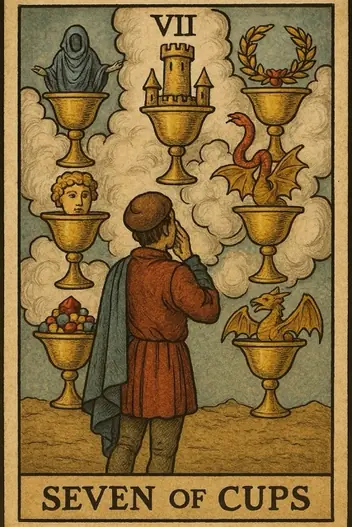

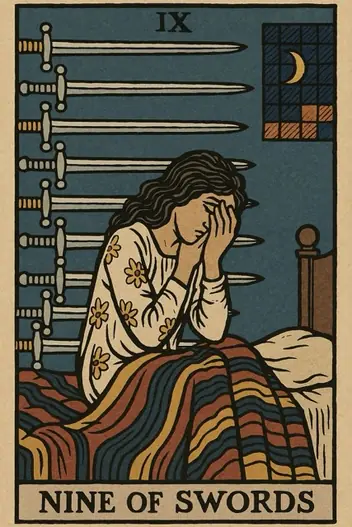
- Arcana
- Seven of Cups — Minor Arcana, Cups; Nine of Swords — Minor Arcana, Swords
- Elements
- Seven of Cups — Water; Nine of Swords — Air
- Elemental interaction
- Neutral elements — energies coexist without conflict
- Numerology
- 7 + 9 = 16 → 7
When the Seven of Cups—the card of fantasy, illusion, and overwhelming choice—collides with the Nine of Swords—the card of anxiety, dread, and sleepless nights—you are looking at a psychological paradox. On one hand, you are presented with a buffet of possibilities. On the other, you are paralyzed by the fear of choosing the wrong one. This combination signals a mind caught between unrealistic desires and catastrophic thinking.
The core conflict here is between wishful thinking and fear-based reasoning. You may be fantasizing about a perfect outcome (Seven of Cups) while simultaneously preparing for the worst-case scenario (Nine of Swords). This is not a sign of danger, but of cognitive dissonance—your ego is trying to protect you from disappointment by pre-emptively imagining failure. The pragmatic work lies in cutting through both the fantasies and the fears to find what is actually real.
Seven of Cups and Nine of Swords Card Meaning Explained
The psychological state created by this pairing is one of analysis paralysis driven by emotional overwhelm. The Seven of Cups represents the shadow of the dreamer: an inability to commit because every option looks either perfect or terrifying. The Nine of Swords adds a layer of rumination—you replay worst-case scenarios in your mind, convincing yourself that any decision will lead to disaster. Together, they create a feedback loop where fear feeds fantasy, and fantasy feeds fear.
In practical terms, this combination warns against cognitive distortions like fortune-telling (assuming you know the negative outcome) and all-or-nothing thinking (believing only one perfect choice exists). The energy here is not about external events, but about your internal narrative. You are likely projecting your own insecurities onto the future, mistaking a lack of clarity for a sign of impending doom.
The key insight is that both cards are mental constructs, not objective reality. The Seven of Cups is a mirage—none of those options are as perfect as they seem. The Nine of Swords is a nightmare—none of those fears are as solid as they feel. Your task is to ground yourself in the present moment and evaluate choices based on verifiable facts, not emotional intensity. A simple decision-making framework—like listing pros and cons on paper—can break the cycle.
Your pair is already on the table. Ask your question and draw the clarifying card
or simply focus on it
Seven of Cups and Nine of Swords: Career and Money
Strategic Opportunities:
Use this energy to brainstorm creative solutions without committing to them immediately. The Seven of Cups is excellent for generating ideas, but the Nine of Swords warns you to vet each option for viability before investing time or money.
Strategic Opportunities:
Leverage your anxiety as a signal to do deeper research. If you are worried about a project failing, that fear can motivate you to build contingency plans, seek expert advice, or improve your skills.
Calculated Risks:
Avoid major financial decisions while in this mindset. The combination of fantasy (overestimating returns) and fear (underestimating risks) is a recipe for poor judgment. Do not invest in "get rich quick" schemes or high-risk ventures.
In a professional context, this pairing often appears when you are considering a career change, a new business idea, or a major negotiation. The Seven of Cups tempts you with a shiny new opportunity that seems perfect. The Nine of Swords whispers that you will fail, embarrass yourself, or lose everything. The pragmatic approach is to separate exploration from commitment. Spend a week researching the opportunity without making any decisions. Gather objective data: market trends, financial projections, competitor analysis. Do not trust your gut when your gut is flooded with fear and fantasy.
A critical financial warning:
This combination is a red flag for impulse spending driven by emotional escape (Seven of Cups) or hoarding cash out of fear (Nine of Swords). Neither extreme is healthy. Create a balanced budget that allows for both savings and a small "play fund" for calculated risks. Do not let anxiety dictate your financial moves. If you are negotiating a salary or contract, prepare your talking points in writing and practice them aloud to reduce the emotional charge.
Seven of Cups and Nine of Swords as Feelings
If you are single:
This pairing suggests you are idealizing potential partners while simultaneously fearing rejection or disappointment. Stop projecting fantasies onto people you barely know. Focus on observing consistent behavior over time, not the story you are telling yourself about them.
If you are in a relationship:
You or your partner may be trapped in a cycle of unspoken expectations and guilt-driven anxiety. One person dreams of a perfect relationship while the other fears it will never be good enough, leading to resentment or withdrawal.
The relationship dynamics here are often about unrealistic standards and fear of vulnerability. The Seven of Cups energy might manifest as comparing your partner to an imaginary ideal—a fantasy of how they "should" be. The Nine of Swords energy turns this into self-criticism or blame: you worry that you are not good enough, or that they will leave you for someone better. The most important relationship advice is to separate your fears from the facts. Ask yourself: "What evidence do I have that this fear is real, versus a story I am telling myself?"
Bold communication is essential. Instead of hinting or withdrawing, state your needs clearly and ask for the same. If you are single, limit your exposure to dating apps (which amplify the Seven of Cups illusion) and focus on one genuine connection at a time. If you are in a relationship, schedule a calm, non-accusatory conversation about expectations. The goal is to replace fantasy and dread with mutual reality-testing.
Ask your specific question
Don't rely on generic meanings. Get a customized reading tailored specifically to your energies.
When Seven of Cups and Nine of Swords Signal Trouble
The shadow manifestation of Seven of Cups and Nine of Swords is a state of delusional anxiety—where you believe your fears are prophecies and your fantasies are guarantees. This leads to cognitive biases like the sunk cost fallacy (staying in a bad situation because you have already invested so much) or confirmation bias (only noticing evidence that supports your worst fears). You may also engage in magical thinking—believing that worrying enough will prevent bad things from happening, or that imagining a perfect outcome will make it real.
Self-sabotage is a high risk. You might reject a good opportunity because it does not match your fantasy, or you might avoid making any decision at all, letting life choose for you by default. The shadow side of the dreamer is the procrastinator; the shadow side of the worrier is the control freak. Together, they create a person who is overwhelmed by possibility yet paralyzed by fear. The antidote is radical acceptance—acknowledging that you cannot control the future, but you can control your next step. Take one small action that moves you toward a realistic goal, not a perfect one.
Seven of Cups and Nine of Swords Reversed: How to Read It
If the Seven of Cups is reversed, this indicates blocked or depressive potential. You aren't just seeing many options — you are actively avoiding choice, falling into a stupor. Warning: this state is worse than mere anxiety. It is a refusal to take responsibility for your life. Instead of fantasizing, you stop dreaming altogether. Advice: start with a minimal action — write a list of three things you can do today, and do at least one.
If the Nine of Swords is reversed, this can mean repressed anxiety. You don't feel fear because you have suppressed it, but it manifests in psychosomatic symptoms (headaches, insomnia) or passive aggression. This is a dangerous scenario, as you don't see the real cause of your problems. It is necessary to audit your state: "What am I avoiding thinking about? What problem am I putting off?"
If BOTH cards are reversed, the dynamic becomes toxic. You are in complete imbalance: neither desires (Cups blocked) nor awareness of fear (Swords suppressed). This is a state of apathy and emotional burnout. The logical way to correct this is radical rest and a complete disconnection from decision-making for 48 hours. After that, start from scratch: identify one basic need (food, sleep, safety) and satisfy it before thinking about anything else.
Overall Meaning of Seven of Cups and Nine of Swords
Constructive use of this pair requires a conscious transition from emotional planning to operational execution. The Seven of Cups provides you with the energy of dreams, but without the discipline of the Nine of Swords (which in this context acts as an "alarm signal," not a punishment), you will be unable to separate the wheat from the chaff. Your task is to transform anxiety into a calibration tool. If an idea evokes fear, it does not mean it is bad. It means it requires a thorough risk analysis.
Strategic advice: use the "backward planning" method. Imagine your goal has already been achieved, then describe the steps that led to that result. This transforms chaotic desires (Seven of Cups) into a clear algorithm of action, reducing anxiety (Nine of Swords) because you now have a roadmap. The main takeaway: do not be afraid to choose; be afraid not to choose. Any choice, even an imperfect one, is better than endlessly lingering in a world of illusions, which is guaranteed to lead to anxiety and stagnation.
Applying This to Your Situation
The core message of Seven of Cups and Nine of Swords is clear: your mind is creating a prison of anxiety and illusion. The way out is not to find the "right" answer, but to stop treating your thoughts as facts. You have the power to choose which option to explore further—not which one to marry for life. Move from imagination to action by picking one realistic path and testing it with a small, low-risk step. The fear will shrink once you start moving.
Your situation is unique. General archetypes can guide you, but they cannot replace a reading tailored to your specific question, relationship, or career path. To get a deep, personalized interpretation of this exact combination—applied to your life right now—use the Fortune Cards app. Available on the web and as a download, it offers instant, context-aware readings that cut through the noise and give you actionable clarity. Stop spinning in your head. Get your answer now.
Interpretation by the Fortune Cards editorial team, based on the Rider–Waite tradition and Jungian archetypes. About our methodology · Updated: 2026-08-26
Other Combinations with Seven of Cups
Other Combinations with Nine of Swords
Explore Individual Card Meanings
Table of Contents
- Seven of Cups and Nine of Swords Card Meaning Explained
- Seven of Cups and Nine of Swords: Career and Money
- Seven of Cups and Nine of Swords as Feelings
- When Seven of Cups and Nine of Swords Signal Trouble
- Seven of Cups and Nine of Swords Reversed: How to Read It
- Overall Meaning of Seven of Cups and Nine of Swords
- Applying This to Your Situation
Ready to find answers to your questions?
Start your first reading now and look at your situation with fresh clarity. The cards are ready to reveal deeper meaning.