Seven of Swords and Knight of Swords Reversed in Tarot
- Arcana
- Seven of Swords — Minor Arcana, Swords; Knight of Swords — Minor Arcana, Swords
- Elements
- Seven of Swords — Air; Knight of Swords — Air
- Elemental interaction
- Same element — energies intensify each other
- Numerology
- 7 + 12 = 19 → 1
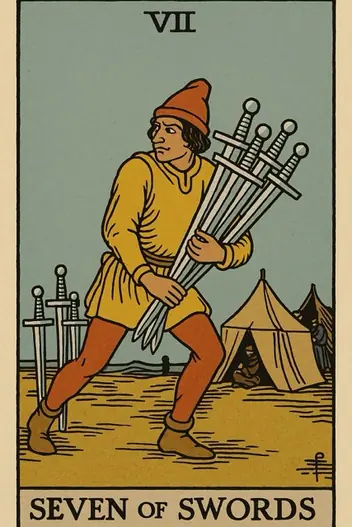
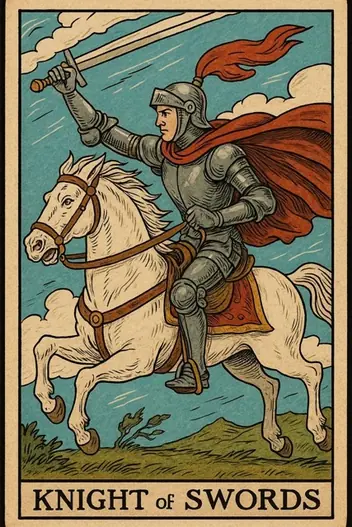
When the Knight of Swords—a symbol of rapid, unfiltered action—collides with the Seven of Swords—the card of strategic deception and covert maneuvering—you get a psychological paradox. This is the energy of someone who moves fast but not always honestly; it’s the intellectual who uses shortcuts, the planner who skips ethical steps to win.
In real life, this combination reveals a high-stakes mental game. You are likely operating with a single-minded focus on a goal, but the path you’re taking involves secrecy, half-truths, or bypassing established rules. The archetype here is the Trickster merged with the Warrior: you possess the drive to break through barriers, but you risk charging into a trap of your own making. The core question is: are you strategically protecting yourself, or are you rationalizing a betrayal?
Seven of Swords and Knight of Swords: How These Energies Interact
The psychological state created by the Seven of Swords and Knight of Swords is one of calculated urgency. Your mind is racing ahead, devising a plan that feels brilliant in isolation but may lack integrity in execution. The Knight provides the speed and courage; the Seven provides the cunning. Together, they produce a mindset where the ends justify the means—temporarily.
This pairing often surfaces when you are trying to outsmart a situation or a person. You may feel cornered, leading you to adopt a "hit-and-run" strategy: act fast, take what you need, and disappear before consequences catch up. The risk here is overconfidence. While the Knight of Swords charges without looking, the Seven of Swords assumes it can get away with the heist. The key insight: this energy works best when applied to intellectual problems, not interpersonal trust. Use it to solve a puzzle, not to manipulate a partner or colleague.
Your pair is already on the table. Ask your question and draw the clarifying card
or simply focus on it
Seven of Swords and Knight of Swords: Career and Money
Strategic Opportunities:
Use your quick thinking to identify market gaps or inefficiencies that others overlook. Speed is your advantage if you keep your ethics intact.
Strategic Opportunities:
Negotiate from a position of information asymmetry—but only if you are prepared to back up your claims with facts. Bluffing works short-term; data works long-term.
Calculated Risks:
Avoid shortcuts that involve intellectual property theft, broken promises, or misleading stakeholders. The legal or reputational cost will outweigh the gain.
In your professional life, this card pair signals a high-risk, high-reward scenario that demands ruthless clarity. You may be tempted to bypass a protocol or poach a client behind a colleague’s back. The Knight gives you the nerve; the Seven gives you the plan—but the plan lacks a contingency for getting caught. Financially, this is a time for strategic stealth rather than outright aggression. For example, you might quietly research a competitor’s weaknesses or discreetly pivot your business model without announcing it. The most pragmatic move: treat this as a reconnaissance phase, not a raid. Gather intelligence, then decide if the battle is worth fighting.
Seven of Swords and Knight of Swords in Love and Relationships
If you are single:
This combination warns against projecting a false image to impress someone. You may be moving too fast, using charm or selective truths to secure a connection. Pause and evaluate whether your strategy is sustainable.
If you are in a relationship:
A power struggle is brewing. One partner may be withholding information or acting on hidden agendas. The dynamic is fragile; honesty is the only way to avoid a sudden breakup.
In relationships, the Seven of Swords and Knight of Swords indicates a tension between intellectual games and emotional trust. You or your partner may feel the need to "win" an argument or control the narrative. This is not a time for grand gestures or impulsive confessions. Instead, focus on boundary-setting and clear communication. If you sense deception, address it directly rather than matching it with your own tricks. The shadow here is competitive love—treating the relationship as a chess match rather than a partnership. The pragmatic advice: slow down the Knight’s charge with the Seven’s caution. Ask yourself: "Am I protecting my ego or my connection?"
Ask your specific question
Don't rely on generic meanings. Get a customized reading tailored specifically to your energies.
Seven of Swords and Knight of Swords Reversed Meaning
If the Seven of Swords is Reversed:
This indicates paralysis of the will or acknowledging one's own wrongdoing. You can no longer lie to yourself. Hidden plans are falling apart, and you are forced to admit defeat. Advice: do not try to "force" the situation. Acknowledge the mistake — this will give you the moral right to start over, but this time honestly.
If the Knight of Swords is Reversed:
The energy for action is blocked. You feel aggression but cannot express it or fear of confrontation. This is a state of internal seething. Warning: do not bottle up your anger. Find a physical way to release the tension (sports, running), otherwise it will spill out as passive aggression (ignoring, sabotage).
If BOTH are Reversed:
Complete imbalance. You are stuck between lies and cowardice. Neither secrecy nor attack works. This is a dead end. The logical way to correct this: a complete stop. Cease all active actions and engage in reflection. You need to understand what you truly want, not what you are running from. Only after this can you build a new strategy.
Negative Meaning of Seven of Swords and Knight of Swords
When this energy goes awry, you fall into the trap of self-sabotage through rationalization. The cognitive bias at play is the illusion of control—you believe you can manage all variables, including the reactions of others. This leads to behaviors like gaslighting, lying by omission, or making promises you cannot keep. The Knight’s impulsiveness amplifies the Seven’s sneakiness, creating a perfect storm for impulsive betrayal. You might cut corners at work, only to find your reputation damaged. In relationships, you might hide a small truth, only to trigger a larger crisis of trust. The shadow question: "What am I afraid to face directly?" If the answer involves shame, fear of failure, or a desire to control outcomes, you are likely misusing this energy. The solution is to redirect the Knight’s speed into honest confrontation.
Seven of Swords and Knight of Swords: The Combined Message
How can you constructively use the energy of the Seven of Swords to balance the Knight of Swords? Answer: transform cunning into tactical flexibility, and aggression into decisiveness. Your task is not to deceive others, but to "outwit" circumstances. Use the Seven to analyze the weak points in your plan, and the Knight to strike swiftly at precisely those points.
Strategic advice: divide the process into two stages. The first stage (Seven) — information gathering and planning. No actions, only observation and analysis. The second stage (Knight) — a short, powerful burst. You must act so quickly that the opponent has no time to counterattack. The key to success is the time gap between these stages. Do not try to do everything at once.
Deep conclusion: this combination demands honesty with yourself. If you are planning deception — acknowledge it. If you want conflict — acknowledge it. Only by recognizing your true motives can you choose the right tactic. Do not try to reconcile these energies — use them sequentially. First reconnaissance, then attack. First stealth, then speed. This method transforms chaos into an effective strategy.
Applying This to Your Situation
The core message of Seven of Swords and Knight of Swords is this: you have the mental firepower to achieve your goal, but the path you choose must align with your long-term integrity. Speed without honesty is a crash waiting to happen. Use your cunning to solve problems, not to deceive people. When you feel the urge to outsmart, ask yourself: "Will this strategy hold up under scrutiny?"
While this article provides the general archetype, the true magic happens when Tarot is applied to your unique situation. That is why we built the Fortune Cards app. You can use it on the web or download it to get a deep, personalized interpretation of this exact combination for your specific question right now. Stop guessing—get the clarity you need to act wisely.
Interpretation by the Fortune Cards editorial team, based on the Rider–Waite tradition and Jungian archetypes. About our methodology · Updated: 2026-08-26
Other Combinations with Seven of Swords
Other Combinations with Knight of Swords
Explore Individual Card Meanings
Table of Contents
- Seven of Swords and Knight of Swords: How These Energies Interact
- Seven of Swords and Knight of Swords: Career and Money
- Seven of Swords and Knight of Swords in Love and Relationships
- Seven of Swords and Knight of Swords Reversed Meaning
- Negative Meaning of Seven of Swords and Knight of Swords
- Seven of Swords and Knight of Swords: The Combined Message
- Applying This to Your Situation
Ready to find answers to your questions?
Start your first reading now and look at your situation with fresh clarity. The cards are ready to reveal deeper meaning.